Wednesday, May 13, 2020

Building the Sandbox: The D&D Cosmology

I've been talking about the supposed "Ultimate Sandbox" for a decade now: the pie-in-the-sky project I've been working on that incorporates every official D&D product ever made into a single campaign.  I started it by piecing bits and bobs together as I read through D&D's history chronologically, but let's be honest here: I have nothing practical to show for it aside from some scattered notes.  And now that I'm factoring in the wider history of D&D outside of TSR, the progress I made has gone somewhat in reverse.  So with that in mind, I'm ready to start knuckling down and doing the hard work of turning this project into something practical.

So if I'm going to do that, I need to start with the big picture: the D&D planar cosmology and the various campaign settings that exist within it.  Using wikipedia, I'm going to list out all of the planes and settings, and give my thoughts on how they might fit together.

THE PLANES

For the majority of D&D's lifespan, its worlds have been contained with the Great Wheel Cosmology, as detailed in the chart below:

The Planes, as detailed in the Players Handbook from 1978.

From AD&D 1st edition to 3rd edition, this was the make-up of the planes.  It all starts getting odd from 4th edition onwards, and the Basic line did its own thing, but I'll deal with those below.  Let's go through the planes one by one.

The Prime Material Plane

This is where the vast majority of D&D worlds and settings reside.  The books have gone back and forth on whether there is one Prime Material Plane or many, but the answer is not particularly important.  What is known is that some worlds exist in the same universe, while there are also parallel timelines and alternate realities.  Our Earth, for example, is a parallel version of Oerth, the World of Greyhawk.  Some worlds are connected by a substance called the phlogiston, which can be traversed by magical ships called Spelljammers - Oerth, Krynn (the world of Dragonlance), and Toril (aka the Forgotten Realms) are three such worlds.  I would also contend that each world and universe has its own set of connections to the Inner and Outer Planes, and thus its own set of physical and magical rules.

The Inner Planes

These planes constitute the basic matter and building blocks of the physical universes.

  • The Positive Energy Plane: Also known as the Plane of Life, it's been described as an "infinite, empty, blinding firestorm of life-giving light", and powers things such as healing spells.  Going to this place can still be deadly, though, as too much healing energy can make you explode.
  • The Negative Energy Plane: The opposite of the above, also called the Plane of Death. It's an airless, featureless void of darkness that is inimical to all life.  Most undead seem to be powered by this plane in some way (particularly those that drain levels), as are some of the spells cast by evil clerics and necromancers.
  • The Elemental Plane of Air
  • The Elemental Plane of Earth
  • The Elemental Plane of Fire
  • The Elemental Plane of Water: Each of these planes is the elemental home of one of the four basic building blocks of physical matter in the D&D universe.
    • The Para-Elemental Plane of Magma: The para-elemental planes exist at the places where the elemental planes meet.  The Plane of Magma exists between the planes of Earth and Fire.
    • The Para-Elemental Plane of Ooze: Exists between the planes of Earth and Water.
    • The Para-Elemental Plane of Ice: Exists between the planes of Water and Air.
    • The Para-Elemental Plane of Smoke: Exists between the planes of Fire and Air.
    • The Quasi-Elemental Plane of Radiance: The quasi-elemental planes exist where the Elemental Planes border the Positive and Negative Energy Planes. The Plane of Radiance exists where the Plane of Fire meets the Positive Energy Plane.
    • The Quasi-Elemental Plane of Minerals: Exists where the Plane of Earth meets the Positive Energy Plane.
    • The Quasi-Elemental Plane of Lightning: Exists where the Plane of Air meets the Positive Energy Plane.
    • The Quasi-Elemental Plane of Steam: Exists where the Plane of Water meets the Positive Energy Plane.
    • The Quasi-Elemental Plane of Salt: Exists where the Plane of Water meets the Negative Energy Plane.
    • The Quasi-Elemental Plane of Dust: Exists where the Plane of Earth meets the Negative Energy Plane.
    • The Quasi-Elemental Plane of Ash: Exists where the Plane of Fire meets the Negative Energy Plane.
    • The Quasi-Elemental Plane of Vacuum: Exists where the Plane of Air meets the Negative Energy Plane.

The Transitive Planes

The Transitive Planes are those that connect the other planes, and generally contain little life.

  • The Astral Plane: The plane of thought, memory, and psychic energy, devoid of space and time.  The souls of the dead pass through this plane on their way to the afterlife, and gods go here when they die or are forgotten.  The Astral Plane can be used to travel to the Outer Planes.
  • The Ethereal Plane: The plane consists of two areas: the Border Ethereal and the Deep Ethereal.  The Border Ethereal connects the Prime Material Plane to the various Inner Planes, which can be seen as a grey haze from the Ethereal.  The Deep Ethereal is the birthplace of many demi-planes and "proto-magical realms", such as the Ravenloft campaign setting.
  • The Plane of Shadow: A shadowy reflection that overlaps the Prime Material Plane, and can be used to cover vast distances.  In earlier editions its referred to as a demiplane, and by 4th edition it's been renamed as the Shadowfell.
  • The Mirror Planes: Introduced during 3rd edition as an alternative to the other transitive planes.  They exist as a series of corridors that can be accessed by mirrors throughout the planes of existence.  Despite being presented as an alternative, I don't see why they can't coexist with the others, perhaps as a weird demiplane in the Deep Ethereal.
  • The Temporal Plane: Otherwise known as the Temporal Energy Plane, or the Demiplane of Time. It's a place where physical travel can allow travel through time.

The Outer Planes

The Outer Planes are realms that embody the alignments, and are the homes of the gods. Souls go here after they have died.  The Outer Planes were mostly renamed for the Planescape setting during 2nd edition.  I suppose that those are the names used by residents of the Outer Planes, while the old names are more common on the Prime Material.

  • The Seven Heavens: Also known as Celestia.  The plane of Lawful Good, and the home of various angelic beings such as archons, solars and devas.
  • The Twin Paradises: Also known as Bytopia.  Exists between the planes embodying Lawful Good and Neutral Good.
  • Elysium: Also known as the Blessed Fields, a realm the embodies the Neutral Good alignment.
  • The Happy Hunting Grounds: Also known as The Beastlands. It exists between the planes embodying Neutral Good and Chaotic Good. It's a plane of idealised nature, inhabited by animal lords.
  • Olympus: Also known as Arborea. A realm of passion, abundance, and capricious nature, the embodies the alignment of Chaotic Good.  The titans, the Greek pantheon and many elven gods reside here.
  • Gladsheim: Also known as Ysgard or Asgard. It exists between the realms that embody the alignments of Chaotic Good and Neutral Good. A place for heroes to prove their valour, and the home of the Norse gods.
  • Limbo: The plane that embodies the alignment of Chaotic Neutral. An alien plane of chaos, home to the frog-like Slaadi.
  • Pandemonium: Exists between the planes the embody Chaotic Neutral and Chaotic Evil. It's described as an infinite network of pitch-dark catacombs, with winds that drive people mad.
  • The Abyss: The plane of Chaotic Evil.  A horrible place with infinite layers, and home to hordes of demonic beings and evil gods.
  • Tarterus: Also known as Carceri.  The plane that exists between those of Chaotic Evil and Neutral Evil.  A place where the souls of liars, cheats and traitors are imprisoned.
  • Hades: Also known as the Grey Waste.  The embodiment of Neutral Evil, it's a place of hopelessness and the main battlefield of the Blood War between the Devils and Demons.  The Yugoloth (also known as Daemons) make their home here, as do the Greek and Norse gods of death.
  • Gehenna: Exists between the planes that embody Neutral Evil and Lawful Evil. A plane of bleak eternity, also home to yugoloths.
  • The Nine Hells: The Plane of Lawful Evil.  The Devils live here, including possibly Satan.
  • Acheron: Exists between the planes that embody Lawful Evil and Lawful Neutral.  A place of pointless warfare, and home to the gods of orcs and goblins.
  • Nirvana: Also known as Mechanus.  The plane that embodies the alignment of Lawful Neutral.  A clockwork plane that is home to the Modrons and Inevitables.
  • Arcadia: Exists between the planes that embody Lawful Neutral and Lawful Good. A place of peaceful wildlands and kingdoms where all live in harmony.
  • The Plane of Concordant Opposition: Also known as the Outlands. The plane that exists at the centre of the other Outer Planes, and embodies the alignment of True Neutral.  Sigil, the City of Doors, exists within this plane.

Other Planes

  • The Far Realm: A place of cosmic horror that seems to exist outside of the other planes.  Exists as an excuse to use the Lovecraft mythos, basically.
  • The Plane of Dreams: A plane far outside the others, usually not included in the standard cosmology. I'd be inclined to make this a part of the Ethereal Plane.

When 4th Edition Messed Everything Up

In a bid to simplify the above (or I don't know, just fuck around with it for the sake of things), the D&D cosmology was boiled down to six major planes in 4th Edition.  I gather that this was explained by cataclysmic events on the various worlds that this affected, such as the Spellplague in the Forgotten Realms.

  • The Astral Sea: Pretty much corresponds to the Astral Plane from earlier editions.  Most of what used to be the Outer Planes now exist within the Astral Sea as "astral dominions".
  • The Elemental Chaos: Corresponds to the old elemental planes.  Elemental Realms exist within this plane; the Abyss is one of them.
  • The Feywild: A parallel wilderness realm that has aspects of the Positive Energy Plane and the Faerie Realm.
  • The Shadowfell: An underworld realms with aspects of the Negative Energy Plane and the Plane of Shadow.
  • The other two realms are The World, which is just the Prime Material Plane, and The Far Realm.

When 5th Edition Sort of Fixed It Again

When 5th edition D&D came out, it restored the old D&D cosmology and retained some of the elements introduced during 4th edition.  I'm not sure that this was ever explained (although I bet the Forgotten Realms came up with something).  The diagram below shows the current structure.  As far as I can tell, the biggest differences are that the Positive and Negative Material Planes encompass everything, the Shadowfell and Feywild have taken their place as Inner Planes, and the Elemental Chaos exists around the old Elemental Planes.
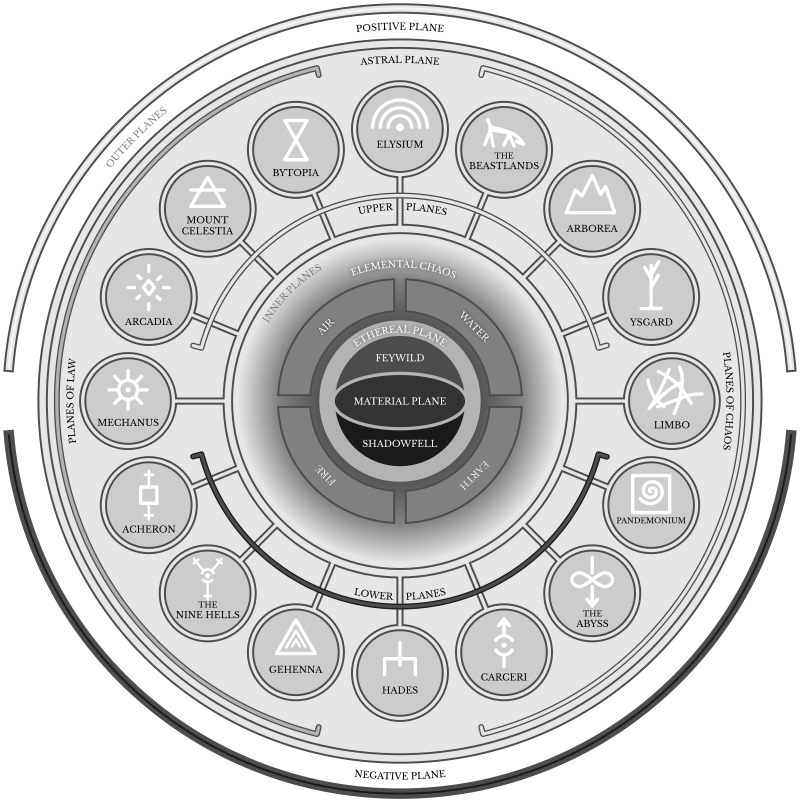

THE OFFICIAL D&D CAMPAIGN SETTINGS:

I'll run through all of the D&D settings below, and briefly discuss how they might fit into the above structure.

  • Birthright:  Set on the world of Aebrynis, on the continent of Cerilia.  The players control divinely powered rulers, descended from those who were infused with the power of dying gods.  Seems like it should exist in its own universe in the Prime Material Plane, given that the  gods are no longer active there.
  • Blackmoor: Dave Arneson's home campaign setting, and the earliest RPG setting of them all.  It's a realm rather than a world, and versions of it exist within various other settings.
  • Council of Wyrms: A setting where the players can act as dragons.  It's set on Io's Blood Isles, separated from the rest of world by vast oceans. It could easily exist in the World of Greyhawk or the Forgotten Realms.  Io is a dragon god that explicitly exists in the Forgotten Realms, so I'd lean towards a placement there.
  • Dark Sun: The post-apocalyptic world of Athas, with a heavy emphasis on psionics and magic that drains the environment.  Could be in its own universe, or possibly reachable by Spelljammer from other D&D worlds.
  • Diablo: There were a couple of products in the late 1990s set in the world of the computer game Diablo, known as Sanctuary.  For consolidation purposes I'd love to be able to combine this with the World of Warcraft products below, given that they're both based on games by Blizzard Entertainment.  Something tells me that World of Warcraft lore is way too in-depth to allow for this sort of thing.
  • Dragon Fist: This was promoted as a new game, and only ever released on the Wizards of the Coast website in the late 90s.  It was an AD&D variant, with some rules brought in from 3rd edition, which was then in development.  It's set in an oriental realm called Tianguo,  based on wuxia films and Chinese folklore.  It's only tangentially related to D&D, so I probably won't include it unless some offical D&D product dredges it up.  Perhaps I could just cram it into Kara-Tur somewhere, or stick it on the other side of Greyhawk.
  • Dragonlance: D&D's first massively popular multimedia setting.  Set on the world of Krynn, with its many wars revolving around dragons.  It's one of the four major realms known to be accessible via Spelljammer.  Most of its products take place on the continent of Ansalon, but there's also a second continent called Taladas. 
  • Eberron: A world that was introduced during the lifespan of 3rd edition.  I've never really got its deal. I guess it's like the industrial revolution but with magic?  It has a very different cosmology than other D&D worlds, but I'd consider those planes to either be demiplanes or smaller parts of existing Outer Planes.
  • Exandria: Matt Mercer of Critical Role's campaign world, which was recently referenced in some D&D products.   Yet another world in the Prime Material Plane.
  • Forgotten Realms: Ed Greenwood's home campaign (the existence of which predated D&D).  It's set on the planet of Abeir-Toril, and focused mainly on the continent of Faerun.  There's some weird jiggery-pokery with the worlds of Abeir-Toril breaking apart and joining back together that I've never fully grasped, but I don't need to get into that here.  It's one of the four major realms accessible via Spelljammer.  There are a number of sub-settings that exist within the Forgotten Realms:
    • Al-Qadim: An Arabian Nights influenced setting in the land of Zakhara, south of Faerun.
    • The Horde: Set in the Endless Waste, a Mongolian inspired setting between Faerun and Kara-Tur.
    • Oriental Adventures/Kara-Tur: An Asian inspired land to the east of Faerun.
    • Malatra - The Living Jungle: A setting to the south of Kara-Tur that was mostly detailed in Polyhedron magazine.  It's a jungle plateau based on pre-colonial Indochina.
    • Maztica: A setting based on the pre-colonial American civilisations, set on the continent west of Faerun.
  • Ghostwalk: Set in the City of Manifest, a gathering-place for ghosts which lies over the Well of Souls.  I'd be inclined to make this a part of Ravenloft, or perhaps put it in its own demiplane.
  • Greyhawk: The world of Gary Gygax's home campaign, and the first official D&D campaign setting.  It was the default setting for 1st edition, and much of 3rd edition, and most of the classic adventures take place there.  It's one of the four major realms accessible via Spelljammer.
    • Blackmoor: There's a version of the land of Blackmoor in this world.
  • The Hyborian Age: TSR put out a few Conan modules, so I guess Hyboria counts as a D&D world.  Given that Gary originally based the Greyhawk continent of Oerik on the USA, I long ago posited that Hyboria could exist on the Greyhawk equivalent of Europe.  
  • Jakandor: A self-contained island setting that's torn between tribes of magic-users and barbarians.  It could fit pretty well into either the World of Greyhawk or the Forgotten Realms.  I'd be inclined to favour Greyhawk given its pulpy vibe.
  • Kingdoms of Kalamar: The World of Tellene, as developed by KenzerCo.  It's main selling point was its supposedly realistic geography and politics.  I remember seeing these books with official D&D logos on them, but I have no idea how Kenzer managed that.  I guess it's just another world in the Prime Material.
  • Lankhmar/Nehwon:  The world of Fritz Leiber's Fafhrd and the Gray Mouser stories, and the subject of a number of D&D products.  It'll be another Prime Material world, possibly accessible via portal or gateway from Greyhawk.
  • Mahasarpa: An Indian themed campaign of seven kingdoms, offered as a free web enhancement to the 3rd edition version of Oriental Adventures.  I'm inclined to place it on another campaign world, perhaps Greyhawk.  There are those realms on the other side of the world that Robilar adventured through after falling from the Greyhawk dungeons all the way to China...
  • Mystara: The world of the B/X and BECMI D&D lines.  It's mostly set in a region called the Known World. A pretty generic high fantasy setting, although it has ascended immortal beings rather than gods.  Any differences to its cosmology can possibly be chalked up to demiplanes like I'm doing with Eberron.
    • Blackmoor: A version of the land of Blackmoor existed in the ancient history of this world.
    • Hollow World: A world that exists inside the globe of Mystara, similar to Edgar Rice Burroughs' Pellucidar.
    • Savage Coast: A coastline area west of the Known World, inhabited by pirates and colonists, where a mutating curse is preventable only by wearing a special type of metal.
    • Thunder Rift: A sub-setting for the revised D&D Rules Cyclopedia from 1991.  It's supposedly set somewhere on Mystara: the line's editor said it's on another continent,  but the author placed it in the mountains of Karameikos.  I'll go with the more specific placement.
  • Nentir Vale: The 4th edition sample setting from the Dungeon Masters Guide, set in a vague world of fallen empires.  It's heavy on 4e stuff like tieflings and dragonborn.  It's possibly generic enough to cram into another setting.
  • Pelinore: A setting developed in the UK via articles in Imagine magazine. Given its origin I'm thinking that I could perhaps use this world to house various other UK stuff, such as from White Dwarf.
  • Planescape: This is set in the Outer Planes, and particularly in Sigil, the City of Doors.  This city lies in the Plane of Concordant Opposition, otherwise known as the Outlands.
  • Ravenloft: The Demiplane of Dread, ruled over by mysterious dark powers.  This demiplane is split into smaller realms, each with its own cursed ruler.  The most famous of these is the vampire Count Strahd Von Zarovitch.
    • Masque of the Red Death: A horror campaign set on 1890s Earth, which is already established as an alternate Oerth.
  • Ravnica: The world of the Magic: The Gathering card game, a little-known fad from the mid-90s.
  • Rokugan: This setting used for the 3rd edition version of Oriental Adventures.  It's also the setting for Legend of the Five Rings, though I'm inclined to just stick to the D&D books where that world is concerned.  I could possibly use it as one of the Asian lands on the flip side of the World of Greyhawk (which works given that Greyhawk was the generic 3rd edition setting).
  • Spelljammer: Set in Wildspace, where magical ships known as spelljammers can be used to traverse the phlogiston to different worlds. Greyspace, Krynnspace and Realmspace, plus  the Astromundi Cluster, make up the four major regions of Wildspace.  I assume that some other  D&D worlds can be visited in this fashion as well, but not alternate prime material worlds like Earth.
  • Theros: Another Magic: The Gathering world, based on Greek mythology.  It's amazing how such a short-lived fad could give birth to multiple campaign worlds.
  • World of Warcraft: These were licensed and published by White Wolf, but they had the official 3rd edition logo on them.  Based on the ubiquitous video game property, obviously.
  • Wilderlands of High Fantasy: The world described in the various Judges Guild products, which kinda sorta had TSR's blessing.  Generic fantasy but with a cool, weird 70s vibe.

OTHER PLACES

There are a bunch of other lands and settings that have been connected to D&D by anecdotes from the founders and articles in Dragon Magazine.  Some of these include:
  • Nazi occupied Europe, which was adventured in by characters from Dave and Gary's campaigns.
  • The American Old West, as depicted in the game Boot Hill. There are conversion notes for these rules in the AD&D Dungeon Master's Guide.
  • Earth in the 25th century, as shown in the game Gamma World. Again, there were conversion notes in the AD&D DMG.
  • The Starship Warden, from the game Metamorphosis Alpha. I'm sure Gary mentioned somewhere that his characters adventuredin the Warden.
  • Edgar Rice Burroughs' Barsoom, on the planet Mars.  Several Barsoomian monsters are in the original D&D booklets.
  • Wonderland, from the novels by Lewis Carroll, as depicted in modules EX1 and EX2.  Accessible through portals in the Greyhawk Castle dungeons.
  • The world of Tekumel, from the game Empire of the Petal Throne. I'm not sure if any characters crossed over between these campaigns, but the rulesets are quite similar.
  • The Isle of the Ape, based on King Kong.  Is this just an island on the world of Greyhawk, or another demiplane?  It's depicted in module WG6, and I believe was accessible through a portal in the Greyhawk Castle dungeons.
  • The world from The Dirdir by Jack Vance.  Gary ran one of his kids through an adventure set there.
  • The world of Frank Baum's Oz books. Accessible via one of the dungeon levels in the expanded Castle Greyhawk.
  • Melnibone, from the Elric books by Michael Moorcock. Accessible via one of the dungeon levels in the expanded Castle Greyhawk.
  • The world of the Dying Earth books by Jack Vance. I'm not completely certain about this one, but I'm sure I read somewhere that Gary ran adventures in this setting.
  • Fomalhaut, a Lovecraftian realm accessible via a gate in Rob Kuntz's Temple of the Elder Gods adventure.  Possibly I'd connect this to the Far Realm, or just make it a demiplane.

Monday, May 11, 2020

Play Report: Zoom Conferencing in the Tower of Zenopus

Holy crap, it feels good to be playing D&D again.

With everyone in lockdown, I've been having a lot of Zoom conferences for work, and while I was zoning out in the middle of one I had the thought that it would be a really good way to play on-line D&D.  I've looked into Roll20, but I'm not all that interested in the fancy mapping tools and the dice rollers and all that.  What I really wanted was an easy way to set up video chat with a whole bunch of people, and Zoom fit that bill.

I'm not all that tech-savvy though, and I figured that running my first ever on-line game would be complicated enough, so I opted to run a simple system: Moldvay's D&D Basic Rules.  Of course, I spent a week drilling down into them, house-ruling a bunch of stuff, bringing in things from other editions, and filling in gaps in the rules, so it's not quite Moldvay Basic.  It's still pretty simple at the table though, especially in comparison to 3rd edition onwards.

I also wanted to opt for a simple adventure.  My plan is to run a continuity-light campaign, which will consist of a series of classic D&D modules, most of which I've never played or run.  Originally I was going to do a combination of the classic modules In Search of the Unknown and Keep on the Borderlands, but there was a fair bit of prep involved with merging those, and I was concerned that Keep would eat my players' characters alive; I've never played or run it, but it looks to me like you need a decent number of PCs to survive it at 1st level.  So I went even simpler, and chose to run the sample adventure from the Holmes Basic Set: the dungeon adventure often referred to as "The Tower of Zenopus".  I combined it with some ideas from Zach Howard's excellent Ruined Tower of Zenopus, which is a conversion of the original to 5th edition.  It has some good background material though, and some ideas for additional encounters that I liked.  I've used most of those additions, including the map of the area surrounding the tower.

I was mega-excited to be running D&D again - I barely slept the night before - but we had quite a lot of problems.  One of my players couldn't connect at all, due to some bad internet at his end.  Another of my players was on long enough to create a character, but then his connection dropped out for good.  One player had a prior Zoom commitment that ran way longer than expected (and I berated him mercilessly about it afterwards).  So I was left with two players in total, to tackle a dungeon using old-school rules...

One created a thief, and the other played an elf.  The second of those was a great choice for a small party, and he had sleep memorised, so I liked their chances of getting through at least one encounter and possibly claiming some treasure.  Alas, they turned left at the first junction, and came to a room where they were attacked by four skeletons: enemies that are sadly immune to sleep.  They were also resistant to every weapon in the players' arsenal, so the skeletons were taking half damage from every blow.  The players were quickly surrounded, but did pretty well all told, managing to defeat two of the skeletons.  Then the elf went down, and the thief decided to get the hell out of there.  The remaining skeletons failed their attacks as he fled, and he made it out alive.  (He was fleeing during a round where I was supposed to check for wandering monsters, and he got lucky on that roll as well.)  So not a total TPK, but not exactly a rousing success either.  They would have done better if the elf had remembered that he had some holy water in his backpack, so it's not entirely my fault.  Still, I probably should have advised them to hire some men-at-arms.  I even had some rules for that in my notes, but it completely slipped my mind.  My bad, I'll definitely correct that for next time unless I get a lot more players.

Everyone had fun though, and the actual play went really smoothly (as it tends to do with a small group).  Playing over Zoom worked well aside from the connection issues, and I was able to use its screen sharing and private chat features to good effect.  It helped with one of the biggest issues that I was worried about, which was visualising the dungeon for mapping and combat.  It's been ages since I've played purely "theatre of the mind", and I like to have at least some kind of map.  I decided to use Excel for the purpose, as you can see below:

The site of the PCs' downfall. Most of the action happened
in front of the top left alcove.

Each of those tabs is a different room of the dungeon.  As soon as the players entered a room, I switched to the correct tab, shared my screen, read the room description, and there was an instant visual for them.  If anyone wants to map they can do it without me tediously explaining the room dimensions or drawing it myself, and in combat you can use letters, number and symbols to show where everyone is.  Excel is great, I use it for mapping old-school CRPGs as well.  The only problem with it is that it can't draw rooms with irregular walls.  There are a couple of circular rooms in this dungeon, and some caves as well, so I'll need to figures out a solution for those before the next game.

I'll do a run-down of some of the house rules that I'm trying out.

  • I'm letting the players roll 4d6 for ability scores, dropping the lowest number and arranging as desired.  I hoped it might offset the numbers disadvantage.  Besides, we've been doing it that way for decades, and it generally results in good characters but not necessarily amazing ones.  Even with this system, the elf still had a Charisma of 4 (I guess nobody will mourn for him too much).
  • Clerics in Basic don't get spells at 1st level, but I did a quick rejig of their class table to allow it.  Seems a bit ridiculous to me.
  • I'm using ascending Armor Class and attack bonuses, as in 3rd edition, but the math is the same as Basic.  As much as I like descending AC, the 3e system has been working like a charm for so long that I can't justify not using it.  And I've never missed explaining how THAC0 works.
  • I also dropped clerics, magic-users and thieves to one level below fighters in combat.  As it is, Basic starts with everyone having the same chance to hit in combat.  I changed it so the fighting classes start with a +1 bonus, and everyone else fights at +0.
  • I'm using the level limits for dwarves, elves and halflings, but I'm allowing their prime requisite modifier to allow them to advance a level or three over what the book says.
  • I also gave fighters their mook sweeping ability from AD&D, and I'll let them have some extra attacks as they advance.  Although I'm thinking of maybe just rolling that into the mook sweeping ability, and letting it be dependent on the monster's Hit Die and the character's level, so that a 4th level fighter could sweep two 2 HD creatures (for example).  Not sure if that would be too powerful though.  I just feel like Basic fighters are a little vanilla.  I don't know why you'd play one instead of a dwarf, except for flavour purposes.
  • Oh yeah, I upped the hit points for thieves, clerics, fighters and dwarves to their AD&D equivalent.  I also let them start at full hit points at level 1.  Sorry old-schoolers, I like to give my players at least some sort of a fighting chance.  I'm certainly not fudging die rolls in their favour at the table, so they need it.
  • One of my players wanted to play a dwarf wielding a two-handed pick, so I house-ruled that up.  I didn't want it to do 1d10 damage, so I gave it 1d8, but I needed a reason for it to be a worthwhile choice.  I gave it a +1 to hit armored foes, to simulate its penetrating power.
  • We did some house-ruling on the fly when we saw the absurd price for a grappling hook in the Expert Rules.  25 gold pieces?  What the hell?  It's worth more than a two-handed sword!  We all agreed to knock it down to five, and while we were doing that we knocked down the crowbar from 10gp to 5gp as well.
  • I've overhauled the encumbrance rules, as I detailed in this post last week.  As I suspected, it's a bit of a bitch to set up and explain, especially over video chat.  It's no worse really than calculating regular encumbrance though, and we had accurate movement rates for both players.  It was dead easy to see the effect on the elf's encumbrance when he dropped his longbow.  Unfortunately the game was too short, and they didn't find any treasure, so I didn't get to really test how it works at the table.  The jury's still out, but I'm optimistic that I've cracked it.
  • I also overhauled the combat sequence, using something similar to the one from Chainmail.  I kind of got sick of the way initiative works in 3rd edition, where one player runs a full move and then a monster makes a move, and everyone can watch while this happens and react to it.  It works, but it's a bit unrealistic, so I want to try something else out. To summarise, both sides roll initiative on d6.  There's a missile phase, a spellcasting phase, a movement phase and a melee phase, and the side with the winning initiative goes first in each (although movement happens simultaneously, which I'm iffy that I can pull off with a large group).  I've already changed this slightly based on play.  We had a situation where a skeleton burst out of an alcove to attack the thief, but he didn't get surprise.  So the elf got to fire an arrow, everyone else got to move, and then the skeleton made its attack.  I'm adding in another melee phase at the start, for those who are already engaged in melee.  I think it will work a little better, but it could overcomplicate things.
  • As a part of the above sequence, I've come up with a house-rule for casting times that makes it a little more unpredictable when spells go off, and gives a chance for spells to be interrupted.  Basically, the level of the spell is the chance on 1d6 that the spell won't be cast during that phase.  So if someone casts a sleep spell - 1st level - they roll a d6 during the spell-casting phase.  If they roll a 1, the spell doesn't happen yet.  Anything else, and it goes off.  If they rolled a 1, they roll again at the end of the missile fire phase (provided they don't get shot).  It goes on down the line like that until the round is ended, and if it still hasn't been cast it happens then.  It still makes low-level spells fast, and high-level spells slower on average.  I've also tied this in to the elf's ability to cast in armour: heavier armour gives a penalty to the spell-casting roll.  So the spell will still be cast in the same round, but if you're casting in plate there's a good chance that it'll happen at the end of a round.  It makes magic armour and especially elven chain more desirable (actually, the entire encumbrance system should do that).
  • Basic characters die at 0 hit points, but that's too deadly for me.  I thought about just going with the AD&D "death at -10" rule, but I figured this was my chance to try something else out.  I'm using something similar to death saves in 5e, where someone dropped to 0 makes a save.  If they succeed, they're unconscious, and if they fail, they're dying.  Once dying they keep rolling saves until dead, so it's still pretty lethal.  Bandaging can save them though, as can healing magic.  I used the Death Ray/Poison saving throw category, but I think I'm going to have to change that, because Dwarves and Halfling have absurdly good saves in that category.  I quite like it that higher level character don't die as easily, but I'm not really down with a 10th level character only needing a roll of 2.  I might have to add a separate Death & Dying category to cover this.
  • Of course I'm using the standard double damage on a natural 20 rule.  It ain't D&D without it.  I've gotten rid of 3rd edition's stupid confirmation roll though, it took all the excitement out of a natural 20.  I just say that if you need a natural 20 to hit, you can't score a critical.
  • Unarmed combat isn't covered much in Basic.  I made unarmed strikes do 1d3 damage plus Strength bonus (with different die rolls for creatures of different sizes; Small creatures do 1d2 for example).  The damage is non-lethal, but the only difference that makes is if you drop someone below zero hit points: you can't kill someone with non-lethal damage unless you drop them to -10.  This allows a strong person to kill a weak character with a single punch, which I'm down with (or for a character to pummel an unconscious foe to death).
  • I also covered grappling, which I'm doing as a hugely streamlined version of 3rd edition grappling.  It's just a series of opposed attack rolls, basically.  Monster's don't get a Strength bonus, but they get hefty size bonuses (or penalties if they're little).  A halfling, say, would be at -4, and an ogre would be at +4 (plus another 4 for Hit Dice).  The halfling might get a win here and there, but on average he's going to get creamed by that Ogre in a grappling contest, unless he's higher level.  (Actually, a halfling tops out at 8th level, with +6 to attack.  Factor in that penalty, and the maximum Strength bonus of +3, and the best bonus he's going to get is a +5.  He'll never be good enough to grapple that Ogre without magic or extra numbers, and that works for me.  After years of 3e, it's nice to go back to a system with a flatter progression.)

There's other stuff, but those rule changes are the bulk of it.  It's stuff I've been thinking over for years, while I've been digesting other D&D clones, old-school blogs, and the original D&D rulebooks.  My ultimate goal would be to have a ruleset that can be expanded or contracted  to mimic every D&D edition up to 3rd - the fabled "D&D Nth Edition" that I've written about before - but that's probably a design goal that's beyond me.  For now I'm happy enough to try out the ideas I've been working on for years, and give them a proper road test.  And more than anything, I'm happy to be playing D&D, and not just pontificating about it.

Wednesday, May 06, 2020

House Rules: Tinkering With Encumbrance

I've been trying to organise some quarantine D&D for the near future, because everyone being at home with nothing to do seems to me like the perfect time for some gaming.  I've never played over video chat before, so I want to run something simple and quick, and the Tom Moldvay version of Basic D&D seemed to fit the bill.  Reading it over, though, there were a number of areas that I'm not entirely satisfied with, so the inevitable red pen came out and I started house-ruling.  So much for quick and simple...

One of those areas that I've been tinkering with since forever is encumbrance.  Tracking encumbrance by coins can result in some very fiddly addition, and using pounds isn't really much better.  I've never found a system that I can keep track of at the table, or that my players can be bothered with.  What I'd like is something that uses a less granular measure of weight, and that can be gauged with a quick look at a player's character sheet.  I was playing around with it again over the weekend, and I think I might have cracked it.

Rather than using exact weights, I'm going with a system that uses encumbrance "slots", kind of like some computer RPGs.  Each character begins with a base of 15 encumbrance slots, which is modified up or down based on their Strength modifier.  For characters created using Moldvay D&D, that gives a range from 12 to 18.

Every item takes up a number of slots.  Most items take up one slot, some take up two, and there are smaller items that take up a third of a slot.  Armour takes up a number of slots based on its bonus to AC.  I'm still tinkering with these numbers, but here's a summary of what I have so far:

  • 7 slots: Plate Mail Armour
  • 5 slots: Chain Mail Armour
  • 4 slots: Pole Arm
  • 3 slots: Leather Armour, Two-Handed Sword, 10' Pole
  • 2 slots: Battle Axe, Long Bow, Crossbow, Spear, Long Sword, Standard Rations
  • 1 slot: Shield, Hand Axe, Short Bow, Quiver, Quarrel Case, Club, Mace, Sling and Stones, Short Sword, War Hammer, Backpack, Crowbar, Grappling Hook, Hammer, 12 Iron Spikes, Lantern, Mirror, Iron Rations, Rope, Large Sack, Thieves Tools, Tinderbox, Torches (6), Waterskin
  • 1/3 slot: Dagger, Oil Flask, Holy Water, Small Sack

Very small items, such as rings, gems, cloves of garlic, etc. don't count towards encumbrance in this system.  Neither does clothing, or pretty much anything else a character is wearing aside from armour.

Backpacks are a special case: a backpack has six slots of its own, but only counts as 1 slot towards a character's encumbrance.  Obviously, only one backpack can be used in this way at a time.

Coins are also a special case.  Every 100 coins take up a slot, so theoretically an average character can carry up to 1,500 coins.  In practice, I assume that any character wearing clothes has enough pockets and pouches to hold 100 coins.  Beyond that, coins can't be carried unless you have a container, such as a sack or a backpack.  Coins placed in your primary backpack won't contribute to your encumbrance beyond the 1 slot for the backpack, but coins in sacks or a second backpack take up slots as normal - I figure dragging around a sack of coins will weigh someone down pretty quickly.  This allows me to properly try to run some logistical D&D; I really want to play one of those game where the players have to make hard decisions about what treasure they carry out of the dungeon.

(Sacks are one of the problem areas I'm still figuring out. I'm thinking of making them weigh nothing, or perhaps only having their weight count when there's nothing in them.)

The character's movement rate is based on the following chart:

Encumbrance Slots Movement Rate: 12 9 6 3 1
12 (Str 3) 1-3 4-6 7-9 10-11 12
13 (Str 4-5) 1-3 4-6 7-10 11-12 13
14 (Str 6-8) 1-3 4-7 8-10 11-13 14
15 (Str 9-12) 1-4 5-7 8-11 12-14 15
16 (Str 13-15) 1-4 5-8 9-12 13-15 16
17 (Str-16-17) 1-4 5-8 9-13 14-16 17
18 (Str 18) 1-4 5-9 10-13 14-17 18

The encumbrance slots are on the left, and movement rates are along the top.  The cross-referenced number show how many encumbrance slots span that movement rate.  For example, a character with a 13 Strength (a +1 modifier) would have 16 encumbrance slots.  Assuming their inventory is filled completely with items that weigh one slot, they have a movement rate of 12 when carrying 1-4 items, 9 when carrying 5-8 items, 6 when carrying 9-12 items, 3 when carrying 13-15 items, and 1 when carrying 16 items.

Writing out like this feels a little complicated, so let's take a sample character with an average Strength and buy some equipment.  Rothgar the fighter has a Strength of 11, which gives him 15 encumbrance slots.  With his 110gp, he buys the following gear: a longsword, chain mail armour, a shield, a backpack, a lantern, 3 flasks of oil, some rope, a week's worth of iron rations, a waterskin, some garlic, and a large sack.  That costs 101gp in total.  Written down, it would look something like this:

So by this system, a character with an average strength and a fairly standard equipment load would have a movement rate of 6 (or 60' per turn).  The coins would normally contribute to encumbrance, but there are so few that for now they're in the section for items of negligible weight.  Rothgar could carry 100 coins in clothes pockets and pouches, and another 600 in his sack, but doing so would reduce his movement rate to 1, which is probably not desirable.

As an option, I'm thinking of making magic armour weigh less, with each "plus" taking off one encumbrance slot.  That makes magic armour desirable for much more than its protective value.  Elven chain I will probably have take up a mere 1 slot.

This system might be a little complicated to set up at the start, but it looks as though it does everything I'm looking for,  The measurements are bigger, the character's Strength is a factor, it looks like it'll be easy to use at the table, and you can see what the character's movement rate is at a glance.  I'm looking forward to seeing how it plays over the weekend.

Monday, May 04, 2020

Recaps & Roundups part 63: The Dragon #8

Cover art by Bill Hannon


The Dragon #8 was cover dated July 1977.  I originally covered it in more detail back here, so I'm going to skim over it this time.  Tim Kask's "Dragon Rumbles" editorial talks about how proud he is to have Harry Fischer writing fiction for the magazine, and he also lies about the potential return of Gygax's "Gnome Cache" serial.  The story by Fischer - "The Finzer Family" - is interminably long, taking up far more real estate than any fiction should in a gaming magazine.  "Featured Creature" presents an Erol Otus illustration and asks the readers to design a creature around it. I'll cover that when the time comes. Finally, "So You Want Realism in D&D" by Brian Blume provides a satirical method of ability score generation designed to gently mock those calling for greater realism.


"Planes: The Concept of Spatial, Temporal and Physical Relationships in D&D" by Gary Gygax: This one is real doozy folks.  It's here that Gary first sets out the planar cosmology of D&D, complete with a diagram, the names of all the planes, and how they interact with D&D spells and magic items.  Here's the diagram:


The diagram is kind of pointless with annotations, so I'll list out all of the Planes as well.


  1. The Prime Material Plane (where most D&D worlds sit)
  2. The Positive Material Plane
  3. The Negative Material Plane
  4. The Air Elemental Plane
  5. The Fire Elemental Plane
  6. The Earth Elemental Plane
  7. The Water Elemental Plane
  8. The Ethereal Plane
  9. The Astral Plane
  10. The Seven Heavens
  11. The Happy Hunting Grounds
  12. The Twin Paradises
  13. Olympus
  14. Elysium
  15. Gladsheim
  16. Limbo
  17. Pandemonium
  18. The 666 Layers of the Abyss
  19. Tarterus
  20. Hades
  21. Gehenna
  22. The Nine Hells
  23. Acheron
  24. Nirvana
  25. Arcadia

Many of these are appearing in D&D here for the first time, but some have been mentioned before.  The elemental planes have been at least implied in the rules about elemental summoning, and the Astral and Ethereal Planes have specifically appeared in certain spells and monster descriptions (particularly in Supplement III: Eldritch Wizardry).  Heaven, Paradise, Elysium, Limbo, the Abyss, Hades, Hell and Nirvana all got mentioned in an article on alignment from The Strategic Review #6, and placed on a chart the I'll show below.


The planes shown here correspond with their placement on the chart above, which is the kind of consistency that I'm here for.  Unfortunately, it gets shifted around a bit by the time the Players Handbook tackles the subject in 1978.  The change is in the order of planes 11 to 14, which are shown as: 11. Twin Paradises; 12. Elysium; 13. Happy Hunting Grounds; 14. Olympus.  The version in the PHB is the one that sticks going forward, so I can only conclude that the planes can be shifted around somehow, or that early planar scholars were incorrect about the configuration.

In addition to the planar cosmology, Gary delves into the idea that creatures that can only be hurt by magic weapons exist on multiple planes at once.  Creatures hit only by +1 weapons exist in two planes at once, those hit only by +2 weapons exist in three planes, etc.  Similarly, magic weapons extend into multiple planes depending on their bonus, and those that deal more damage to specific monsters have a more intense nature in the plane relevant to that monster.  The idea is even posited that every type of creature is somehow connected to its own sub-plane, to explain those magic weapons that deal extra damage to monsters who aren't immune to normal weapons.  It's all pretty wild stuff, and very AD&D in flavour; in fact, Gary casually drops at the end of the article that he's revising the whole game to incorporate these ideas.

"The Development of Towns in D&D" by Tony Watson: This article gives some advice on laying out the PC's home town, including how to map it out, what types of shops and areas it should include, and notes on population and how NPCs should be generated. The following examples are given that I can include as part of the Ultimate Sandbox:

  • An inn named Falgrave's, which is run by a dwarf named Falgrave and mostly frequented by demi-humans.  Falgrave is up on all the non-human gossip.
  • Blatherson of Hillock, an NPC with the following stats: Str 12, Con 9, Int 13, Cha 15, Dex 8, Wis 7.  He's 4th level, and I assume a fighter. He's Lawful, old, loyal to his friends, cooperative and friendly.  He likes to frequent the Golden Goblet tavern, where he constantly drinks mead and tells stories about his exploits in the Goblin Wars.

There are also some examples of goods and services given that I may or may not use:

  • Cartographers sell wilderness and dungeon maps for 100 to 600 gp, depending on how remote the area is.
  • A shave and a haircut at the barbers costs 1 gp.
  • Armour and weapons can be bought at pawnshops, but they have a 1-in-6 chance of being defective.
  • There is a 1-in-4 chance that a foreign merchant or two will be present in the main square.
  • Horses can be boarded at the stables for 2-3 gp per week.
  • In the seedy area of town, there is a 1-in-8 chance per turn of encountering a thief or a band of brigands.
  • Soothsayers charge 20 gp to predict how a planned adventure might turn out.
  • There are magicians who will cast spells for a fee of 50gp x spell level. Now this is something I will have to limit to very low level spells, probably only 1st or 2nd. The price is far too low for anything more powerful, and only the weakest and poorest of magic-users would resort to selling their services for such a low price.
  • Brothels charge 20gp (and 35 gp for the special!). Bribes of 10-100 gp can be made to find out information.
  • Surgeons can heal 1-6 hit points for 25 gp with a 50% chance of success. They have a 1-in-6 chance to cure poison for 35 gp.
  • Scholars at the library can research facts for a fee that begins at 100gp and goes up as the info required gets more specific.

"Introduction to: Gamma World": This article gives a brief overview of the backstory of Gamma World: in the 23rd century a mysterious group known as "The Apocalypse" issues an ultimatum to the world powers to stop fighting or be destroyed.  Mankind bands against them, and the resultant war devastates the Earth.  Gamma World gets into my campaign because the AD&D Dungeon Masters Guide has conversion rules for it.

"A Re-Evaluation of Gems & Jewelry in D&D" by Robert J. Kuntz: This article presents more comprehensive tables for determining the value of gems and jewelry, as well as their type.  I'll keep this in mind for when I get around to working up some comprehensive charts of my own.

"Still More Additions to MA" by James Ward: This article presents twenty new mutated plants and animals for use in Metamorphosis Alpha: jawed lily pads; fungus domes; red puff balls; stalkers; radiation vines; island plants; jawed creeping vines; reflector brambles; spear trees; poison thorn grass; tigeroids; gorillaoids; bulleroids; rabners; blumers; carrins; kerasks; gygarants; sotherlans; and wardents.  You might have figured out that the last have dozen or so are based on TSR staffers, and have abilities that are based on the personalities of those folks.  It's all a bit inside baseball, but the monsters are workable and the names not too stupid, so I'll use them.

Thursday, April 30, 2020

Recaps & Roundups part 62: Character Record Sheets

Cover art by Tom Wham

I've reached July 1977 in this D&D product chronology, but evidence suggests that Character Record Sheet came out around April.  These aren't the first player character sheets to be made by TSR, but they are the first to be sold commercially.  I covered the first ones here, along with The Character Archaic from Wee Warriors.

Finding actual scans, not recreations, of these sheets was a little difficult.  These were the best I could manage.


There's nothing too surprising on the front, though I always find it a little odd to see Psionic Strength listed right there alongside D&D staples like the six ability scores; it's just never been a part of my games.  I always like a sheet with a space for a drawing though, and this one doubles down on that by also having a space for a "sign or blazon".

The back sheet gives a lot of real estate to equipment and where its stored, affirming old school D&D dedication to encumbrance.  The big box for GOLD should probably read TREASURE.  I don't know why there's such a large space for Experience, though.  It's probably not going above seven figures, right?

Tuesday, April 28, 2020

Recaps & Roundups part 61: Dungeons Geomorphs Set Three: Lower Dungeons

The exciting cover of Dungeon Geomorphs: Set Three

I origjnally had this product placed chronologically later in the year, but it's listed as being for sale in Judges Guild Journal M, so I've moved it back to June of 1977.  Set One was said to be available by the time Judges Guild put their first products out, which was in August 1976.  That leaves the question of when Set Two was first on sale.  It wasn't listed in the products for sale in Judges Guild Journal L, but it's there alongside Set Three in Journal M.  That leads me to conclude that Set Two and Three came out at the same time, but it's pretty weak evidence.  Weak evidence is better than no evidence, but I'm still not certain about it.  (ADDENDUM: I just discovered that Set Two was advertised in The Dragon #6, so it would have been available by April 1977.)

Dungeon Geomorphs Set Three: Lower Dungeons features - like its predecessors - example dungeon layouts that can be mixed and matched on the fly to create dungeon levels.  Set One featured simple dungeon layouts, and Set Two featured caves.  Set Three returns to the dungeons, but with slightly more complex designs, with more slanting passages and oddly-shaped rooms.

The instruction page for putting the geomorphs together is the same as in the first two installments (and can be read about here and here if you want more..  The sample level at the back is as follows;

The sample dungeon layout.

Every one of these sample dungeons uses the longer strip sections as well as the squares, and it really offends my design sense.  I'd prefer to see them laid out in such a way that they're still square or rectangular, which is boringly symmetrical but more aesthetically pleasing to me.

I'll reproduce the map key (presumably written by Gary) below.

7A. One huge Black Pudding, H.P.: 50. This monster is always very hungry, and it will pursue relentlessly as long as the party is in the room complex. Amidst the mass of junk in its lair is a bag of devouring with 7,000 gold pieces therein which it uses to attract prey.

7B. The Altar of the demon Sha-Hec'urah, set with fifty base 100 GP gems. There is a pit trap (10' deep, with six poisoned spikes) before it, with the cover trip mechanism to lock, unlock, or spring it hidden in a recess in a wall at the spot marked X. Touching the altar automatically alters 7C (below).

7C. An evil lama and curate (H.P.: 26, 21; A.C.: 0, 2; S.A.: Lama has snake staff and normal mace, curate has +1 mace) who serve the altar. With them is the "Arm of Sha-Hec'urah," a creature which appears to be a troll, but which strikes as a nine-die monster and causes only a loss of strength at 1 point per hit. Strength loss lasts for 2-12 turns, except on a roll of 20, in which case the loss is permanent unless a cure disease spell is cast upon the victim within 24 hours of the hit. The "Arm" wears an amulet which gives him this weakening ability. If he is slain the amulet may be worn by any player character, and his scoring a hit by touch will enable the strength loss to take place; the wearer loses 5 points permanently from charisma and will become more and more chaotically evil until becoming the new "Arm." The "Arm of Sha-Hec'urah": H.P.: 43; A.C.: -2 (due to the amulet). The "Arm" will call if below 20 H.P., and if the demon is thus summoned, there is a 10% chance it will come.

7D. 6 GNOLLS, H.P.: 13, 11, 11, 10, 9, 7. These are the guards for 7E, and as soon as they see any trespasser enter their area two will run for help, three will attempt to hold off the enemy for a moment, and the last will slip to the alcove in the passage leading out. As he hears his three rear-guards shouting, he will pull the chain which opens the bars of the cages set high in the walls of the chamber they are deserting, freeing 2 GARGOYLES (H.P.: 20, 17). In the far corner of the chamber are 3 magic arrows (+1) and 670 GP belonging to the gnolls.

7E. 2 STONE GIANTS. H.P.: 44, 36. These two are quite clever for their kind, having amassed treasure of 10,400 CP, 4,500 SP, 1,980 EP, and 625 GP stored in two large chests with no locks or protection.  They have hidden a potion of hill giant strength in a bucket of water on their table. The "water" in their bucket is actually a powerful delusive agent, and if it is touched it will cause delusions that the bucket has disappeared. There are ten base 100 GP gems hidden in the larger giant's club handle.

I'll use this sample dungeon level, combining it with the levels from the other geomorph sets to make a complete geomorph dungeon.  The only curious thing in the room description above is the note in room 7B that touching the altar will alter 7C.  It doesn't say how 7C will be "altered", so I'm taking this as a typo that should say that it will "alert" 7C.

Thursday, April 23, 2020

Recaps & Roundups part 60: Judges Guild Installment M - Modron

This was the package sent out to Judges Guild subscribers in June of 1977.  It contained the following products:

  • JG33 Journal M (issue 4 of the Judges Guild Journal)
  • JG32 Booklet M - Modron
  • JG31 City of Modron Maps (one for Judges and one for players)
  • JG35 Monstrous Statistics Compendium Sheets

JG33 JOURNAL M

The journal begins with its regular "Jocular Judgements" segment, which is mostly very short news snippets and recommendations.  Of particular note is that the authors have been sent a pre-publication version of the upcoming Dungeons & Dragons Basic Set, due out in September.

"Shrewd Slants From the Sagacious Sages" notes that Monster Assortment Set One: Levels 1-3 has just been released by TSR, as has Dungeon Geomorphs Set 3: Lower Dungeons.  I just covered Dungeon Geomorphs Set 2, and had the third set slated for coverage later in the year; I need to update my chronology a bit.  It ends with a short note from Bob Bledsaw answering some frequently asked questions about the nature of the alignments of Lawful Evil and Chaotic Good. He equates Lawful Evil to characters like Tolkien's Morgoth, or Adolf Hitler, and Chaotic Good to unorganised, sporadic acts of kindness such as those practised by flower children.

"Demented Demography" by Bob Bledsaw: This article provides some notes on the demographics and economy of the area surrounding the City State. This includes all sorts of little snippets of info: five hours of labor in the City-State is worth 1 copper piece; the total population of the City-State is about 80,000, with a further 6,240 living outside the walls; there are villages that provide troop levies, and notes on mercenaries.  It ends with a short look at the ratio between adventurers and regular folks, and an explanation for why pretty much everyone in the City-State has a level in fighter or some other adventuring class.  It's a glossing over of materials that are obviously of great depth: it's apparent that there's much more to the City-State that has yet been published.  I find it interesting to see the emphasis that the different RPG companies have.  Judges Guild has a focus on intricate setting details, with a strong basis in a workable economy to underpin the adventuring side of things. The majority of what they've put out has been urban-related, with lots of shops and NPCs.  TSR is much more focused on things that directly pertain to adventuring, and to me it seems like they couldn't care less if the economic side of things makes sense.  I think this holds up going forward, at least for the next few years: TSR's products will mostly be self-contained adventure sites, with little in the way of coherent setting details.  They'll eventually start doing setting materials, but I don't think they ever create something that gets down into the details like Judges Guild.

"Religion and Justification for Magic" by Tom Holsinger: The author puts forth the idea that magic is actually taking energy from another realm through a "gate", and spends a couple of pages writing about the nature of gods and religion in D&D campaign worlds, and giving some suggestions, with special mention being given to the religions in Empire of the Petal Throne.  There's good advice and ideas in here, but it's all pretty scattershot, bouncing from topic to topic without ever expanding on the concepts introduced in a useful way.

"Economics & Technology" by Tom Holsinger: This article, like the Bledsaw one from earlier, stresses the importance of a strong economy in a campaign. It gives special attention to the realities of transporting food, and the effect that can have on a nation's military. It then gets into some very dense economics from the author's own campaign, and I have to admit that this stuff flies right over my head.  I can see the value in it if you're interested in having any sort of realism in your campaign world, but I struggle to care about it, and I rather doubt that the amount of effort required to get it to work would be worth it, unless you and your players are into that sort of thing.

"The Quest of Klanker Wildfoot" by Cathy Bledsaw: This is the beginning (I think) of a short story that apparently continues next issue. It's about a hobbit who is given a treasure map by a creature called an Alleroid.  The story begins in Modron, so I'll have to consider it as having happened in the Wilderlands setting.  It's not particularly good though.

JG32 BOOKLET M - MODRON

The original cover, and the 1980 rerelease

This book details the port city of Modron, which lies northeast of the City-State of the Invincible Overlord.  Five hundred years ago it was a thriving centre of trade, whose inhabitants worshipped the river goddess Modron, and Proteus, the Shepherd of Neptune. A migration of orcs cut off their flow of dwarven merchandise, trade dwindled, and the rival temples erupted in civil war.  Raiders from the sea started carrying the people away into slavery, and the city finally fell when orc scavengers moved in.

More recently, a new town was founded on the old one's ruins, funded by the City-State to protect the Overlord's merchant ships from river pirates. The builders of this new city were protected by Maelstron, a giant sea snake who owed allegiance to the City-State. (This is a pretty odd detail that should be elaborated on further, but really isn't.  He's shown in an illustration and titled Guardian of the Estuary. Is he still there?)  The new city has been open for the past fifty years, filled with "sailors, star-men, buccaneers and traders".  Star-men?  Is Modron being frequented by visitors from outer space?

The intro ends with this evocative paragraph: "Soggy, bound chests still nestled in the holds of scuttled warships dot the bottom. A legendary fortune is said to lie within the sunken temple's ruins. Columns laying in the sand, arches dislocated and slime-misted statues are visited only by the Creatures of the Deep. No hero has returned from the foamy labyrinth river-bed. Sulphurous smoke still bubbles from boiling water in one area of the sound. Sages tell of a river of incandescent lava beneath the wavelets, sea-bats, a Triton Treasure House, sea-frogs and deadly clouded water."  It all sounds quite evocative, and would probably make for a good adventure. Too bad it's barely in the book.  Instead, it's much more focused on the city and its inhabitants.

The city of Modron is presented in much the same content-dense style as the City-State, although it's a bit more manageable in terms of size. It's major features are the two docks, the palace to the north-west, the Temple of Mitra to the north-east, and an arena for gladiatorial combat to the south.  Other than that it's shops, shops, NPCs, more NPCs, and probably a few more shops.  It's good content if you're looking for a city adventure, or a place to base your PCs, but it's not the most exciting thing to read, and it's very much the kind of thing that Judges Guild has already provided in plenty.

The city is ruled by the Patriarch-King Anoethin, who came to power after the death of his father two years ago. The other two powers in the city seem to be the Temple of Mitra (a Hyborian god whose stats were given in Supplement IV), and the Waterfront Storage Company, an evil group who run a lot of the city's sea trade.  Anoethin is a 10th level cleric, so I assume he must be a cleric of Mitra, but it's not specified.

The NPC singled out for the "Benevolent Character Module" is Sonniboot the Pirate, who is constantly switching sides to get ahead in the cold war between the temple and the Waterfront Storage Company. He has a tendency to kill gnomes on sight, which is a trait that I can admire.

There's also a write-up of the goddess Modron, for whom the city was named.  She has great power underwater, but can't survive on land for more than 6 turns.  Her temple is currently underwater, but can be reached via a tunnel from the cellars of the Kellarbari Tavern.  There are still some worshippers who go down there, and there's also a city of mermen that attend services.  If any adventurers want to go adventuring underwater, there's a sea hag who lives outside the city walls who serves meals made of red seaweed and octopus eyes that can confer water breathing for a day.

The rest of the book is given over to charts and rules for underwater adventures. These include expanded rules for swimming in armour, drowning, and the effects of weather conditions on both. Also included, pertaining specifically to the map below, are charts for visibility in certain underwater terrains, the effects of certain magical misty waters, and the effects of different types of coral.

The following underwater map of the bottom of the estuary to the west of Modron is provided. It shows the Temple of Modron and the merman village mentioned earlier. It would certainly be possible to run an adventure there as is, but some more details of this would have been appreciated.

The bottom of the Roglaroon Estuary

The back of the book has charts with stats for underwater creatures, and includes a lot that are new to D&D. Most of the underwater monsters from Supplement II are there, as well as a whopping 24 different varieties of shark, and some new fish and sea monsters. I'll list the new ones below:

  • Sand sharks
  • Porbeagle sharks
  • Lemon sharks
  • Great hammerhead sharks
  • Bull sharks
  • Whaler sharks
  • Great blue sharks
  • Tiger sharks
  • Black tip sharks (small and large)
  • Ganges River sharks (which would need a name change if I ever used them)
  • Bay sharks
  • Mako sharks (misspelled as maco)
  • Great white sharks
  • White-tipped sharks
  • Bronze whaler sharks
  • Brown whaler sharks
  • Nurse sharks
  • Whale sharks
  • Basking (bone) sharks
  • Makara (a sea monster from Hindu mythology)
  • The Loch Ness Monster
  • Killer whales
  • Kraken
  • Zeuglodan (a type of prehistoric whale)
  • Cecrops (a mythical Greek king who was often depicted with the lower body of a serpent or fish-tail; how he can have a Number Appearing of 1-4 is anyone's guess)
  • Ea (the Mesopotamian god of water)
  • Great barracuda
  • Flying fish
  • Bluefin tuna
  • Tarpon
  • Needlefish
  • Muskellunge
  • Ocean sunfish
  • Blue marlin
  • Atlantic halibut (name change required)
  • Conger eels
  • Black jewfish
  • Black drums
  • Stingrays
  • Catfish
  • Paddlefish
  • Stingarees
  • Devil rays
  • Ratfish
  • Lantern fish
  • Pilot fish
  • Sea bass
  • Sea raven
  • Porcupine puffer
  • Star gazer
  • Wolfish
  • Remoras
  • Goosefish
  • Hagfish
  • Sea turtles
  • Giant clams

It may not be necessary, but it sure is comprehensive.

JG31 CITY OF MODRON MAPS

This is the Judges Map of Modron.

The city of Modron

JG35 MONSTROUS STATISTICS COMPENDIUM SHEET

These three sheets compile the stats for most of D&D monsters to date.  They're identical to what was printed on the recent Judges Shield, which I covered here. No need to go over it again.