Showing posts with label Dragon Magazine. Show all posts

Friday, May 29, 2020

Recaps & Roundups part 66: The Dragon #9


Cover art by Bill Hannan

This issue of The Dragon is cover dated September 1977.  Tim Kask's editorial reflects on the recent Origins convention, held in late July (so the cover date for The Dragon is fairly accurate as to when it was released).  It was apparently down on attendance due to a heatwave, but there was enough new product for Kask to be confident in the growth of the industry.  He ends it by mentioning that the magazine is expanding to 40 pages next month, and including Tom Wham's board game, Snit Smashing.

In other news, Harry Fischer's "The Finzer Family" concludes, taking up the majority of the page count.  "Floating in Timeless Space" is a Tom Wham comic promoting his board game, "Finieous Fingers continues to do its thing, and "Wormy" by Dave Trampier makes its debut.

There's also an ad for the D&D Basic Set, which was recently released.
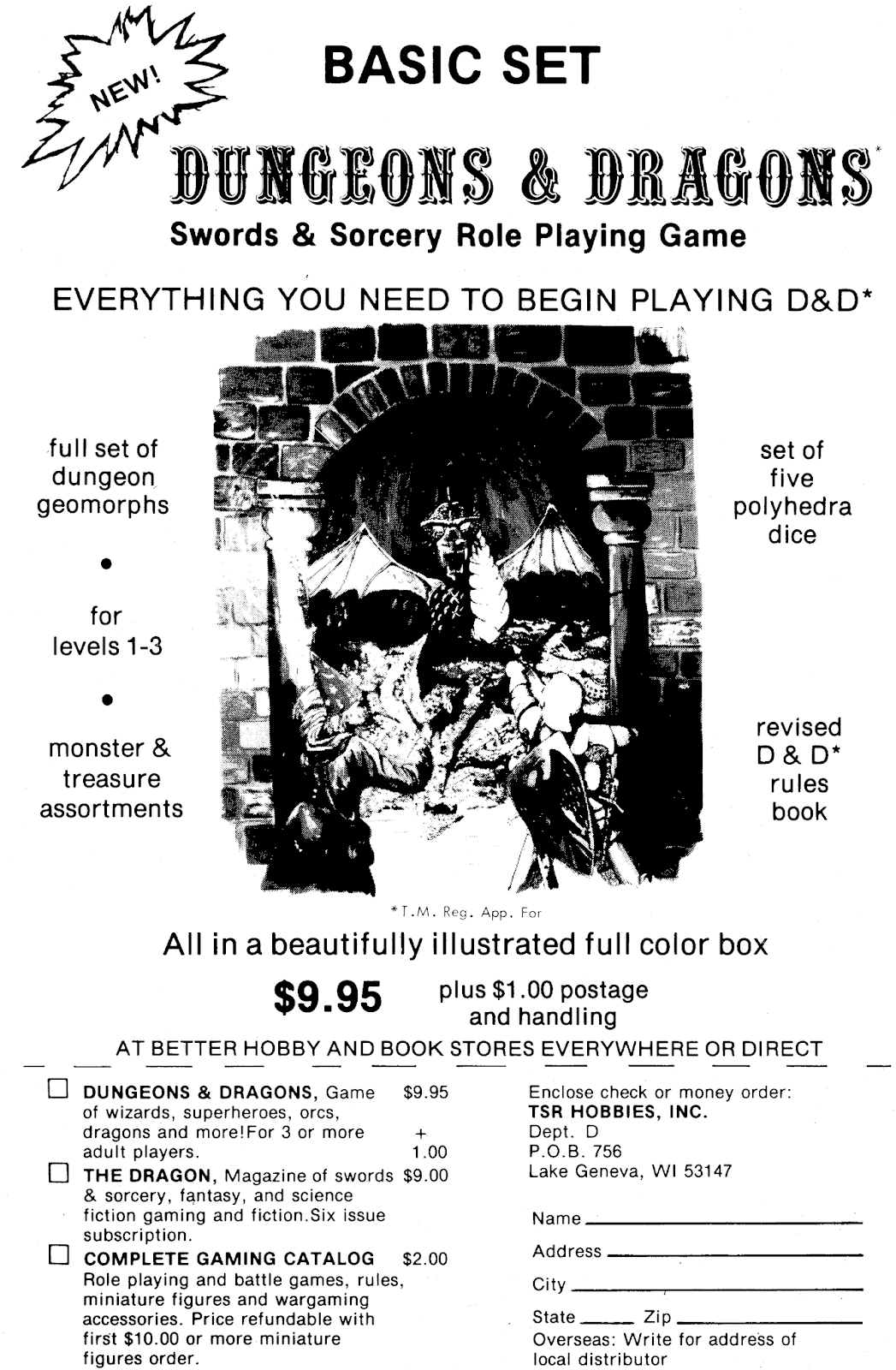
The ad for the first Basic Set

"Varied Player Character and Non-Player Character Alignment in the Dungeons & Dragons Campaign" by Gary Gygax: In this article Gary talks about alignment, specifically focusing on the kinds of conflicts that can arise from having characters of varied alignment within the game.  It's interesting from a historical perspective, because I'd say it's pretty likely that the things Gary is writing about here are scenarios he had to deal with in his own games.  He says that the most common problem in long-running campaigns is with cooperating blocks of players, who coerce new players into taking a certain alignment, and dispatching those who refuse.  It reminds me a bit of the early days of MMOs, where stronger characters would frequently prey on newbies.  Gary's recommendation here is that new players simply lie about their alignment, and play along until they are high enough level to stand up to the established guys.  He even says that it's fine for the players to keep their true alignment secret from the DM, which isn't something I thought I'd ever see from Gary's pen.

It's mentioned that, in the Greyhawk campaign, "good" is the desired end sought by the majority of humanity and its allied races.  Most planned actions are based on a threat to the overall good by the forces of evil, but there's still room for lawful good to go to war with chaotic good, with either aligned with evil beings of lawful or chaotic alignment respectively.

The article also has a very vivid description of the City of Greyhawk that I'll reproduce here in full: "This walled town was the area trade center and seat of feudal power, then began to decline when the overlordship transferred from a suzerain to the city itself, but is now undergoing a boom due to the activities of adventurers and the particular world system events (a new struggle between lawful good and chaotic evil, with the latter on the upswing). The oligarchs of the city are neutral in outlook, if not in alignment, viewing anything which benefits their city as desirable. Therefore, all sorts of creatures inhabit the city, commerce is free, persons of lawful alignment rub elbows with chaotics, evil and good co-exist on equitable terms. Any preeminence of alignment is thwarted by the rulers of the place, for it would tend to be detrimental to the city trade."  That mention of a suzerain is intriguing.  TSR products have the mad wizard Zagyg as a former ruler of Greyhawk, so I could make that a reference to him.  It's also interesting to note that "chaotics" are said to frequent the city.  Does that just mean chaotic humans, or are there orcs, goblins, gnolls, etc. walking around and doing business there?  Something to think about.

The article finishes up with the example of a cleric who opens a small shrine and starts selling holy water.  This doesn't attract much attention, but once he builds a church and starts seeking mass conversions, this attracts the enmity of other leading clerics of the city, as well as the government.  Assassination attempts are possible, and hefty taxes and bribes will be required for the cleric to navigate the paths of power.  It paints a picture of a city where the rulers are desperate to maintain some sort of an alignment balance, so as not to disrupt trade and commerce, or otherwise upset things.

"Seal of the Imperium" by M.A.R. Barker: Professor Barker answers some questions and provides rules clarifications regarding Empire of the Petal Throne.  Some interesting stuff here, but it's relation to D&D is tangential at best.  I'll keep it in mind for when I need to compile info on Tekumel.

"The Fastest Guns That Never Lived - Part II" by Brian Blume: Blume provides stats for the following fictional cowboys and actors:
  • Don "Red" Barry
  • William "Wild Bill" Elliot
  • "Hoot" Gibson
  • William S. Hart
  • Tim Holt
  • Allan "Rocky" Lane
  • Colonel Tim McCoy
  • Joel McCrea
  • Tom Mix
  • The Durango Kid
  • Bob Steele
  • Lee Van Cleef
  • The Cisco Kid and Poncho
Hardly household names these days, except for perhaps Lee Van Cleef, but I'll have to find a place for them should my campaign ever take a turn into the Old West.

"Tombs & Crypts" by James M. Ward: This is a set of charts for randomly determining the contents of a tomb. Always handy to have, and quite reminiscent of the kind of thing found in Judges Guild products.  I rolled on the charts and came up with the following:
  • A roll of 11 on 1d12 means that it's a wizard's tomb
  • The tomb is one room, cave or mound of dirt
  • It contains 2,000 gold pieces, 20 base 10,000gp gems, 2 base 500gp gems, a map, 4 pieces of base 500 gp jewelry, and a misc. magic weapon (10 arrows +1)
  • Guarded by vampires 
That was rolled up pretty quickly.  The system is perhaps a little too generous where gems and jewelry are concerned, but Jim Ward's defense that anyone special enough to be placed in a tomb probably had a lot of treasure to be buried with is hard to argue against.

Monday, May 04, 2020

Recaps & Roundups part 63: The Dragon #8

Cover art by Bill Hannon


The Dragon #8 was cover dated July 1977.  I originally covered it in more detail back here, so I'm going to skim over it this time.  Tim Kask's "Dragon Rumbles" editorial talks about how proud he is to have Harry Fischer writing fiction for the magazine, and he also lies about the potential return of Gygax's "Gnome Cache" serial.  The story by Fischer - "The Finzer Family" - is interminably long, taking up far more real estate than any fiction should in a gaming magazine.  "Featured Creature" presents an Erol Otus illustration and asks the readers to design a creature around it. I'll cover that when the time comes. Finally, "So You Want Realism in D&D" by Brian Blume provides a satirical method of ability score generation designed to gently mock those calling for greater realism.


"Planes: The Concept of Spatial, Temporal and Physical Relationships in D&D" by Gary Gygax: This one is real doozy folks.  It's here that Gary first sets out the planar cosmology of D&D, complete with a diagram, the names of all the planes, and how they interact with D&D spells and magic items.  Here's the diagram:


The diagram is kind of pointless with annotations, so I'll list out all of the Planes as well.


  1. The Prime Material Plane (where most D&D worlds sit)
  2. The Positive Material Plane
  3. The Negative Material Plane
  4. The Air Elemental Plane
  5. The Fire Elemental Plane
  6. The Earth Elemental Plane
  7. The Water Elemental Plane
  8. The Ethereal Plane
  9. The Astral Plane
  10. The Seven Heavens
  11. The Happy Hunting Grounds
  12. The Twin Paradises
  13. Olympus
  14. Elysium
  15. Gladsheim
  16. Limbo
  17. Pandemonium
  18. The 666 Layers of the Abyss
  19. Tarterus
  20. Hades
  21. Gehenna
  22. The Nine Hells
  23. Acheron
  24. Nirvana
  25. Arcadia

Many of these are appearing in D&D here for the first time, but some have been mentioned before.  The elemental planes have been at least implied in the rules about elemental summoning, and the Astral and Ethereal Planes have specifically appeared in certain spells and monster descriptions (particularly in Supplement III: Eldritch Wizardry).  Heaven, Paradise, Elysium, Limbo, the Abyss, Hades, Hell and Nirvana all got mentioned in an article on alignment from The Strategic Review #6, and placed on a chart the I'll show below.


The planes shown here correspond with their placement on the chart above, which is the kind of consistency that I'm here for.  Unfortunately, it gets shifted around a bit by the time the Players Handbook tackles the subject in 1978.  The change is in the order of planes 11 to 14, which are shown as: 11. Twin Paradises; 12. Elysium; 13. Happy Hunting Grounds; 14. Olympus.  The version in the PHB is the one that sticks going forward, so I can only conclude that the planes can be shifted around somehow, or that early planar scholars were incorrect about the configuration.

In addition to the planar cosmology, Gary delves into the idea that creatures that can only be hurt by magic weapons exist on multiple planes at once.  Creatures hit only by +1 weapons exist in two planes at once, those hit only by +2 weapons exist in three planes, etc.  Similarly, magic weapons extend into multiple planes depending on their bonus, and those that deal more damage to specific monsters have a more intense nature in the plane relevant to that monster.  The idea is even posited that every type of creature is somehow connected to its own sub-plane, to explain those magic weapons that deal extra damage to monsters who aren't immune to normal weapons.  It's all pretty wild stuff, and very AD&D in flavour; in fact, Gary casually drops at the end of the article that he's revising the whole game to incorporate these ideas.

"The Development of Towns in D&D" by Tony Watson: This article gives some advice on laying out the PC's home town, including how to map it out, what types of shops and areas it should include, and notes on population and how NPCs should be generated. The following examples are given that I can include as part of the Ultimate Sandbox:

  • An inn named Falgrave's, which is run by a dwarf named Falgrave and mostly frequented by demi-humans.  Falgrave is up on all the non-human gossip.
  • Blatherson of Hillock, an NPC with the following stats: Str 12, Con 9, Int 13, Cha 15, Dex 8, Wis 7.  He's 4th level, and I assume a fighter. He's Lawful, old, loyal to his friends, cooperative and friendly.  He likes to frequent the Golden Goblet tavern, where he constantly drinks mead and tells stories about his exploits in the Goblin Wars.

There are also some examples of goods and services given that I may or may not use:

  • Cartographers sell wilderness and dungeon maps for 100 to 600 gp, depending on how remote the area is.
  • A shave and a haircut at the barbers costs 1 gp.
  • Armour and weapons can be bought at pawnshops, but they have a 1-in-6 chance of being defective.
  • There is a 1-in-4 chance that a foreign merchant or two will be present in the main square.
  • Horses can be boarded at the stables for 2-3 gp per week.
  • In the seedy area of town, there is a 1-in-8 chance per turn of encountering a thief or a band of brigands.
  • Soothsayers charge 20 gp to predict how a planned adventure might turn out.
  • There are magicians who will cast spells for a fee of 50gp x spell level. Now this is something I will have to limit to very low level spells, probably only 1st or 2nd. The price is far too low for anything more powerful, and only the weakest and poorest of magic-users would resort to selling their services for such a low price.
  • Brothels charge 20gp (and 35 gp for the special!). Bribes of 10-100 gp can be made to find out information.
  • Surgeons can heal 1-6 hit points for 25 gp with a 50% chance of success. They have a 1-in-6 chance to cure poison for 35 gp.
  • Scholars at the library can research facts for a fee that begins at 100gp and goes up as the info required gets more specific.

"Introduction to: Gamma World": This article gives a brief overview of the backstory of Gamma World: in the 23rd century a mysterious group known as "The Apocalypse" issues an ultimatum to the world powers to stop fighting or be destroyed.  Mankind bands against them, and the resultant war devastates the Earth.  Gamma World gets into my campaign because the AD&D Dungeon Masters Guide has conversion rules for it.

"A Re-Evaluation of Gems & Jewelry in D&D" by Robert J. Kuntz: This article presents more comprehensive tables for determining the value of gems and jewelry, as well as their type.  I'll keep this in mind for when I get around to working up some comprehensive charts of my own.

"Still More Additions to MA" by James Ward: This article presents twenty new mutated plants and animals for use in Metamorphosis Alpha: jawed lily pads; fungus domes; red puff balls; stalkers; radiation vines; island plants; jawed creeping vines; reflector brambles; spear trees; poison thorn grass; tigeroids; gorillaoids; bulleroids; rabners; blumers; carrins; kerasks; gygarants; sotherlans; and wardents.  You might have figured out that the last have dozen or so are based on TSR staffers, and have abilities that are based on the personalities of those folks.  It's all a bit inside baseball, but the monsters are workable and the names not too stupid, so I'll use them.

Thursday, April 09, 2020

Recaps & Roundups part 58: The Dragon #7


The Dragon #7 was cover-dated June 1977.  I originally covered it way back in 2010 (!) if you want a more in-depth look at it.  This issue marks the one year anniversary of the magazine's birth, and in the "Dragon Rumbles" editorial Tim Kask is quick to note that circulation has jumped by 300% since the first issue.  It was mentioned last issue that The Dragon was going to be covering a wider variety of games, and as such there's not a lot of D&D content to be had here.

These are the articles with no D&D relevance: "What to Do When Dogs Eat Your Dice" by Omar Kwalish presents some alternate number generation methods (including some absurdities like snatching chest hairs and using numbered jumping beans); "Mapping the Dungeons" has more addresses of DMs (including one from Australia, representin' for my homeland!); "Mystery Hill - America's Stonehenge?" by Lynn Harpold wastes space with the history of an American rock formation; "The Journey Most Alone" by Morno is a sequel to his earlier story "The Forest of Flame"; the comic strip "Finieous Fingers" begins a new story; and "Editor's Library" reviews Steve Jackson's O.G.R.E., and gives the thumbs up to Judges Guild.

"Gary Gygax on Dungeons & Dragons: Origins of the Game": Presents Gary's perspective on how D&D came to be.  Most of what's said is quite well-trodden territory.  As far as things that are relevant to my campaign, near the beginning Gary mentions the Great Kingdom, and states that Dave Arneson's land of Blackmoor was placed to the northeast.  I'd been of a mind to ignore that statement, as later maps show Blackmoor in a more north-westerly direction.  Now that I've seen some of the extant maps of the Great Kingdom (such as Dave Megarry's, which I've included below) I'm definitely inclined to ignore it. It's possible Gary just made a mistake here.

Dave Megarry's map of the Great Kingdom

"Military Formations of the Nations of the Universe" by M.A.R. Barker: When you see Professor Barker's name, you know there's some Empire of the Petal Throne comin' at ya. This lengthy article discusses the various military formations used by the armies of Tekumel, complete with rad names like "the two gates of Wuru, the many-legged serpent of gloom".  I'll keep this one in mind in case my players ever get embroiled in mass combat in Tekumel.

"Featured Creature: The Prowler": A serpentine creature with a gaze that can wipe its victims' minds, turning them into "zombei's" (yes, that's how it's spelled) under the prowler's control.  It will then lay eggs inside the zombei and send them roaming the wilderness until the eggs hatch.  As with most non-standard monsters from The Dragon, I'm inclined to make it unique, or use it very sparingly. On my original pass through, I thought of using a sage who insisted on pronouncing "zombei" in a specific manner, who would sharply correct any PC who used the standard "zombie". I still like the idea.

"The Gnome Cache, Chapter 7" by Garrison Ernst (aka Gary Gygax): This is the final installment of Gary's serialised novel, which got unceremoniously cut off because Tim Kask thought it was a bit crap.  It ends with the main characters, Dunstan and Mellerd, encountering a dwarf being chased by giant toads and weirdly hopping men.  This is a round up of the details relevant to my campaign:

  • The Nehron uprising mentioned by the bandits last issue was no hoax, and they actually have taken Blackmoor.
  • East of Blackmoor is a jumble of broken terrain stretching out to the sea, home to roving bands of Nehronlanders.
  • West is a trackless forest which leads to the slopes of the Senescent Hills, an inhospitable place that is home to creatures that do not welcome men.
  • The Free City of Humpbridge bends from south-west to south across the base of the Senescent range.
  • South-west of Blackmoor, in a valley near the Senescents, is a strange black river.

Originally I decided that the fates of Dunstan and Mellerd in my campaign would be death at the hands of the frog men, and I'm still probably going to go with that.  I was also going to tie it in to Dave Arneson's "Temple of the Frog" adventure, given the presence of giant frogs near Blackmoor, by putting the remains of Dunstan and Mellerd (and the dwarf, I guess) in the wilderness nearby.  And because the story was called "The Gnome Cache", I'm going to make said dwarf a gnome, and put a treasure map on his body.

Wednesday, February 26, 2020

Recaps & Roundups part 48: The Dragon #6

Cover art by Morno

Issue #6 of The Dragon was published 1977, cover dated April. Editor Tim Kask noted in his Dragon Rumbles editorial that readership has increased fourfold over the last year, so obviously the magazine is doing well. He also notes that they plan to expand coverage to a wider variety of games, but we'll see how long that lasts; I suspect it'll be mostly D&D before the end of the year.

I covered this issue previously, back in 2010, so I'll be skimming it a bit in this post. The relevant articles are below; the only article I'm ignoring is a short story called "The Forest of Flame" which was written by Morno (real name Bradley Schenck).

"An Alternate Beginning Sequence for Metamorphosis Alpha" by Guy W. McLimore Jr.: Instead of starting PCs off as tribesmen aboard the Starship Warden, this article gives suggestions for running a game where the players are clones of the original crew. I doubt I'll use this article as intended, but such clones might come into play should any D&D characters end up on the Warden.

"Sea Trade in D&D Campaigns" by Ronald C. Spencer Jr.: Some simple rules for determining the success of any sea trading ventures that the PCs may wish to get involved with. It uses a chart, with the number of ports visited determining how much gold is made. More ports equals more gold, but also increases the chance of running into some kind of hazard. I'll keep this article in mind if I ever get around to developing rules for trade.

"Legions of the Petal Throne Painting Guide" by M.A.R. Barker: An article detailing the colours of various troop types and monsters in the world of Tekumel, including clothing, armour, and even flesh tones. That Professor Barker is thorough. Various Tsolyani troops are included, as is the priest of Vimuhla, Yan Koryani troops, the priest of Hry'y, and the following non-human creatures: Shen, Ssu, Hlaka, Ahoggya, and Sro. I'll try to keep this info in mind should I ever have players stray into Tekumel.

"Further Rules, Modifications and Clarifications for Metamorphosis Alpha" by James M. Ward: Clarifications on some of the vaguer mutation rules, some new rules to make being poisoned multiple times deadlier, and some changes to missile and vibro weapons. Again, this is all stuff I'll keep in mind for games on board the Warden.

"From the Fantasy Forge": The first official D&D miniatures have been released by Minifig. I'll probably do a post on them in the near future, so I won't cover them here.

"The Gnome Cache Chapter 6" by Gary Gygax: Dunstan joins up with a merchant caravan, but ends up fleeing for his life when it's attacked by bandits. Here are the setting tidbits I gleaned:

  • After a week's journey, the merchant caravan crosses the Aarn River and enters the walled town of Rheyton.
  • The men of the distant western plains are small and wiry.
  • The land that Dunstan hails from is known as Thalland, and the people that live there are called Thallites.
  • Northerners from Nehron or Kimbry are broad, burly and dark-haired.
  • The merchant is a Thallite known as Evan. The leader of his mercenary band is called Rufus, and Baldwin is his lieutenant. One of the Kimbry in the band is known as Vardabothet. All of them probably die at the end of this chapter.
  • The Kimbry live in the Kimbry Vale, beyond which are mountains.
  • After many days travel they reach the border keep of Blackmoor, which also has a village and a guardian castle. The Nehron peasants seem unhappy with their noble lord.
  • An evergreen forest begins a few leagues north of Blackmoor.
  • The bandits mention a Nehron uprising against Blackmoor, but this could be a ruse on their part.

"D&D Option: Determination of Psionic Abilities" by David W. Miller: Alternate rules for determining whether a PC has psionic powers, that allow a PC to test for them regardless of their ability scores. It also opens the psionic powers to all character types, rather than restricting them by class. Probably the most relevant thing for me is that it allows half-human PCs to test for psionics as well.

"Morale in D&D" by Jim Hayes & Bill Gilbert: An alternate morale system that assigns a Bravery score to NPCs and PCs alike. I originally dismissed these rules for taking agency away from the PCs - I don't like any rules that make PCs do things against their will, unless it's a magical effect of some sort.

The authors talk about their home setting of Fantorgn, where humans are predominant and demi-humans rare and mustrusted. I considered using this setting as a proto-Ravenloft, with a magical aura of dread to explain why the PCs are more fearful than usual. Sample PCs in this setting are: Klabath Durhn (6th level fighter, 14 bravery) and Maygreth the Fierce (7th level fighter, 15 Charisma). Their entourage consists of another 6th level fighter, three 4th level fighters, a 5th level magic-user, his three 2nd level assistants, three village priests from the local temple, a half-elf guide and two elf hirelings. In the example of play they are attacked by six ogres.

"Featured Creature: Death Angel" by John Sullivan: Grim reaper types that either act as oracles, warning of death, or as representatives of death itself to kill a specific creature. They are said to be "fingers of fate", and work for powerful entities such as gods, demi-gods, some liches and a few Evil High Priests of 20th level or higher. I plan on using these beings sparingly, pretty much as described.

Thursday, February 20, 2020

Recaps & Roundups part 46: The Dragon #5


The Dragon #5 was published in March of 1977. I originally covered it back in 2009 if you feel like reading that again; I'll cover it here again but in a bit less detail. The Dragon Rumbles editorial mentions that the magazine is expanding to eight issues a year. Out on a Limb has a number of letters, including one that bemoans the plethora of new rules and sub-classes (I'm laughing at this guy from 2020). Beyond the Wizard Fog by Gardner Fox is another Niall of the Far Travels story/Conan knockoff. And then there's Gandalf Was Only a Fifth Level Magic-User, in which Bill Seligman tries to argue that Gandalf doesn't use much magic by D&D standards. He's right.

"Witchcraft Supplement for Dungeons & Dragons" by an unknown author: Witches are introduced here as an ancient order that's divided by alignment: 35% are Lawful, while the rest are Chaotic. The author seems to be working from the original alignment system, so it's possible that by AD&D standards the divide could be Good/Evil. Chaotic Witches are further split into Low Order, High Order and the forbidden Secret Order who never mix with other types of witches.

The history of the witch orders is given as follows:

"In forgotten ages past, in kingdoms unheralded and dead centuries of untold history, a fiery confrontation emerged between witch covens world-wide. The myriad witches of the woodlands and the fields formed an alliance which dominated all other covens. This group forcibly directed the studies of other witches, and great emphasis was placed on the magic of plants and animals, that they might grow stronger still in their respective domains. But there were those who sought darker and more Godly enchantments, pursuing powers of devastation and the very elements. They promised to teach what they learned, to enslave the world of men, and to shape raw power to the ends of witches everywhere. This the alliance would not permit, for power inspires fear, fear of those that have it. Those who allied with the new Secret Coven were cast out, and in time only the mountains offered refuge to the members of this radical coven."

Witch magic is its own thing, and it's said that Djinn, Efreet and clerics are all immune to it. Each type of witch gets its own spell list drawing from existing D&D spells, as well as a number of new ones introduced here. Particularly ancient Lawful witches (known as priestesses) can cast from the following list of mega-powerful abilities:

  • Youth: remove 40 years from a creature's age
  • Influence: Turn a creature Lawful
  • Banish Any One Creature: Instantly send one creature to Hell with no save
  • Enchantment: Create any magic ring, potion or weapon in one day, with no expense
  • Seek: Visualise the surroundings of any creature, object or place.

Chaotic witches have their own spell list, with High Order witches being more powerful than Low Order (as you'd expect). The following spells are new:

  • Pit: Opens a 15' deep hole.
  • Fire Box: Creates a cube of flame around a target
  • Diminish Plant/Animal/Men: Shrinks all the creatures within the target area
  • Plant Entrapment: Causes plants to entangle creatures in the area

There are Major Spells that are only available to High Order Witches.

  • Paralyzing Pit: Like Pit above, but all within the pit must save or be paralyzed.
  • Undead Control: Gives the caster control over 1-6 undead creatures.
  • Aging: Ages the target by 20 years.
  • Circle of Blindness: Creates a circle that prevents all within from seeing and hearing, as well as using magical detection spells.
  • Curse: A vague spell that can inflict pretty much any negative effect short of death.
  • Poison Touch: Coats an object in poison, or can be used as a save or die touch attack.
  • Curtain Wall: Creates an extradimensional room that the witch can use as a secret lair.

Secret Order Witches also have their own spell selection. Group A consists of spells from other lists, but Group B are all new, highly powerful special abilities:

  • Intensify: Greatly increases the power of any natural weather phenomenon.
  • Wither: Causes every living thing in the area to rapidly age and die.
  • Weight Concentration/Dilution: Controls the weight of any creature or object.
  • Quake: Causes earthquakes
  • Vaporise: Transmutes stone into fog
  • Solidify: Turns fog into stone, which can be used to entomb creatures in the area.
  • Volcanic Circle: Creates an expanding ring of lava that deals 10d6 damage
  • Reflections: Bounces spells cast at the witch back on the caster

The Secret Order Witches also have their own set of new magic items. A cleric who tries to wield on of these will die instantly; otherwise, only a witch priestess, High Order Chaotic Witch, or a magic-user of level 13+ can safely wield them.

  • Skull of Death: A dragon skull helmet that can command undead and cast finger of death.
  • Mountain Seeds: Become the size of a castle when thrown
  • Leech Dust: Forms a cloud that sucks the blood from those within.
  • Assassin's Eyes: Invisible eyes that can fly, cast charm person and shoot death rays.
  • Witch Wands: Can be used to cast a number of witch spells per day.
  • Serpent Belt: Said to be a more powerful form of snake belt, which is detailed below.
  • Seed Satchel: Contains seeds that can transform into things like a wall of thorns or a wyvern.
  • Hornet Cape: The wearer can fly, command other flying creatures, and fire stingers.
  • Potion Cauldron: Allows the user to create any potion in just one day.

There are also magic items that can be used by all kinds of witches, and could appear in any regular treasure hoard.

  • Snake Belt: Transforms into a snake strong enough to strangle a wyvern (how very specific).
  • Ivy Bracelets: Control and communicate with plants. They are very fragile.
  • Dart Rings: Fire poisonous thorns.
  • Locket of Satan: Only used by evil witches, grants command of any three Chaotic creatures within range.
  • Love Locket: Only used by good witches, makes any male humanoid within range smitten and under their sway
  • Thorn Twine: A 40 foot thorny vine that can be used to entangle or keep foes at bay.
  • Guardian Egg: Can be transformed into a Hill Giant, a Roc or a Dragon Turtle.
  • Hill Seeds: Expand in size when thrown, acting like cannonballs.
  • Luck Charms: Grant bonuses in combat, as well as wishes and greater luck when finding treasure.
  • Mirror-Crystal: Protects against charm person, sleep, paralyzation, curses, and other mind-affecting magic.
  • Amulets of Power: The caster can memorise more spells, and increase the power of their spells by 50%.

I'll include these witches as secretive orders in my campaign, keeping in mind that the Secret Order is said in the article to have only resurfaced recently. It should also be noted that Satan is referred to in this article, who I'll happily use as an Arch-Devil on par with Asmodeus and the like.

"Some Ideas Missed in Metamorphosis Alpha" by James M. Ward: Ward includes here a number of rules that missed the cut for his recently-released game. These include: chemical radiation neutralizers (gel that can nullify radioactive material); chemical flammable retardants (or fire extinguishers); radioactive material in containment; sensory intensifiers (a pendant that increases the senses of the wearer). It's also noted that the poison charts in the game are really deadly, but there are a bunch of ways to counteract that poison: shamans, antidotes, mutations, etc.

"Tribal Society and Hierarchy On Board the Starship Warden" by James M. Ward: A quick article that gives some details about how the tribes live and interact in Metamorphosis Alpha. Each tribe has a leader and a shaman, who pretty much exists as a healer and quest-giver (a tool for the DM to prod PCs in the right direction, in other words). It's mentioned that the two dominant life-forms aboard the Warden are Androids and Wolfoids. The Androids have infiltrated human society as shamans, and use the humans to fight the mutated intelligences on the ship. Not much is said about the Wolfoids, except that they know less about technology but more about mutation. It's also mentioned that a group of players recently killed four important android scouts, robbed them of duralloy shields and color bands, and discovered that their shaman is not human. I'll make sure to include this group as NPCs should I ever have players find themselves aboard the Warden.

"Featured Creature: The Anhkheg" by Gary Gygax (I assume): The Anhkheg makes its first appearance here, with a great illustration from Erol Otus.


"How Green Was My Mutant: The Appearance of Humanoids in Metamorphosis Alpha" by Gary Gygax: Gary provide some random charts to determine the appearance of mutants on board the Starship Warden. Doing some random rolling just now, I came up with a guy who has pocked skin that is striped grey, a very thick neck, a thin body, no nose, wide hands and feet, and webbed fingers and toes. The table results are a little bland by Gary's standards, to be honest.

"Wizard Research Rules" by Charles Preston Goforth, Jr.: These rules are additions to those found in D&D Vol. 1: Men & Magic and The Dragon #2, and are consistent with what has gone before. A bunch of new possibilities that can be researched, which I'll outline below:

  • Spells that can permanently increase one ability score (but only once per stat per character). The spell increase begins at 1 point, increasing to an absurd 1d12 points when cast at higher levels.
  • Weapons of +1 enchantment can be made with a simple expenditure of gold and time, but anything stronger that that requires a roll on a chart to determine the resultant magic bonuses (or curses).
  • A caster can "embed" a spell in an object (though it's not exactly clear what this is for).
  • Rules are given for creating "true rings", which can enslave lesser rings and function much like Tolkien's One Ring.
  • There are also rules for "Wizard blades", which are special magic swords that can be wielded by a magic-user.
  • The ability is given for wizards and patriarchs to spontaneously create magic items under duress, by speaking a Power Word of Distress. Such creation permanently drains the caster of 1d8 hit points, which is a fair bit by OD&D standards.
  • Magic items can be sacrificed as a way of seeking aid from the gods, although the gods aren't guaranteed to answer.

I'll introduce all of these options into the campaign, but probably as forbidden knowledge; only those PCs who find such knowledge will be able to use these abilities.


"The Gnome Cache" by Garrison Ernst aka Gary Gygax: In this chapter Dunstan and Mellerd join a merchant caravan heading north. Some relevant details:

  • The Upplands north of Crosshill Road are wild and desolate. Rabbits live there.
  • It takes a week by foot to travel from Huddlefoot to Deepwell.
  • Dolph is the liveryman in Deepwell. He can't read very well.
  • Evan the Trader is a dealer is rich furs from Nehron-land.
  • The town of Rheyton lies north of Deepwell, and further north are the forests of Nehron.
  • Not too far from Deepwell live the wild Kimbry, who are known to brand their horses.
  • Some coin types are named: plumbs, and gold scruples (or scrups).

Whether these details match up with later Greyhawk lore I have no idea. They might fit better with the world as it was before being published as a TSR product.

Friday, August 23, 2019

Recaps & Roundups part 41: The Dragon #4


Cover dated December 1976, The Dragon #4 is a special issue devoted almost entirely to Empire of the Petal Throne. It seems like an odd move for a magazine so early in it's run, but TSR was selling EPT at $25 a pop, and no doubt were pretty keen to shift some units. Most of the articles in it were for EPT, and thus only of minor relevance to the Ultimate Sandbox; I do plan to use Tekumel as a setting, but only as a peripheral world that the PCs might visit, not as a central part of the campaign.

Articles not relevant to that project are: "Miscellaneous Oddball D&D Stuff" which presents a number of overtly comedic game elements, which I'm not including because they are very silly indeed; "Mapping the Dungeons" which has more names and addresses of DMs; and "Wizards Defined" which outlines the abilities for various levels of magic-user in an attempt at humour.

Relevant articles are listed below. I'm including them here for my own reference, but since they aren't D&D-related I'll gloss over them pretty quickly. I covered this in more detail some years ago.

"Reports Submitted to the Petal Throne" by M.A.R. Barker: This is a follow-up to a previous article, and features a number of reports to the Emperor about goings on in Tekumel. It's very dense stuff, but an intriguing look into the weird, alien world of EPT.

"Notes on Androids on The Starship Warden" by Jim Ward: An article detailing the history and use of androids on the Starship Warden of Metamorphosis Alpha, which I'm using as another possible setting for adventures in my campaign.

"Jakalla Encounters" by Steve Klein: A random table for generating encounters in the Foreigners' Quarter of EPT's Jakalla.

"The Battle of the Temple of Chanis" by M.A.R Barker: An account of a large-scale battle in Tekumel, complete with the fictional account of one of the soldiers. The battle is waged between an army from Mu'ugalavya and one from Tsolyanu, which the Mu'ugalavyani lost.

"Creature Features - The Mihalli": Stats and description for the Mihalli, a non-human race that hitched a ride with humanity to the planet of Tekumel (back when humans were still a star-faring race). Most of them were wiped out with fission bombs ages ago.

"Creature Features - The Vriyagga": A weird creature that trundles around on fleshy wheels, dwelling in the fabled subterranean City of Red-Tiled Roofs.

"Roads from Jakalla" by Jerry Westergard: Some adventurers are hired to transport a book to the Emperor, to prevent a plot to assassinate a prominent general.

"Wargaming World": Shows some of the earliest miniatures for D&D and EPT. The pictures are quite low quality, but it looks like the orcs are pig-faced (some of the earliest images of that style of orc). The pictures of the EPT figures might come in handy if I need to see what certain types of troops are meant to look like. It's not hard to find visual aids for D&D, but EPT is more difficult.

"Fantasy/Swords & Sorcery Recommended Reading" by Gary Gygax: This is a list of recommended books from Gary, a precursor to the one in AD&D. Some authors have specific works listed, and some dont. I'll list them below.

  • Three Hearts and Three Lions by Poul Anderson
  • Algernon Blackwood
  • Leigh Brackett
  • John Carter of Mars (et al) by Edgar Rice Burroughs
  • Warriors of the Worlds End by Lin Carter
  • The Incompleat Enchanter and Castle of Iron (et al) by deCamp & Pratt
  • Gates of Creation (et al) by P.J. Farmer
  • Kothar the Barbarian (et al) by Gardner Fox
  • Conan the Conqueror (et al) by R.E. Howard
  • Hiero's Journey by Sterling Lanier
  • Swords of Lankhmar (et al) by Fritz Leiber
  • H.P. Lovecraft
  • Creep Shadow Creep, The Moon Pool, Face in the Abyss and Dwellers in the Mirage (et al) by A. Merritt
  • Stealer of Souls and Stormbringer by Michael Moorcock
  • Changeling Earth by Fred Saberhagen
  • Margaret St. Clair
  • The Hobbit and Lord of the Rings by J.R.R. Tolkien
  • Eyes of the Overworld and The Dying Earth by Jack Vance
  • Stanley Weinbaum
  • M.W. Wellman
  • Jack of Shadows (et al), Lord of Light and Nine Princes of Amber series by Roger Zelazny
Of the above, I've only read the first five of Burroughs John Carter books, all of Howard's Conan, a good chunk of Lovecraft, the two Moorcock books, both Tolkien books, and both of Vance's books. Fritz Leiber is probably the most glaring thing on this list that I haven't got to yet. Alas, most of my youthful fantasy reading went on official TSR novels and epic fantasy from the 1980s and onwards. I need to check out some of this stuff.

Saturday, August 10, 2019

Recaps & Roundups part 37: The Dragon #3


Cover-dated October 1976, the third issue of The Dragon was released not long after Swords & Spells (it has a full page ad for the product, as well as for the Lankhmar wargame). It kicks off with an editorial defense of including fiction in the magazine by Tim Kask, and has the following articles that are irrelevant to this blog: Gary's reminiscences about an old play-by-mail wargame called War of the Empires; more DM listings in Mapping the Dungeons; a round-up of recent miniature releases in Wargaming World; an defense of the way the D&D tournament was run at Gen Con IX, and list of the winners; and the first letters column, Out on a Limb, wherein Scott Rosenberg uses the lack of TSR accessories to defend his rampant copyright violation, and Lewis Pulsipher goes Full Tolkien Nerd in criticising the article about the Eldar from issue #1. Also we have the first installment of the Finieous Fingers strip, and I should have noted that the Dirt strip started back in The Strategic Review #7.

Now, the articles that are relevant:

"Notes on Women & Magic - Bringing the Distaff Gamer into D&D" by Len Lakofka: We just had Jennell Jaquays' ideas about female PCs in Dungeoneer #2, and now it's time for Len Lakofka to weigh in on the matter. It begins by limiting a female's Strength score, and replacing Charisma with Beauty, which is certainly a whole thing I don't want to get into. Apparently they also "surpass men as thieves". Yup, I'm just going to move on here.

It then provides alternate level titles for each class, which I'm happy to include as an option for whoever wants to use them. They're different to the ones in Jaquays' article; I'll use those for the specific classes he introduced, and these for generic fighters/magic-users/theives/clerics. They are:

  • Fighters: Fighting Woman; Swordswoman, Gladiator, Battle Maiden, Shield Maiden, Myrmidon, Heroine, Valkyrie, War Lady
  • Clerics: Novice, Initiate, Postulant, Apostolate, Sister, Deaconess, Canoness, Prioress, Superioress, Matriarch
  • Thieves: Wench, Hag, Jade, Succubus, Adventuress, Soothsayer, Gypsy, Sibyl
  • Magic-Users: Medium, Seer, Sage, Mystic, Oracle, Enchantress, Illusionist, Sorceress, Witch

Female thieves are given spellcasting abilities, and the power to see the future via tarot reading, at higher levels. I think I'm going to split these off as an NPC faction; the thief titles above (which are pretty rough) will apply only to members of that faction. Fighters get a few seduction abilities, and magic-users get some female-only spells. Female clerics are the same as males, except that Chaotic clerics get access to the worship spell. For the sake of simplicity, the faction I posited above will include fighters, thieves and magic-users. Clerics are unchanged enough that I don't think they need to be a part of it.

Here are the new spells below. Very few of them are ever used going forward in D&D:
  • Charm Man I through III
  • Tarot Reading
  • Seduction I through VIII
  • Charm Humanoid Monster I through IV
  • Magic Mount
  • Mind Meld
  • Poison
  • Spirit
  • Horrid Beauty
  • Worship

As you can see, most of them are variants of charm spell. I'll have them known and in use by the faction I mentioned above, but it's doubtful they'll survive in the campaign long-term (unless a PC gets hold of one and takes a liking to it).

"The Search for the Gnome Cache: Chapters 3 and 4" by Garrison Ernst (aka Gary Gygax): In these two chapters Dunstan gets away from the ne'er-do-wells he hooked up with last issue. He also hires a tableboy named Mellerd to go along with him on his journey.

Some details I need to remember:
  • The Inn of the Riven Oak is run by Innkeeper Krell, with the help of Meggin the buxom tavern wench.
  • The soldiers searching for Dunstan serve the Overking, and are called Warders.
  • Silver pieces are known as nobs, and there are 20 coppers to 1 silver. This is different to the exchange rate from D&D, which is 5 copper to a silver, and the one from AD&D (10 cp to 1 sp).
  • South of the area around Endstad are forbidding deserts. To the east, not far from Endstad, are the Monley Isles. West lies the vast expanse of Silent Forest, and beyond that the outpost of Far Pass and then nothing but arid steppes. North the realm of the Overking stretches for a time, into the blue Upplands, until reaching Arnn River, where the independent northern folk give strong resistance.
  • The Overking is named Eddoric IV.
  • The badge of knighthood in the Overking's realm is a pennon and acorn.
  • Huddlefoot is a small village at the base of the Upplands, about a day's ride by horse from the Inn of the Riven Oak. It is on a secondary lane which connects Forgel Road at Dyrham to the Wild Road just above Edgewood. It has a large inn, stables, a blacksmith, other businesses and yeoman's cottages.
  • Mellerd is a stableboy at Huddlefoot's inn, apprenticed to Master Grund. His brother is named Taddy.
  • About half a day's walk north from Huddlefoot is a stream that is the only inlet to Lake Dyrn. The Hills of Dyrn continue for two days travel beyond this, at which point Crosshill Street cuts across them.
  • Not far from the Hills of Dyrn are the Hills of Nyrn, said to be home to gnolls, and slimy creatures that live in cursed lakes.

"Birth Tables for D&D" by Brad Stock and Brian Lane: I don't know that I'll ever use birth tables for PC generation, but there are some things about the setting that can be gleaned from reading the tables. Bastards (the Game of Thrones variety) are a thing. Peasants exist, as do knights, orators, courtiers, sheriffs, and magistrates. Barons, Counts, Earls, Marquis, Dukes and Royalty exist as part of the nobility. Half-goblins and (more significantly) half-orcs are mentioned for the first time.

Also included is the first ever D&D skill system, or at least a determination of the skills a PC might have based on their father's occupation. Here's the full list:

  • Vagabond
  • Farmer
  • Serf
  • Tinker
  • Miner
  • Woodsman
  • Sailor
  • Fisherman
  • Craftsman
  • Soldier
  • Adventurer
  • Merchant/Master Merchant
  • Scribe
  • Seaman
  • Slaver
  • Animal Trainer
  • Shipwright
  • Bird Trainer
  • Asassin
  • Spytracker
  • Sheriff
  • Magistrate
  • Sage
  • Alchemist
  • Physician
  • Artist
  • Sculptor
  • Musician
  • Engineer
  • Interpretor
  • Writer
  • Astronomer
  • Don Juan (yes, really)
  • Orator
  • Actor
  • Dream Interpreter
  • Biologist
  • Gambler
  • Astrologer
  • Tailor
  • Smith
  • Fletcher
  • Cobbler
  • Horseman
  • Weaver
  • Carpenter
  • Armorer
  • Bowyer
  • Mason
  • Cartographer
  • Jeweler

The article also changes the rules for ability scores, giving different races a different amount of dice to roll for certain abilities. For example, a Hobbit rolls 4 dice for Dex and Con, but only 2 for Str. I wouldn't use this, especially not for PCs, but it's interesting to note that this is about a year before demi-humans get any sort of ability score adjustments in the official rules. There's also a chart for starting experience points, which can allow a character to start at higher than 1st level. Again, I wouldn't use this for PCs.

It's noted that demi-humans can't rise higher than the rank of earl in human lands. Elves are never less than gentlemen or nobility, and half-orcs and half-goblins are never more than commoners. There's also an example character created at the end, a noble, well-to-do bastard whose father was a 4th level magic-user, a duke, a courtier, and an interpreter. I named the character Briad Stane by combining the names of the article's authors. Briad is a 2nd level cleric.

"A Plethora of Obscure Sub-Classes"

  • "Healers" by C. Hettlestad: This is a spell-casting class with a spell list that includes cleric and magic-user spells. They can't be Chaotic. I'll keep them as NPCs, possibly as part of a healer god's church. Some new spells are included as part of this article:
    • Detect Phase
    • Cure Blindness
    • Energy
    • Cure Lycanthropy
    • Wake Spell
    • Cure Paralysis
    • Longevity
    • Size Control
    • Improved Cure Serious Wounds
    • Sterilize
    • Remove Charm
    • Cure Deafness

  • "Scribes: New Specialists Described" by David Mumper: A new type of specialist that has the ability to copy spells from scrolls and books into the spellbooks of the PCs. They're said to be the only ones who can do so without going insane, but this obviously doesn't apply to magic-users, who can also do this job. They still have a small chance of insanity, so I'll say that they're the only non-spellcasters who can do it without going mad for certain.
  • "Samurai" by Mike Childers as modified by Jeff Kay: A fighter sub-class that's very attached to their katana, wakizashi and composite bow. Their main ability is to strike critical blows that can deal extreme amounts of damage, and sever limbs. They can also throw people about and stun them with judo. I'll include them as a type of fighter, but any critical strike ability will simply be folded into whatever standard critical hit system I use.  These are, I think, the first D&D appearances for the katana, wakizashi, yumi (japanese bow) and samurai armor. Any samurai in the campaign will hail from the same land that ogre magi originate from.
  • "New D&D Character Subclass: The Berserker" by John Pickens: Not just fighters that can go berserk in battle, this class also has a "were-shape" ability. Each of them belongs to a clan dedicated to one of the varieties of lycanthrope, and at higher levels they can change into that animal's form when going berserk. They can gain bards as followers, so I'm going to tie these clans to the barbarians that follow the druids. Each of the clans has a single Clanmaster, who can be duelled for the title.
  • "A New View of Dwarves" by Larry Smith: An article that brings dwarves more in line with Tolkien. There are said to be seven families of dwarves, and seven dwarf kings. One of these is the line of Durin. They get their own level titles (Dwarf, Warrior, Spearman, Dwarf Hero, Swordbearer, Axewielder, Champion, Dwarf Lord, Dwarf King). A duel must be fought to become a Dwarf King, unless the post is absent. They get a number of new abilities related to appraising gems, recognising magic arms and armor, and weaponsmithing. They hate orcs and goblins, dislike elves. They reach adulthood at about 50, and live to around 250. This fits well with my use of Middle-Earth as the campaign's distant past, but I won't be using it to alter current-day NPCs. It'll only come into play if the PCs somehow find themselves in the past.
  • "The Idiot Class" by Gordon Davidson: A very stupid person that can be hired to come along into the dungeon with the purpose of confusing monsters with their idiocy. You can hire one with dwarfism for a bit extra, which apparently gives a bonus to the confusion chance. You guys, it was 1976. I'll probably leave this out altogether, to be honest, it's very silly.
  • "The New Category: Jesters!" by Charles Carner, William Cannon & Pete Simon: A uses humor and jokes to incapacitate its foes. They can only use weapons such as smelly socks, pillows, and dirty underwear, and their spells are mostly in the form of terrible jokes and puns. I almost have to respect a class that has a spell called "ballbuster", but this is well past my tolerance for bad D&D humour. As with the Idiot class, this one's going right in the bin.

"Combat Modifiers for Dexterity" by Steve Cline: A chart that grants bonuses to melee attacks, damage, missile attacks and Armor Class for having a high Dexterity. It even takes into account the exceptional Dexterity score introduced in The Strategic Review #7. I doubt I'll incorporate thisstuff beyond what's already in the core D&D rules.

Monday, July 29, 2019

Recaps & Roundups part 32: The Dragon #2


Cover dated August of 1976, The Dragon #2 sees TSR deep in preparation for GenCon IX. In terms of articles not relevant to this blog, there's part 2 of the short story "Search for the Forbidden Chamber" by Jake Jaquet; another list of DMs in "Mapping the Dungeons"; "Shadow of a Demon", a story by Gardner Fox featuring Conan knock-off Niall of the Far Travels; "The Feathered Serpent", an article about the worship of Quetzalcoatl, which is far too steeped in Earth history for me to use; and reviews of the games Venerable Destruction and Star Command. Relevant articles are quickly summarised below.

"Monkish Combat in the Arena of Promotion" by John M. Seaton: This article provides a new combat system for use when monks duel for level advancement. Rather than rolling dice, it involves each combatant picking a series of maneuvers and comparing the results. If I do use this system, it will be exclusively for monk advancement, and won't be usable elsewhere.

In terms of fluff, it's said that these advancement duels are fought in a ceremonial arena, overseen by the next highest master. The combatants approach from opposite sides of the arena, and bow three times: once to their past masters, one to their sensei, and once to their opponent. Then combat commences.

"The Gnome Cache chapter 2" by Garrison Ernst (aka Gary Gygax): In this chapter Dunstan encounters some bandits who convince him that they rob from the rich and give to the poor. Further details I gleaned:

  • Three leagues from Endstad (the village that Dunstan came from), the Wild Road runs into the King's Way, and there is a shrine there to Saint Cuthbert of the Cudgel (who has already been introduced by way of Supplement III).
  • A short walk through the woods from the shrine is a thorp that is home to the Inn of the Riven Oak.
  • Along Wild Road is the Edgewood, and therein is a castle inhabited by Baron Teric.
  • There are "strange lands" westward beyond Far Pass.

I'll have to try to make these details fit with the World of Greyhawk. At the moment this is all small picture stuff, and shouldn't be too difficult.

GenCon Update: Details are given for the GenCon IX tournament scenario, the set-up of which is as follows:

“ . . . The group of adventurers in question has offended the resident Wizard of the town in which they reside, having referred to him as a ‘shriveled old nit.’ He is about to end their miserable existences with a well-placed fireball, but stops short of uttering the final words of the incantation. Eyeing them speculatively, he offers them a chance to redeem themselves. He tells them a tale of a highly magical staff that once belonged to him, but was stolen a few ages ago. He now believes it is in the dungeons of a nearby ruin, and says that if they find it and bring it back to him he may just see them in a different light, so to speak. The party is ecstatic, relatively, at the opportunity to save their skins, and readily agree to the adventure, thinking that they will be able to line their own pockets as well as retrieve the old fool’s bit of magic kindling. As they neglect to ask him why he doesn’t go with them, or why he hasn’t recovered this bit of magic aforenow, he does not volunteer the information. Before sending them off, he takes the Mage aside and tells him they should begin their search off the Sixth Stairway, at the same time covertly slipping a curiously carved piece of amber into the Mage’s hand. . .”

This scenario was written by Bob Blake, and will eventually be published by Judges Guild as JG55 GenCon IX Dungeons.  More on that in a few posts time.

"Hint for D&D Judges part 3: The Dungeons" by Joe Fischer: Fischer provides some hints on dungeon design, and along the way drops some Greyhawk tidbits and provides ideas for some tricks and traps. Right at the start he talks about some entrances to Greyhawk Castle:

  • Through the castle itself
  • Through an old dry cistern
  • Under a pool of quicksand
  • In a simple hole in the ground

I'll have to incorporate these. In my earlier post in this issue I said that Gary had disavowed the quicksand entrance. I'm not sure where I got this from, but it means that it might not actually exist. One possibility is that this was one of Rob's entrances, added once he started co-DMing. I'm inclined to keep it.

The rest of the traps and tricks I will incorporate into the already-mentioned Castle Blackstar from Fishcer's last article:

  • Entrances under the nearby town, the guard barracks, and a peasant's hovel.
  • A shattered skeleton that, when reassembled, will either attack, serve the party until destroyed, lead to the nearest unguarded treasure, or lead to his master (a high-level magic-user).
  • There's a chart here for determining traps on treasure chests that I will use only in Castle Blackstar.
  • Some of the coins in this dungeon are sentient, and will attack, or scream if taken from their resting place.
  • Somewhere in the dungeon is a dragon who has a hoard of gold pieces that are really made of chocolate wrapped in gold foil. (Ehhh. This one I might ignore.)
  • There's an area here guarded by a realm of chaotic dwarves.
  • Some gems in this dungeon can be commanded to transform into a random monster.
  • Some monsters in this dungeon will turn into gold pieces when killed. (Just like in Super Mario!)
  • The following destinations can be reached via portals in Castle Blackstar: the Santa Maria on its way to discover America, the Normandy beaches on D-Day, the USS Nautilus (a nuclear-powered sub) on its shakedown cruise, and the Little Big Horn as blue-clad cavalry attack. Other destinations are Larry Niven's Ringworld, Tolkien's Moria, Clark Ashton Smith's Hyperborea, Arthur Conan Doyle's Lost World and Fritz Leiber's Nehwon, the Starship Enterprise and the Bermuda Triangle.
  • The following special monsters may be encountered here: those found in the works of HP Lovecraft, the sandworms of Dune, Larry Niven's "Puppeteers", Dickson's "Dorsai", and the martians from War of the Worlds.
  • There's a 10'x10' room that will shrink anyone crossing it so that it seems to be 200'x200'. This serves to drive mappers crazy.
  • There's a room maze full of transporters that constantly return the party to the centre.
  • There's a room with unguarded treasure that, when touched, activates secret doors allowing hordes of hobgoblins to attack.
  • There are underground rivers and lakes here, as well as a random chart for determining the inhabitants of islands.
  • Somewhere in the dungeon is a Pool of Endless Ogres.
  • Somewhere in the dungeon is a room full of gems. Three turns after the gems are taken from the room, half of them turn into orcs and attack.
  • Some magic items found in this dungeon: a ring that works like a Staff of Wizardry, an Unholy Sword, a dagger that works like a Wand of Fireballs, an idol that answers yes/no questions once a week, and an incense burner that works like a Crystal Ball.

Lastly, there are a number of new magic items given here that I will probably only place in Castle Blackstar:

  • The Hobbits' Pipe
  • Pipeweed of Tranquility
  • Pipeweed of Stoning
  • Pipeweed of Illusion
  • Pipeweed of Acapulco
  • Ring of Magic Missiles
  • Bag of Infinite Wealth
  • Helm of Forgetfulness
  • Ring of Infravision

"Creature Features" presumably by Gary Gygax: This article introduces the Remorhaz, as illustrated by Erol Otus.

"A New D&D Character Class: The Alchemist" by Jon Pickens: This is an expansion of the alchemist, introduced as a specialist in D&D Vol. 3, into an adventuring role. Their abilities mostly involve around the creation and use of poisons, drugs, potions and acids. Transmutation is mentioned as being possible. Some new special items are introduced:

  • Purification Powder (makes food and water fit to eat)
  • Flash Pellets (blinding)
  • Dust of Sneezing
  • Tanglefoot Pills (surprising to see, and no doubt influential on 3rd edition's tanglefoot bags).
  • Dust of Paralyzation
  • Potion of Immunization from Lycanthropes
  • Potion of Cure Disease
  • Potion of Regeneration
  • Potion of Mind Damp (immune to mental location or attack)
  • Greek Fire
  • Gunpowder
  • Hallucinogens
  • The Grimoire of Archaic Alchemy (adds a level for alchemists, damages others)
  • Philosopher's Stone (transmute lead into gold or silver, aids research, cures disease)

A system for variable poison damage is introduced at the end of the article.


"D&D Option: Weapon Damage" by Jon Pickens: Pickens introduces a system whereby fighters and thieves master weapons as they advance and deal more damage with those weapons. The concept of dual-wielding is also dealt with.

The list of weapons includes a Dwarf Hammer.

Tuesday, July 16, 2019

Recaps & Roundups part 27: The Dragon #1

Cover art by Bill Hannan

With TSR and the fantasy gaming hobby as a whole exploding in popularity, The Strategic Review was cancelled to make way for two magazines. The first, called Little Wars, dealt primarily with miniature wargaming, and I assume has little of relevance to D&D players. The other was The Dragon (later shorted to just Dragon), which covered fantasy and sci-fi gaming in all its forms, but primarily Dungeons & Dragons. It was initially overseen by Tim Kask, who would be the magazine's editor for its first few years.

The first issue is about a third larger than the last issue of The Strategic Review, and contains an eclectic selection of material. "Dragon Rumbles" and "In the Cauldron" do the standard introductory stuff, "Wargaming World" and "GenCon Update" give news about upcoming cons, "The Search for the Forbidden Chamber" is a short story by Jake Jaquet that's far too anachronistic for me to bother with, "Hobbits and Thieves in Dungeon" provide new character types for that board game, there are reviews for such games as Classic Warfare, Citadel, and White Bear and Red Moon, and Len Lakofka provides his own hefty set of mass combat rules as an alternative to Chainmail.

As for relevant D&D-related articles, here we go (in brief):

"Fafhrd and the Gray Mouser Say Their Say" by Fritz Leiber: This article gives some details about the world of Nehwon, with some amusing banter from Fafhrd and the Mouser thrown in. I doubt there's much of relevance here, but this setting is eventually tied to D&D with Lankhmar: City of Adventure in 1985. I'll make a note to refer back to this article if necessary.

"The Battle of Five Armies in Miniature" by Larry Smith: This article gives suggestions for staging this battle from The Hobbit using the rules from Chainmail. For reasons I'll get to later Middle Earth could be relevant to my campaign, so I'll keep this article in mind.

"How to Use Non-Prime-Requisite Character Attributes" by Wesley D. Ives: This article provides what might be the first "skill system" for D&D, using a bunch of rolls against a PC's ability scores to determine success with any action. For my tastes it uses too many dice rolls, and also allows high-Dexterity character to outshine Thieves at lower levels.

The main thing of relevance from this article is the sample PC, Grod the Myrmidon. Grod is a 6th-level Fighter with the following stats: Str 17, Int 9, Wis 5, Con 14, Dex 14, Cha 12. At some point in his past he and three minions were attacked by two bugbears. He tried to convince his minions to hold them off while he rolled away a boulder blocking the exit to the dungeon. He also tried to use a censer of controlling air elementals. I'll use him as an NPC in and around Greyhawk.

It should also be noted that the article gives characters a small chance based on Intelligence to use items that their class normally wouldn't allow. I'll have to think about whether this is a possibility I want to include.

"Magic and Science: Are They Compatible in D&D?" by James M. Ward: This article tries to present the idea that magic and science are very compatible, and does so by introducing the Artificers, a highly technological race that lives on the island of Atlantis. It says they "teleported their island land Atlantis to another nearby dimension", which I'll have to interpret at some point. The Artificers are possessed of a lot of technology designed to counter magic: spheres that fire different rays, and a super-computer that can analyze and counteract any magic sent against it. I'll place this society somewhere in the campaign, either on an island or in a pocket dimension somewhere.

"Languages or, Could You Repeat That in Auld Wormish?" by Lee Gold: An article that delves into languages in D&D. It asks a lot of questions, such as whether animals, plants, bugs, bacteria, and even inanimate objects like stones have their own languages. The existence of "group" languages such as Equine (for horse-like creatures), Canine (for dogs), Auld Wormish (for older dragons), and the Great Tongue (for Giants) are also posited. Lycanthropes are given a greater chance than other monsters of speaking Common, which makes sense. Cavemen are said to speak "Cavish". Cultural and national languages are brought up. I can get behind the idea that every sentient creature has some form of language, and that there are certain non-human equivalents of Common. I'll adopt most of this, I think.

The idea is brought up that characters might be able to learn the alignment tongue of an opposing alignment, albeit with great difficulty. I'll hold off on adopting this one to see what later books say about it.

"Creature Features: The Bulette" by Gary Gygax (I assume): The bulette is introduced, said to be a cross-breed from snapping turtle and armadillo stock. They were thought to be extinct up until recently, and have a fondness for eating horses and hobbits.

"Hints for D&D Judges Part 2: Wilderness" by Joe Fischer: Some general tips for creating and mapping wilderness areas. It's solid, basic advice for beginners, but doesn't have anything I can pull out for the campaign.

"Mighty Magic Miscellany: Illusionist Additions" by Peter Aronson: Gives new spells and abilities for the Illusionist class, including spells of Levels 6 and 7 for the first time. The new spells introduced here are:

1st level
  • Detect Illusion
  • Color Spray
2nd level
  • Dispel Illusion
  • Blur
3rd level
  • Phantasmal Killer
  • Illusionary Script
  • Dispel Exhaustion
6th level
  • Mass Suggestion
  • Permanent Illusion
  • Shadow Monsters III
  • Programmed Illusion
  • True Sight
7th level
  • Vision
  • Alter Reality
  • Prismatic Spray

The vision spell allows an illusionist to contact higher powers and ask questions of them, but these ones don't punish the caster as harshly as those contacted by magic-users. Whatever powers they end up being, I'll probably make them Neutral in alignment.

"Royal Armies of the Hyborean Age Additions" by Lin Carter and Scott Bizar: Conan eventually gets some D&D modules, so I'll need to keep an eye on articles about the Hyborian Age. This one gives some details about the armies of Khitai, the Kushites, and Juma's Kushites specifically.

"The Gnome Cache" by Garrison Ernst: Psst, Garrison Ernst is Gary Gygax. This is the beginning of a novella that runs through The Dragon for a few months before quietly disappearing, unfinished. This installment tells the story of Dunstan, a youth unsatisfied with his lot as a merchant's son, who steals some of his father's gold and sets out to find glory.

The opening paragraphs are very significant. The parallel worlds theory is stated outright and applied to Oerth, which is specifically said to be a counterpart to Earth. It has a similar make-up, although Asia is a little smaller, and Europe and North America are a little bit larger. History apparently branched off significantly about 2,500 years ago. It should be noted that this is the first use of the name Oerth that we've seen, although it isn't specifically tied to Gary's D&D campaign world yet.

All of the above ties together a lot of stuff: references to real-world places in monster entries, the use of Earth mythology, adventures in Nazi Germany. It also allows me to incorporate Middle-Earth (in the very distant past) and the Hyborian Age (in a less distant past).

As for the story, it probably happened at some point in the past of the campaign world, though I'm not sure how long ago.  The following elements are included:

  • Dunstan, and his merchant father Rodigast
  • The small town of Endstadt, with the Nallid River looping around it to the west and north.
  • Rauxes, city of the Overking of Thalland

"Three Kindreds of the Eldar" by Larry Smith: An article that ties D&D elves to Tolkien elves. It equated Silvan Elves to Wood Elves, and Grey Elves to the Sindar. The greatest elves are said to be the Noldor (who I might relate to the Fairy Elves that have been mentioned a few times in early D&D and Chainmail). They get extra powers and different level limits, and are said to be immune to sickness and disease, but also have a longing to return over the sea to the land of the Valar. I probably won't use these rules, unless an elf who has somehow survived all the way from Tolkien times shows up (or the players do some time travelling). Current D&D elves are diminished from their ancestors, and the way to Valinor is closed so they no longer have a longing to cross the sea.