As mentioned yesterday, my contribution to worldwide GaryCon was a trip through the Random Dungeon Generator tables in the back of the Dungeon Masters Guide. As those tables are in a 1st Edition AD&D manual, I opted for the 1e rules, and went at it.
My character was Ravel Utharien, an elf fighter/magic-user of chaotic neutral bent. I decided to powergame it here with the elf f/mu combo, as any character adventuring alone is always in for some trouble. I also got totally lucky with my random spell selection - my offensive spell was the much-coveted sleep! So, donning studded leather, and wielding longsword and shortbow, Ravel ventured into the depthless dungeons!
The first foray was a success. Ravel encountered a skeleton in the second room, guarding a whole lot of gold and platinum coins. He took a couple of minor wounds, before destroying the foul thing (it had 1 hit point, luckily). Ravel took the coins and made a hasty retreat, some 600-odd gold pieces richer.
One week later, rested and refreshed, Ravel returned for a second go at it. While trying to force open a door in the first chamber, he copped a random encounter with an adventuring party - 9 of the bastards lead by an evil cleric! One lucky initiative roll and a sleep spell later, the whole lot were asleep. Ravel took the opportunity to get out of there, as there was no obvious treasure to be had.
At this point, I really should have bought Ravel some plate mail, or had him hire a few men-at-arms. But I was getting cocky, and figured I could take care of anything with the almighty sleep. Also, I wanted to stay with the studded leather so that I could take advantage of the elf's increased chance of surprise, which he wouldn't get in plate.
The next day, sleep spell restored, Ravel made his final journey into the underworld. After a brief exploration he came to a dead end - only to be cornered by a ravening pack of 14 giant rats! The sleep spell was deployed, but five of the rats were unaffected. Ravel fought bravely, killing one, but the rest bore him down and tore out his throat. And so Ravel died, and the rats feasted on his corpse.
I've never actually played with the 1st Edition rules before, and the first thing that struck me is that the rules are very poorly organised. Character creation took me forever. I was flicking from one end of the Player's Handbook to the other, and I even had to venture into the DM's Guide a few times. Item weights were in the DMG, which threw me for a loop.
Actual play was pretty smooth, but there was a lot of paging back and forth. Mostly that's because everything in 1e requires a chart. The Random Dungeon Generator did the job, but there were a few instances where it didn't quite make sense. Mainly, I wonder how often you're supposed to roll on the Periodic chart. And I couldn't find how often you're supposed to roll for Wandering Monsters, so I went with OD&D's 1-in-6 per turn.

Saturday, March 08, 2008

Friday, March 07, 2008
Gary Gygax, RIP
Gary Gygax is dead.
I still can't wrap my head around that. Gary, father of the game, mentor to a generation of nerds, is gone. I've been feeling totally bummed out about it since Wednesday. My childhood neighbour passed on a week earlier, and it didn't affect me in the slightest. But the death of Gary, who I never met, has genuinely touched me.
Now, it would be wrong to say that it feels like I've lost a member of my family, or a close friend. That would be a complete disservice to what Gary's actual friends and family are going through right now. I was thinking about how I felt yesterday, and it struck me that what I'm experiencing is similar to what happens when one of my favourite characters dies in a story.
Because that's what Gary was to me - a character. (Bear with me here.) I didn't know him as a person, but through his works I knew him as GARY GYGAX, Dungeon Master supreme, foe of player characters and kindly mentor of beleaguered referees everywhere. This was the guy who designed the Tomb of Horrors - how could he be but a mere mortal? He was larger than life, he WAS D&D.
And not only that, but the influence that Gary had on popular culture is staggering. Just think about how many people right now are playing games based on his work. Everyone playing D&D, everyone playing Magic: The Gathering, every single person logged on to World of Warcraft. They're all playing Gary's game, in one form or another. Add it up over the years, and it must be millions, maybe even billions.
To put it in perspective, in comic book terms he's Stan Lee. In rock and roll terms, he's Elvis Presley. Everything in fantasy gaming draws from Gary's imagination on some level. Even in terms of fantasy fiction, there's a mere handful of authors who've impacted the genre as much as he has. Few people outside the hobby know his name, but I can guarantee they saw his influence at some point.
Although I never met Gary in the flesh, I was lucky enough to trade a few posts over the message boards with him. It's so cool that he made himself accessible, answering page after page after page of questions. And to him it was just conversing with fellow gamers. Gary placed himself among us, not above us, and that's a genuine rarity for celebrities (which Gary was, at least in gamer circles).
The influence he had on my life was strong. I had already made my foray into fantasy gaming before I found D&D - Fighting Fantasy gamebooks had taken over my life by that point. But D&D was a far more profound experience, and better yet a shared one. To this day I feel closer to the friends that I gamed with than I ever have to those I didn't. Coincidence? Probably, but the many fun afternoons (and frustrating rules arguments!) with my friends are some of my most treasured memories, and I have Gary to thank for that.
I desperately wanted to game this weekend, but none of my friends are available. So, my contribution to worldwide Garycon will be a solo expedition into the random dungeon generator in the back of the AD&D Dungeon Master Guide. It's a poor substitute for gaming with my buddies, but we must make do.
So goodbye Gary. I didn't know you, but I miss you. The game won't be the same with you gone.
I still can't wrap my head around that. Gary, father of the game, mentor to a generation of nerds, is gone. I've been feeling totally bummed out about it since Wednesday. My childhood neighbour passed on a week earlier, and it didn't affect me in the slightest. But the death of Gary, who I never met, has genuinely touched me.
Now, it would be wrong to say that it feels like I've lost a member of my family, or a close friend. That would be a complete disservice to what Gary's actual friends and family are going through right now. I was thinking about how I felt yesterday, and it struck me that what I'm experiencing is similar to what happens when one of my favourite characters dies in a story.
Because that's what Gary was to me - a character. (Bear with me here.) I didn't know him as a person, but through his works I knew him as GARY GYGAX, Dungeon Master supreme, foe of player characters and kindly mentor of beleaguered referees everywhere. This was the guy who designed the Tomb of Horrors - how could he be but a mere mortal? He was larger than life, he WAS D&D.
And not only that, but the influence that Gary had on popular culture is staggering. Just think about how many people right now are playing games based on his work. Everyone playing D&D, everyone playing Magic: The Gathering, every single person logged on to World of Warcraft. They're all playing Gary's game, in one form or another. Add it up over the years, and it must be millions, maybe even billions.
To put it in perspective, in comic book terms he's Stan Lee. In rock and roll terms, he's Elvis Presley. Everything in fantasy gaming draws from Gary's imagination on some level. Even in terms of fantasy fiction, there's a mere handful of authors who've impacted the genre as much as he has. Few people outside the hobby know his name, but I can guarantee they saw his influence at some point.
Although I never met Gary in the flesh, I was lucky enough to trade a few posts over the message boards with him. It's so cool that he made himself accessible, answering page after page after page of questions. And to him it was just conversing with fellow gamers. Gary placed himself among us, not above us, and that's a genuine rarity for celebrities (which Gary was, at least in gamer circles).
The influence he had on my life was strong. I had already made my foray into fantasy gaming before I found D&D - Fighting Fantasy gamebooks had taken over my life by that point. But D&D was a far more profound experience, and better yet a shared one. To this day I feel closer to the friends that I gamed with than I ever have to those I didn't. Coincidence? Probably, but the many fun afternoons (and frustrating rules arguments!) with my friends are some of my most treasured memories, and I have Gary to thank for that.
I desperately wanted to game this weekend, but none of my friends are available. So, my contribution to worldwide Garycon will be a solo expedition into the random dungeon generator in the back of the AD&D Dungeon Master Guide. It's a poor substitute for gaming with my buddies, but we must make do.
So goodbye Gary. I didn't know you, but I miss you. The game won't be the same with you gone.
Saturday, February 23, 2008
My First 4th Edition Character!
Over the Christmas period, Wizards of the Coast gifted us with the 4th Edition elf. Just yesterday, they gave is the 4th Edition rogue. Who am I to keep them apart? And so I present to you, with a sprinkling of fact and a dollop of speculation, my first 4th Edition character.
Name: Erdan
Race: Elf
Class: Thief
Level: 1
Alignment: Unaligned
Height: 6'0"
Weight: 130 lb.
Size: Medium
Speed: 7 squares
Vision: Low-light
Languages: Common, Elven
Strength: 13 (+1)
Dexterity: 18 (+4)
Constitution: 11 (--)
Intelligence: 11 (--)
Wisdom: 12 (+1)
Charisma: 13 (+1)
Hit Points: 23 (11 Bloodied)
Healing Surges: 6
Armor Class: 16 (+0 level bonus, +2 armor bonus, +4 Dex bonus)
(17 against opportunity attacks)
Reflex Defense: 16 (+0 level bonus, +2 class bonus, +4 Dex bonus)
Fortitude Defense: 10 (+0 level bonus)
Will Defense: 11 (+0 level bonus, +1 Wis bonus)
Initiative: +4
Trained Skills: Acrobatics (+9), Bluff (+6), Insight (+6), Perception (+10), Stealth (+9), Thievery (+9)
Other Skill Bonuses: +2 Nature
Feats: Alertness, Trapfinding (it's been mentioned that rogues get this for free)
Weapon Proficiencies: Dagger, hand crossbow, longbow, short sword, shortbow, shuriken, sling
Armor Training: Leather
Equipment: Leather Armor, Short Sword, Dagger
RACIAL POWERS
Elven Accuracy (Encounter/Free Action/Personal): Reroll an attack roll. Use the second roll, even if it is lower.
Wild Step: Ignore difficult terrain when you shift (even if you have a power that allows you to shift multiple squares.
Group Awareness: You grant non-elf allies within 5 squares a +1 racial bonus to Perception checks.
CLASS FEATURES
First Strike: At the start of an encounter, you have combat advantage against any creatures that have not yet acted in that encounter.
Rogue Tactics – Artful Dodger: You gain a bonus to AC equal to your Charisma modifier (+1) against opportunity attacks.
Rogue Weapon Talent: When you wield a shuriken, your weapon damage die increases by one size. When you wield a dagger, you gain a +1 bonus to attack rolls.
Sneak Attack: Once per round, when you have combat advantage against an enemy and are using a light blade, a crossbow, or a sling, your attacks against that enemy deal +2d6 extra damage.
ROGUE POWERS
Piercing Strike (At Will/Standard Action): When wielding a light blade you can slip your weapon past armor, making an attack with Dex vs. Reflex. You deal 1[W]+4 damage.
Deft Strike (At Will/Standard Action): When wielding a crossbow, light blade, or a sling, you can move 2 squares before the attack before making an attack with Dex vs. AC. You deal 1[W]+4 damage.
Tumble (Emcounter/Move Action/Personal): You can shift 3 squares (ignoring difficult terrain due to being an elf).
Crimson Edge (Daily/Standard Action): When wielding a light blade, you make an attack with Dex vs. Fortitude. On a hit you deal 2[W]+4 damage, and the target takes ongoing damage equal to 6 and grants combat advantage to you (save ends both). On a miss you deal half damage.
NOTE: It has been brought to my attention that my rogue cannot have the powers of Tumble or Crimson Edge due to level-based requirement. I'm leaving them in, though, because I don't have any known alternatives to swap them with.
Name: Erdan
Race: Elf
Class: Thief
Level: 1
Alignment: Unaligned
Height: 6'0"
Weight: 130 lb.
Size: Medium
Speed: 7 squares
Vision: Low-light
Languages: Common, Elven
Strength: 13 (+1)
Dexterity: 18 (+4)
Constitution: 11 (--)
Intelligence: 11 (--)
Wisdom: 12 (+1)
Charisma: 13 (+1)
Hit Points: 23 (11 Bloodied)
Healing Surges: 6
Armor Class: 16 (+0 level bonus, +2 armor bonus, +4 Dex bonus)
(17 against opportunity attacks)
Reflex Defense: 16 (+0 level bonus, +2 class bonus, +4 Dex bonus)
Fortitude Defense: 10 (+0 level bonus)
Will Defense: 11 (+0 level bonus, +1 Wis bonus)
Initiative: +4
Trained Skills: Acrobatics (+9), Bluff (+6), Insight (+6), Perception (+10), Stealth (+9), Thievery (+9)
Other Skill Bonuses: +2 Nature
Feats: Alertness, Trapfinding (it's been mentioned that rogues get this for free)
Weapon Proficiencies: Dagger, hand crossbow, longbow, short sword, shortbow, shuriken, sling
Armor Training: Leather
Equipment: Leather Armor, Short Sword, Dagger
RACIAL POWERS
Elven Accuracy (Encounter/Free Action/Personal): Reroll an attack roll. Use the second roll, even if it is lower.
Wild Step: Ignore difficult terrain when you shift (even if you have a power that allows you to shift multiple squares.
Group Awareness: You grant non-elf allies within 5 squares a +1 racial bonus to Perception checks.
CLASS FEATURES
First Strike: At the start of an encounter, you have combat advantage against any creatures that have not yet acted in that encounter.
Rogue Tactics – Artful Dodger: You gain a bonus to AC equal to your Charisma modifier (+1) against opportunity attacks.
Rogue Weapon Talent: When you wield a shuriken, your weapon damage die increases by one size. When you wield a dagger, you gain a +1 bonus to attack rolls.
Sneak Attack: Once per round, when you have combat advantage against an enemy and are using a light blade, a crossbow, or a sling, your attacks against that enemy deal +2d6 extra damage.
ROGUE POWERS
Piercing Strike (At Will/Standard Action): When wielding a light blade you can slip your weapon past armor, making an attack with Dex vs. Reflex. You deal 1[W]+4 damage.
Deft Strike (At Will/Standard Action): When wielding a crossbow, light blade, or a sling, you can move 2 squares before the attack before making an attack with Dex vs. AC. You deal 1[W]+4 damage.
Tumble (Emcounter/Move Action/Personal): You can shift 3 squares (ignoring difficult terrain due to being an elf).
Crimson Edge (Daily/Standard Action): When wielding a light blade, you make an attack with Dex vs. Fortitude. On a hit you deal 2[W]+4 damage, and the target takes ongoing damage equal to 6 and grants combat advantage to you (save ends both). On a miss you deal half damage.
NOTE: It has been brought to my attention that my rogue cannot have the powers of Tumble or Crimson Edge due to level-based requirement. I'm leaving them in, though, because I don't have any known alternatives to swap them with.
Monday, February 11, 2008
Review: Original D&D Part 2 - Monsters & Treasure
DUNGEONS & DRAGONS Volume II - MONSTERS & TREASURE
by Gary Gygax and Dave Arneson

The second booklet of the original D&D boxed set, entitled Monster & Treasure, serves the same purpose as the Monster Manual, with a dash of the treasure-related sections of the Dungeon Master's Guide.
Let me say that this book certainly doesn't mess about. There's the cover and the title page, both featuring artwork of dubious quality, the index, and then it's straight into the tables with barely a word of explanation. It's Gygax all over.
The table in question runs for two pages, and summarises the stats of every monster in the game. Needless to say that it would be highly unintelligible to anyone unfamiliar with the game. But then again, Original D&D isn't the version of the game that you use to introduce people. It was written for a small audience of hardcore wargamers, and they'd probably know what's going on.
There are a refreshingly small number of stats. There's Number Appearing (which is always some absurdly high range that I always ignored), Armor Class, Move in Inches, Hit Dice, % in Lair, and Treasure Type. And really, in the middle of a game you probably only need three of those. It's great.
After the table the book moves on to the actual monster descriptions. The list is surprisingly comprehensive. There are very few monsters added to the game after this book that are essential. Just as surprising are some of the monsters that aren't present. You won't find most of the quintessential D&D monsters, the ones that are unique to the game. Stuff like beholders, mind flayers, rust monsters, owlbears, and the gelatinous cube didn't come until later (although the cube gets a mention).
Mostly the entries focus on monsters from mythology and fantasy novels. The order of the creatures is seemingly random. It doesn't follow an alphabetical pattern, but rather a series of groupings by type. It makes some creatures hard to find until you learn your way around the book. So what are the groupings and monsters?
Humans: The first few "monsters" shown are the commonly encountered human-types, such as bandits, pirates, berserkers, etc. I'm a big fan of these. This is the sort of thing that was really missing from 3rd Edition, and I'm hoping it makes a comeback for 4th. Ready-made NPC stats are always a god-send. Extra points for the inclusion of Cavemen!
Humanoids: Original D&D has humanoids covered. Kobolds, Goblins, Orcs, Hobgoblins, Gnolls, Ogres, Trolls, and Giants. Back in the days before monsters could get class levels, you didn't battle 2nd-level Orc Fighters, you moved up to Hobgoblins or Gnolls. The only thing missing here is the Bugbear, and that came along soon enough to fill the 3 Hit Dice niche.
There are five types of Giants detailed here: Hill, Stone, Frost, Fire, and Cloud. That's all of the classic varieties except for Storm Giants. Don't fret, they come along soon enough.
Undead: The undead scale upwards in power much like humanoids. Skeletons (1/2), Zombies (1), Ghouls (2), Wights (3), Wraiths (4), Mummies (5), Spectres (6), and Vampires (7+). They've got all the HD filled out, and nearly all the classic types as well. And yes, level drain abounds. Level drain seems like a much more usable mechanic in this form of the game, because there are far fewer things to remember about your character. It was always a pain in AD&D to recall just how many things on your character sheet tied to level, and in 3e it's an utter nightmare. Here, it's the perfect way to instill the proper fear of the undead in your players, without grinding your game to a halt.
Shit That Turns You To Stone: I'm pretty sure that this hits all of the mythical creatures in this category - the Cockatrice, the Basilisk, the Medusa, and the probably-superfluous metallic bull Gorgon. The Gorgon as a metallic bull was always a strange one, but by all reports Gygax got it from a medieval bestiary. And honestly, it's just such an awesome monster that it demands to be included.
Mythological Made From Bits Of Other Creatures: This is a short category, which includes the Manticore (here called a Manticora), the Chimera, and the Hydra. The D&D Hydra doesn't have the typical snake's body, but is instead like a dinosaur with multiple heads. A twelve-headed Hydra in this game is just about the baddest thing going around.
Dragons: The Wyvern gets in first, followed by a three page entry on Dragons proper. This is a lot of space in a 40 page book, but when the game is called Dungeons & Dragons you can't call it excessive. The five classic Chaotic types are included (White, Black, Green, Blue and Red) with the Golden Dragon the sole representative of Law. There are six age categories of Dragon, and this determines how many hit points they get. It's amusing to see that a Very Old Dragon is one that's been alive for 100 years - D&D would later posit much longer lifespans for its draconic beasts. There are rules for attacking sleeping dragons, and for subduing them as well. I've always found it strange that dragons are the only monsters seemingly subject to this rule, but then again I've never seen it used in a game anyway. The rules for selling Dragons on the open market are D&D in its purest form.
Really Strange Humanoids: Yeah, I'm stretching here. Gargoyles and Lycanthropes are up next. The Lycanthrope entry includes Werewolves, boars, tigers, and bears. The Wererat is sadly absent.
Really Big Bastards: The Purple Worm! This guy is a party-killer, and even in these earliest of days he can swallow you whole. Sea Monsters are given a cursory treatment, but it seems like Gygax deemed them beyond the scope of the game to handle. Their stats are very sketchy.
Human-Animal Hybrids: The two classics of mythology - the Minotaur and the Centaur. No surprises here, apart from the humourous dig at rules lawyers that Gygax throws into the Minotaur entry.
Forest-Dwellers and Fairy-Tale Creatures: Ah, the beginning of a long tradition of monsters that are seldom used. This is the domain of the Unicorn, and all those fairy-types that I've never seen in a game - Nixies, Pixies, and Dryads. Actually, Dryads got used a lot in games when I was a teenager, for some reason...
Gnomes, Dwarves, and Elves continue this group, and it's weird to see that Hobbits don't get mentioned. Just more of that Gygax-brand mild contempt for the little folk, methinks!
Ents are next, although my book calls them Treants. They were Ents in the original printings. Then we get more staples of myth: the Pegasus, Hippogriff, Roc, and Griffon.
Other-Planar Beings: The Invisible Stalker gets an entry, as do all four types of Elemental, Djinni, and Efreet. The Efreet entry has a mention of the fabled City of Brass, which is one of the very first mentions of a specific setting in D&D.
Oozes: There is a surprisingly comprehensive spread of oozes - Ochre Jelly, Black Pudding, Green Slime, Gray Ooze, Yellow Mold. Green Slime and Yellow Mold are lethal bastards, and I'm surprised that I've never seen them used much - I guess they got passed over because they never had cool illustrations. I must also laugh at Gygax's description of the Black Pudding as a "nuisance monster". It's got 10 Hit Dice and deals 3d6 damage per hit, which is well hard by the standards of the day.
Animals: And finally, a category for horses, and a general guide for creating animals and insects of all sizes.
That's it for the proper monster entries, except that the list is rounded out with some suggested monsters at the end - Titans, the Cyclops, Living Statues (including the legendary Iron Golem of Maure Castle), Salamanders, Gelatinous Cubes, and even robots.
From there we go into the Treasure Tables, which use the old system of alphabetical categories. I think I prefer this as a way of randomising treasure to the Challenge Rating system of 3rd Edition - it keeps things reasonably balanced while still providing the chance for that occasional big haul. Treasures were much too standardised for my liking in 3e.
The rest of the book is taken up by magical item descriptions, and there are some interesting differences here from later editions. The first is that every magical sword is intelligent. This may be hard to process for AD&D players, because those things were rare in that game. But here, 20% of all magical items will be swords, and all of those are going to have a personality. It sounds like a lot of work to me, and I can see why the idea fell out of favour later on. It should also be noted that while all magical swords get a bonus to hit, only those with a bonus against specific creatures add to damage. It's another strange disconnect from the later game. Other weapon types aren't intelligent, but they all get their bonuses to damage. I'm guessing that players got this "confused" all the time, because it all got simplified eventually.
The rest is a the usual assortment of potions, rings, scrolls, wands, staves, and miscellanous stuff. You'd be hard pressed to find an item from the later core rules that's not here, other than the "named" ones like Heward's Handy Haversack, et al.
What we have with this book is the foundation of the AD&D Monster Manual, and also the core list of magical items that would see the game through for years. I think it's telling that nearly all of these monsters appeared statistically unchanged in AD&D, some 5 years later - Gygax got a lot of this stuff right the first time. It's fascinating as a historical artifact, but it's also a masterclass on cramming as many useful and evocative monsters and items into one book as is possible. It's probably the most important D&D book ever in terms of establishing the game's internal mythology.
by Gary Gygax and Dave Arneson

The second booklet of the original D&D boxed set, entitled Monster & Treasure, serves the same purpose as the Monster Manual, with a dash of the treasure-related sections of the Dungeon Master's Guide.
Let me say that this book certainly doesn't mess about. There's the cover and the title page, both featuring artwork of dubious quality, the index, and then it's straight into the tables with barely a word of explanation. It's Gygax all over.
The table in question runs for two pages, and summarises the stats of every monster in the game. Needless to say that it would be highly unintelligible to anyone unfamiliar with the game. But then again, Original D&D isn't the version of the game that you use to introduce people. It was written for a small audience of hardcore wargamers, and they'd probably know what's going on.
There are a refreshingly small number of stats. There's Number Appearing (which is always some absurdly high range that I always ignored), Armor Class, Move in Inches, Hit Dice, % in Lair, and Treasure Type. And really, in the middle of a game you probably only need three of those. It's great.
After the table the book moves on to the actual monster descriptions. The list is surprisingly comprehensive. There are very few monsters added to the game after this book that are essential. Just as surprising are some of the monsters that aren't present. You won't find most of the quintessential D&D monsters, the ones that are unique to the game. Stuff like beholders, mind flayers, rust monsters, owlbears, and the gelatinous cube didn't come until later (although the cube gets a mention).
Mostly the entries focus on monsters from mythology and fantasy novels. The order of the creatures is seemingly random. It doesn't follow an alphabetical pattern, but rather a series of groupings by type. It makes some creatures hard to find until you learn your way around the book. So what are the groupings and monsters?
Humans: The first few "monsters" shown are the commonly encountered human-types, such as bandits, pirates, berserkers, etc. I'm a big fan of these. This is the sort of thing that was really missing from 3rd Edition, and I'm hoping it makes a comeback for 4th. Ready-made NPC stats are always a god-send. Extra points for the inclusion of Cavemen!
Humanoids: Original D&D has humanoids covered. Kobolds, Goblins, Orcs, Hobgoblins, Gnolls, Ogres, Trolls, and Giants. Back in the days before monsters could get class levels, you didn't battle 2nd-level Orc Fighters, you moved up to Hobgoblins or Gnolls. The only thing missing here is the Bugbear, and that came along soon enough to fill the 3 Hit Dice niche.
There are five types of Giants detailed here: Hill, Stone, Frost, Fire, and Cloud. That's all of the classic varieties except for Storm Giants. Don't fret, they come along soon enough.
Undead: The undead scale upwards in power much like humanoids. Skeletons (1/2), Zombies (1), Ghouls (2), Wights (3), Wraiths (4), Mummies (5), Spectres (6), and Vampires (7+). They've got all the HD filled out, and nearly all the classic types as well. And yes, level drain abounds. Level drain seems like a much more usable mechanic in this form of the game, because there are far fewer things to remember about your character. It was always a pain in AD&D to recall just how many things on your character sheet tied to level, and in 3e it's an utter nightmare. Here, it's the perfect way to instill the proper fear of the undead in your players, without grinding your game to a halt.
Shit That Turns You To Stone: I'm pretty sure that this hits all of the mythical creatures in this category - the Cockatrice, the Basilisk, the Medusa, and the probably-superfluous metallic bull Gorgon. The Gorgon as a metallic bull was always a strange one, but by all reports Gygax got it from a medieval bestiary. And honestly, it's just such an awesome monster that it demands to be included.
Mythological Made From Bits Of Other Creatures: This is a short category, which includes the Manticore (here called a Manticora), the Chimera, and the Hydra. The D&D Hydra doesn't have the typical snake's body, but is instead like a dinosaur with multiple heads. A twelve-headed Hydra in this game is just about the baddest thing going around.
Dragons: The Wyvern gets in first, followed by a three page entry on Dragons proper. This is a lot of space in a 40 page book, but when the game is called Dungeons & Dragons you can't call it excessive. The five classic Chaotic types are included (White, Black, Green, Blue and Red) with the Golden Dragon the sole representative of Law. There are six age categories of Dragon, and this determines how many hit points they get. It's amusing to see that a Very Old Dragon is one that's been alive for 100 years - D&D would later posit much longer lifespans for its draconic beasts. There are rules for attacking sleeping dragons, and for subduing them as well. I've always found it strange that dragons are the only monsters seemingly subject to this rule, but then again I've never seen it used in a game anyway. The rules for selling Dragons on the open market are D&D in its purest form.
Really Strange Humanoids: Yeah, I'm stretching here. Gargoyles and Lycanthropes are up next. The Lycanthrope entry includes Werewolves, boars, tigers, and bears. The Wererat is sadly absent.
Really Big Bastards: The Purple Worm! This guy is a party-killer, and even in these earliest of days he can swallow you whole. Sea Monsters are given a cursory treatment, but it seems like Gygax deemed them beyond the scope of the game to handle. Their stats are very sketchy.
Human-Animal Hybrids: The two classics of mythology - the Minotaur and the Centaur. No surprises here, apart from the humourous dig at rules lawyers that Gygax throws into the Minotaur entry.
Forest-Dwellers and Fairy-Tale Creatures: Ah, the beginning of a long tradition of monsters that are seldom used. This is the domain of the Unicorn, and all those fairy-types that I've never seen in a game - Nixies, Pixies, and Dryads. Actually, Dryads got used a lot in games when I was a teenager, for some reason...
Gnomes, Dwarves, and Elves continue this group, and it's weird to see that Hobbits don't get mentioned. Just more of that Gygax-brand mild contempt for the little folk, methinks!
Ents are next, although my book calls them Treants. They were Ents in the original printings. Then we get more staples of myth: the Pegasus, Hippogriff, Roc, and Griffon.
Other-Planar Beings: The Invisible Stalker gets an entry, as do all four types of Elemental, Djinni, and Efreet. The Efreet entry has a mention of the fabled City of Brass, which is one of the very first mentions of a specific setting in D&D.
Oozes: There is a surprisingly comprehensive spread of oozes - Ochre Jelly, Black Pudding, Green Slime, Gray Ooze, Yellow Mold. Green Slime and Yellow Mold are lethal bastards, and I'm surprised that I've never seen them used much - I guess they got passed over because they never had cool illustrations. I must also laugh at Gygax's description of the Black Pudding as a "nuisance monster". It's got 10 Hit Dice and deals 3d6 damage per hit, which is well hard by the standards of the day.
Animals: And finally, a category for horses, and a general guide for creating animals and insects of all sizes.
That's it for the proper monster entries, except that the list is rounded out with some suggested monsters at the end - Titans, the Cyclops, Living Statues (including the legendary Iron Golem of Maure Castle), Salamanders, Gelatinous Cubes, and even robots.
From there we go into the Treasure Tables, which use the old system of alphabetical categories. I think I prefer this as a way of randomising treasure to the Challenge Rating system of 3rd Edition - it keeps things reasonably balanced while still providing the chance for that occasional big haul. Treasures were much too standardised for my liking in 3e.
The rest of the book is taken up by magical item descriptions, and there are some interesting differences here from later editions. The first is that every magical sword is intelligent. This may be hard to process for AD&D players, because those things were rare in that game. But here, 20% of all magical items will be swords, and all of those are going to have a personality. It sounds like a lot of work to me, and I can see why the idea fell out of favour later on. It should also be noted that while all magical swords get a bonus to hit, only those with a bonus against specific creatures add to damage. It's another strange disconnect from the later game. Other weapon types aren't intelligent, but they all get their bonuses to damage. I'm guessing that players got this "confused" all the time, because it all got simplified eventually.
The rest is a the usual assortment of potions, rings, scrolls, wands, staves, and miscellanous stuff. You'd be hard pressed to find an item from the later core rules that's not here, other than the "named" ones like Heward's Handy Haversack, et al.
What we have with this book is the foundation of the AD&D Monster Manual, and also the core list of magical items that would see the game through for years. I think it's telling that nearly all of these monsters appeared statistically unchanged in AD&D, some 5 years later - Gygax got a lot of this stuff right the first time. It's fascinating as a historical artifact, but it's also a masterclass on cramming as many useful and evocative monsters and items into one book as is possible. It's probably the most important D&D book ever in terms of establishing the game's internal mythology.
Sunday, February 03, 2008
Review: Original D&D Part 1 - Men & Magic
I promised I'd start doing this long ago, so I suppose it's about time that I got to it. This is the first installment in what is hopefully going to be a long series of D&D product reviews, starting from the beginning and moving through them chronologically. The first product is naturally going to be the original D&D boxed set, and the first review will be of the first book in that set - Men & Monsters.
I don't actually have a hard copy of this book. I'm working from a PDF of the Original Collector's Edition re-release, so if anything I say doesn't jibe with your own copy, that could be the where the discrepancy lies. And now, onward!
DUNGEONS & DRAGONS Volume 1 - MEN & MAGIC
by Gary Gygax and Dave Arneson

The original D&D boxed set is comprised of three booklets, each about 30 pages long. The first book, Men & Magic, is essentially what would later become the Player's Handbook. It contains everything you need to create a character, as well as a list of spells.
The initial impression that these books give is that of being gloriously unpolished. The cover is tan, with a servicable yet uncoloured picture of a warrior. And you have got to love the tag-line under the heading - "Rules for Fantastic Medieval Wargames Campaigns Playable with Paper and Pencil and Miniature Figures" It's a mouthful, and it's also something that would be anathema to a lot of gamers that I have met. But I love that in the olden days D&D wasn't trying to hide its war-gaming roots.
The book begins with an uh... 'Forward' that goes into a little of the history behind the game's development. It's a fascinating snippet that has kept would-be D&D historians chasing their tales for years. The gist of it is that a bunch of wargamers known as The Castle & Crusade Society (of which Gygax and Arneson were members) published their rules for medieval fantasy wargames as a supplement to the game Chainmail. Dave Arneson used the Chainmail rules to run a game where the players controlled one character instead of an army, and this became an ongoing campaign known as Blackmoor. Gary Gygax heard about the game, and from that he developed D&D.
This is followed by an introduction, which vaguely details what the game is about and what is involved. The requirements are pretty alien to me, it has to be said. Age level is given as 12 and up, which is probably fair enough - my friends and I started at 10 or so. The number of players is insane, though: "At least one referee and from four to fifty players can be handled in any single campaign..." Gygax ran a campaign where a lot of players were filtering through, forming various disparate groups all with him as the referee. I've never seen this type of game before, as every campaign I've ever been in has involved a solid group of 5 or 6 people that doesn't change much.
The recommended equipment is also important, as apparently you need a copy of Outdoor Survival (a game by Avalon Hill) and Chainmail, a medieval wargame designed by Gygax that was a sort of precursor to D&D. This is something of a fallacy - Chainmail is only necessary if you want more detailed combat rules, and Outdoor Survival is only needed for the game board, which can be used for ad hoc forays into the wilderness. I'll be covering both products in brief in the future, but for the moment they can be ignored.
And then we get to the important part: the rules. Even long-time D&D players will be surprised by what's here; or more accurately, what isn't here. For instance, there are only three classes: Fighting Man (no, not Fighter), Cleric and Magic-User. The Thief, normally considered to be one of the game's four essential classes, is nowhere to be seen.
The three classes are much the same as they were presented in later editions. Fighting Men have the pick of the crop when it comes to magic weapons, but use no spells. Magic-Users have a lot of spells, but can't use magic weapons or armour. Clerics fall sort of half-way, and use a different spell list then Magic-Users, more focused on healing. They can turn undead as well, with much the same rules as later editions. These classes run on strong archetypes, and they haven't changed much at all over the years.
Probably the most jarring change here is that every class rolls a d6 for hit points. The Fighting Man still gets the most, and the Magic-User the least, because the rate of progression is different for each class. It's a bit confusing, actually. At 1st level, the Fighting Man has 1+1 hit dice - he rolls a d6, and adds 1 to get his total. Then at 2nd level, the chart says he has 2 hit dice. Where does the extra +1 go? The chart is full of discrepancies like that. If I ever get to run this version of the game I'll be going with the interpretation that most favours the players. It's a deadly enough game as it is.
A lot of the class write-ups are dedicated to what happens when you build a stronghold and the like. I've never seen players get too involved with this stuff. There are also guidelines for Magic-Users to create magic items that are pretty useful in that they make simple items viable to create and powerful items not worth the time. It's exactly how I like my item creation rules.
It's interesting that at no point is there a list of what mundane weapons and armour the classes can use. We are told that Fighting Men can use all magical weapons, that Magic-Users can't use magic weapons and armour, and that Clerics can use magic armour but only non-edged magic weapons. By the book, the only restriction on normal weapons and armour is that Magic-Users can only use daggers. Otherwise, Magic-User in plate-mail? Done. Cleric with longsword? Go ahead. Presumably Gygax intended the restrictions on magic arms to include normal ones as well, but it's never explicitly spelled out.
The list of races available is similarly short compared to later editions, limited to Human, Dwarf, Elf, and Hobbit. Humans are the baseline, with no bonuses or limitations, but the other races get various abilities to set them apart. My PDF copy of the books has Halflings, but they were Hobbits in the earliest printings. Eventually the Tolkien Estate got wind of this, and the name was changed. Balrogs got excised from the game as well, and Ents became Treants.
Dwarves can only be Fighting-Men, may only progress to 6th level, and have a couple of other simple abilities related to finding stone traps and slanting passages. Hobbits are also limited to Fighting Man, and only 4th level at that! There's a certain level of veiled contempt in Gygax's writing whenever he refers to these little guys that I find amusing. He's on record as being no great fan of Lord of the Rings, and the Hobbit race was included apparently to attract Tolkien's many fans to the game.
Elves in D&D are a story all by themselves. They are Fighting Men and Magic-Users, but can only operate as one at a time in any adventure. How this is supposed to work is left as a mystery, explained in only the most vague and contradictory fashion. The best thing to do is probably to check the next version of the rules (the Holmes-edited Basic Set) and see how they did it. I would certainly be interested to know just how groups back then handled the elf, and how those interpretations differed from group to group.
Alignment is also much simpler than it later became. Your character can be Lawful, Neutral, or Chaotic. That's it, no mention of Good or Evil is made. Alignment seems less like a measure of your character's internal qualities, and more of an indicator of what side you are on in the cosmic struggle between Law and Chaos. That's not explicit, though. The idea of alignment is just thrown out there and abandoned, and it's up to the referee to decide what is done with it.
Finally we get to Ability Scores, and it's the classic array of six: Strength, Intelligence, Wisdom, Constitution, Dexterity and Charisma. Determination of these is brutal - you roll 3d6 in order - that is, first you roll for Strength, then for Intelligence, and so on down the line. But that's ok, because Ability Scores are nowhere near as important as they would later become. High Dexterity might give you a +1 to hit with missile weapons, and high Constitution gives you +1 hit points per level. Strength gives you no combat bonuses at all. Having a high score in the ability that's most important for your class lets you gain experience points faster. It's a refreshing change from the reliance on stats fostered by later editions. Besides, there are limited rules for raising scores by lowering others, so you can probably get the scores you need without a lot of difficulty.
Following a couple of pages on hiring NPCs and forcing monsters into service, there's a great section of PC relatives and rules for leaving them your stuff when you die. Not only that, but there are guidelines for what happens if the original character returns from the dead to claim his stuff! I can't wait to introduce this into a campaign.
Equipment is really basic, as you'd expect in a 36 page book. Nothing out of the ordinary in the list, and encumbrance gets only a cursory treatment. That's good - I've never paid too much attention to it anyway. Experience points also get the once-over, and it's interesting to see that XP gained is commensurate with the risks undertaken - a high level character on the first level of the dungeon gets very little. And in true bastard Gygax fashion, you can't get XP above a 1-for-1 basis, so if your 1st level Fighting Man somehow knocks over a dragon you're outta luck.
The combat system is the familiar one - you find your level on the chart, cross-index it with the target's AC, and find the number you need to hit on 1d20. That's how it worked until THAC0 came along, and even that was just a different expression of the same system. What you don't get is the details - there are no rules for initiative, or anything else. For that you need Chainmail. The biggest difference in combat is that every weapon deals 1d6 damage. A dagger does 1d6, a sword does 1d6, an axe does 1d6. It's great. I love the fact that any weapon attack can be deadly to a 1st level character. It would be hard for modern players to accept, though. They love their d12s. Also, death comes at 0 hit points. There's no hovering at death's door, you get pushed inside by a burly man with a pointed stick. PC fatalities must have been obscenely common.
The rest of the book is taken up by spells, and it's a damn good list. You won't find any of the named spells like Bigby's Crushing Hand, but you will find pretty much all the classics. Sleep, Charm Person, Fire Ball, Lightning Bolt. Cure Light Wounds. The only absolute D&D staple that is absent is Magic Missile. The Magic-User list only goes to level 6, and the Cleric list to level 5, but you could seriously run campaigns for years without ever expanding it. The loose spell descriptions are great as well. There are a lot of ways that a smart player could use them to his advantage, and I always like to see that.
Intriguingly, all spell-casters require spellbooks. That includes Clerics!
The art in these books, by George Bell, is infamous. To be honest, it's all bad, but there are some interesting pieces in Men & Magic. The bearded man standing next to a tree that comes up to his knee is nice, except that it is clearly labelled 'DWARF'. And what's wrong with the following picture?
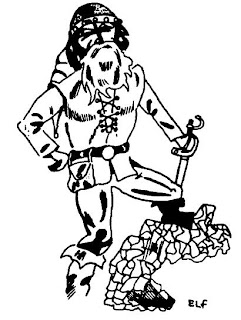
IT'S AN ELF! WITH A BEARD!!!
But you know, some things can earn you forgiveness for any misdeed. Case in point:

Ah, it was the 70s alright. God bless you, George Bell!
So that's Men & Magic. It's vague in places, and confusing in others, but it crams the entirety of character creation into under 40 pages. The rules are so open-ended and just begging for DM interpretation that I want to play it - it's exactly the antidote I need for 3e's heavily structured and codified style. More than a historical curio, Men & Magic is the Player's Handbook in it's most compact form, and everything that made the game awesome was here from the start.
I don't actually have a hard copy of this book. I'm working from a PDF of the Original Collector's Edition re-release, so if anything I say doesn't jibe with your own copy, that could be the where the discrepancy lies. And now, onward!
DUNGEONS & DRAGONS Volume 1 - MEN & MAGIC
by Gary Gygax and Dave Arneson

The original D&D boxed set is comprised of three booklets, each about 30 pages long. The first book, Men & Magic, is essentially what would later become the Player's Handbook. It contains everything you need to create a character, as well as a list of spells.
The initial impression that these books give is that of being gloriously unpolished. The cover is tan, with a servicable yet uncoloured picture of a warrior. And you have got to love the tag-line under the heading - "Rules for Fantastic Medieval Wargames Campaigns Playable with Paper and Pencil and Miniature Figures" It's a mouthful, and it's also something that would be anathema to a lot of gamers that I have met. But I love that in the olden days D&D wasn't trying to hide its war-gaming roots.
The book begins with an uh... 'Forward' that goes into a little of the history behind the game's development. It's a fascinating snippet that has kept would-be D&D historians chasing their tales for years. The gist of it is that a bunch of wargamers known as The Castle & Crusade Society (of which Gygax and Arneson were members) published their rules for medieval fantasy wargames as a supplement to the game Chainmail. Dave Arneson used the Chainmail rules to run a game where the players controlled one character instead of an army, and this became an ongoing campaign known as Blackmoor. Gary Gygax heard about the game, and from that he developed D&D.
This is followed by an introduction, which vaguely details what the game is about and what is involved. The requirements are pretty alien to me, it has to be said. Age level is given as 12 and up, which is probably fair enough - my friends and I started at 10 or so. The number of players is insane, though: "At least one referee and from four to fifty players can be handled in any single campaign..." Gygax ran a campaign where a lot of players were filtering through, forming various disparate groups all with him as the referee. I've never seen this type of game before, as every campaign I've ever been in has involved a solid group of 5 or 6 people that doesn't change much.
The recommended equipment is also important, as apparently you need a copy of Outdoor Survival (a game by Avalon Hill) and Chainmail, a medieval wargame designed by Gygax that was a sort of precursor to D&D. This is something of a fallacy - Chainmail is only necessary if you want more detailed combat rules, and Outdoor Survival is only needed for the game board, which can be used for ad hoc forays into the wilderness. I'll be covering both products in brief in the future, but for the moment they can be ignored.
And then we get to the important part: the rules. Even long-time D&D players will be surprised by what's here; or more accurately, what isn't here. For instance, there are only three classes: Fighting Man (no, not Fighter), Cleric and Magic-User. The Thief, normally considered to be one of the game's four essential classes, is nowhere to be seen.
The three classes are much the same as they were presented in later editions. Fighting Men have the pick of the crop when it comes to magic weapons, but use no spells. Magic-Users have a lot of spells, but can't use magic weapons or armour. Clerics fall sort of half-way, and use a different spell list then Magic-Users, more focused on healing. They can turn undead as well, with much the same rules as later editions. These classes run on strong archetypes, and they haven't changed much at all over the years.
Probably the most jarring change here is that every class rolls a d6 for hit points. The Fighting Man still gets the most, and the Magic-User the least, because the rate of progression is different for each class. It's a bit confusing, actually. At 1st level, the Fighting Man has 1+1 hit dice - he rolls a d6, and adds 1 to get his total. Then at 2nd level, the chart says he has 2 hit dice. Where does the extra +1 go? The chart is full of discrepancies like that. If I ever get to run this version of the game I'll be going with the interpretation that most favours the players. It's a deadly enough game as it is.
A lot of the class write-ups are dedicated to what happens when you build a stronghold and the like. I've never seen players get too involved with this stuff. There are also guidelines for Magic-Users to create magic items that are pretty useful in that they make simple items viable to create and powerful items not worth the time. It's exactly how I like my item creation rules.
It's interesting that at no point is there a list of what mundane weapons and armour the classes can use. We are told that Fighting Men can use all magical weapons, that Magic-Users can't use magic weapons and armour, and that Clerics can use magic armour but only non-edged magic weapons. By the book, the only restriction on normal weapons and armour is that Magic-Users can only use daggers. Otherwise, Magic-User in plate-mail? Done. Cleric with longsword? Go ahead. Presumably Gygax intended the restrictions on magic arms to include normal ones as well, but it's never explicitly spelled out.
The list of races available is similarly short compared to later editions, limited to Human, Dwarf, Elf, and Hobbit. Humans are the baseline, with no bonuses or limitations, but the other races get various abilities to set them apart. My PDF copy of the books has Halflings, but they were Hobbits in the earliest printings. Eventually the Tolkien Estate got wind of this, and the name was changed. Balrogs got excised from the game as well, and Ents became Treants.
Dwarves can only be Fighting-Men, may only progress to 6th level, and have a couple of other simple abilities related to finding stone traps and slanting passages. Hobbits are also limited to Fighting Man, and only 4th level at that! There's a certain level of veiled contempt in Gygax's writing whenever he refers to these little guys that I find amusing. He's on record as being no great fan of Lord of the Rings, and the Hobbit race was included apparently to attract Tolkien's many fans to the game.
Elves in D&D are a story all by themselves. They are Fighting Men and Magic-Users, but can only operate as one at a time in any adventure. How this is supposed to work is left as a mystery, explained in only the most vague and contradictory fashion. The best thing to do is probably to check the next version of the rules (the Holmes-edited Basic Set) and see how they did it. I would certainly be interested to know just how groups back then handled the elf, and how those interpretations differed from group to group.
Alignment is also much simpler than it later became. Your character can be Lawful, Neutral, or Chaotic. That's it, no mention of Good or Evil is made. Alignment seems less like a measure of your character's internal qualities, and more of an indicator of what side you are on in the cosmic struggle between Law and Chaos. That's not explicit, though. The idea of alignment is just thrown out there and abandoned, and it's up to the referee to decide what is done with it.
Finally we get to Ability Scores, and it's the classic array of six: Strength, Intelligence, Wisdom, Constitution, Dexterity and Charisma. Determination of these is brutal - you roll 3d6 in order - that is, first you roll for Strength, then for Intelligence, and so on down the line. But that's ok, because Ability Scores are nowhere near as important as they would later become. High Dexterity might give you a +1 to hit with missile weapons, and high Constitution gives you +1 hit points per level. Strength gives you no combat bonuses at all. Having a high score in the ability that's most important for your class lets you gain experience points faster. It's a refreshing change from the reliance on stats fostered by later editions. Besides, there are limited rules for raising scores by lowering others, so you can probably get the scores you need without a lot of difficulty.
Following a couple of pages on hiring NPCs and forcing monsters into service, there's a great section of PC relatives and rules for leaving them your stuff when you die. Not only that, but there are guidelines for what happens if the original character returns from the dead to claim his stuff! I can't wait to introduce this into a campaign.
Equipment is really basic, as you'd expect in a 36 page book. Nothing out of the ordinary in the list, and encumbrance gets only a cursory treatment. That's good - I've never paid too much attention to it anyway. Experience points also get the once-over, and it's interesting to see that XP gained is commensurate with the risks undertaken - a high level character on the first level of the dungeon gets very little. And in true bastard Gygax fashion, you can't get XP above a 1-for-1 basis, so if your 1st level Fighting Man somehow knocks over a dragon you're outta luck.
The combat system is the familiar one - you find your level on the chart, cross-index it with the target's AC, and find the number you need to hit on 1d20. That's how it worked until THAC0 came along, and even that was just a different expression of the same system. What you don't get is the details - there are no rules for initiative, or anything else. For that you need Chainmail. The biggest difference in combat is that every weapon deals 1d6 damage. A dagger does 1d6, a sword does 1d6, an axe does 1d6. It's great. I love the fact that any weapon attack can be deadly to a 1st level character. It would be hard for modern players to accept, though. They love their d12s. Also, death comes at 0 hit points. There's no hovering at death's door, you get pushed inside by a burly man with a pointed stick. PC fatalities must have been obscenely common.
The rest of the book is taken up by spells, and it's a damn good list. You won't find any of the named spells like Bigby's Crushing Hand, but you will find pretty much all the classics. Sleep, Charm Person, Fire Ball, Lightning Bolt. Cure Light Wounds. The only absolute D&D staple that is absent is Magic Missile. The Magic-User list only goes to level 6, and the Cleric list to level 5, but you could seriously run campaigns for years without ever expanding it. The loose spell descriptions are great as well. There are a lot of ways that a smart player could use them to his advantage, and I always like to see that.
Intriguingly, all spell-casters require spellbooks. That includes Clerics!
The art in these books, by George Bell, is infamous. To be honest, it's all bad, but there are some interesting pieces in Men & Magic. The bearded man standing next to a tree that comes up to his knee is nice, except that it is clearly labelled 'DWARF'. And what's wrong with the following picture?

IT'S AN ELF! WITH A BEARD!!!
But you know, some things can earn you forgiveness for any misdeed. Case in point:

Ah, it was the 70s alright. God bless you, George Bell!
So that's Men & Magic. It's vague in places, and confusing in others, but it crams the entirety of character creation into under 40 pages. The rules are so open-ended and just begging for DM interpretation that I want to play it - it's exactly the antidote I need for 3e's heavily structured and codified style. More than a historical curio, Men & Magic is the Player's Handbook in it's most compact form, and everything that made the game awesome was here from the start.
Saturday, January 26, 2008
Deconstructing the Pit Fiend
The Wizards of the Coast web-site has kindly provided us with another genuine 4th Edition preview. Last time it was the elf, and this time it's the Monster Manual entry for the Pit Fiend. I'm going to go through this sucker section by section, and extract as much game-systemy goodness as I'm able to.
Alright, this is all pretty sound, and has the Pit Fiend playing much the same role that it did in earlier editions. My only niggling complaint is the assertion that only the Archdevils stand higher than them - it's a constraint on future designers that seems unecessary. But, a minor one, so no big deal.
Now, on to the stats!
The top line defines the role that the monster is supposed to play in a combat. It's level 26, which normally means that it is an appropriate match for one 26th level PC. But a Pit Fiend is Elite, meaning that it is a match for two PCs. Monsters in 4e are apparently designed so that there will be one monster of equivalent level per PC. If a Pit Fiend is there, it counts for two, so ideally you'd face him and three other non-Elite 26th level guys.
The Pit Fiend's role is defined as a Soldier. This is the role that the monster is most effective in - other roles include Brute, Skirmisher, and Lurker. At my best guess, a soldier is most effective as a melee fighter with mostly defensive capabilities. But honestly, I don't know squat. The (Leader) after that is a mystery to me, although there is a Leader role defined for PCs that is for Clerics, and mostly about buffing other party members.
The Pit Fiend is Large, which probably means much the same as it did in 3e. It's type is defined as Immortal Humanoid (devil). This is a huge difference from what in 3e would have been an Outsider. I can only guess at what it means and what game effects it has.
And lastly there is XP, good old Experience Points. It wouldn't be D&D without 'em, and it warms my monster-killing heart to see the number right there in the stat-block.
Wow, by 3e standards the guy is fast with a +22 to Initiative. It can only be assumed that, in addition to Dexterity bonus, monsters get some sort of bonus tied to their level. The same is true of the Perception skill, the new combination of Spot and Listen. The formula seems to be half of the monster's level (+13) plus Wisdom modifier (+5) plus another 5 for being trained in the skill. At a guess. Plus, darkvision is still in. Sweet.
Auras! The aura 5 written first up seems to be range - ranges and distances in 4e are expressed in number of squares on the battlemat, which is something of a throwback to 1e giving them all in inches. Then we get a no-nonsense write-up of what the aura does. They're both nice, useful, and quite easy to remember. I'm not a big fan of the fixed damage on the fire aura, but if it speeds things up at the game table it's all good.
It looks as though Hit Dice are gone in favour of a flat hit point total. Blah. I liked having a defined upper and lower limit. The Bloodied condition is something that applies to creatures and characters when they hit half hit points. Some abilities only work on Bloodied creatures, and some monsters get abilities that only function once it is bloodied. I like it - it gives just a touch of realism to the abstract hit point system without losing the abstraction that is its greatest strength.
And here we have the mechanic that replaces saving throws. First we have Armor Class, which means exactly what it always has. Fortitude, Reflex and Will were formerly saving throws, shown as a bonus that was added to a d20 roll. Now they work like Armor Class - the opponent makes an attack roll against a static number. So, for example, if a dragon breathes fire at you it makes an attack against your Reflex defense.
I'm having a hard time coming around to this one, as the saving throw mechanic is deeply ingrained into my subconscious (just take a look at the blog title!). It's a good mechanic, and it will probably work very well with the much-vaunted new math that's underlying the system. It'll just take some getting used to. Kinda like how I missed telling players to Save vs. Death when 3e first appeared.
And yet, here are Saving Throws! Some detective work has revealed to me that there is a saving throw mechanic for ongoing effects in the D&D Miniatures game, used against ongoing effects like being set on fire. You roll 1d20, and if you get 11 or over, the effect ends. In that context, a +2 is pretty good.
The resistances to fire and poison show how much damage a round of the given type is ignored by the creature (unless there has been a big change from 3e). The interesting thing is that apparently there will be very few flat immunities in 4e. The example given was that a Fire Elemental can still be destroyed by a dragon's breath. Sounds weird to me, but I suppose I can go with it. For the Pit fiend these immunities are good ones.
Heh. That's about twice as fast as the average PC. Fleeing from this guy is going to be tough. I really like having the teleport ability, along with its range, right there.
Ah, Action Points. These pop up in a lot of other RPGs, and are generally used by characters to accomplish things that would be otherwise impossible. It's strange to see them in the hands of a monster.
I don't mind Action Points in the context of other RPGs, but to my mind they are the antithesis of D&D. I won't houserule them out, but I'll be paying a lot of attention to their effect on the game.
These are the two regular melee attacks that the Pit Fiend has. We start with the attack type (in this case melee), followed by the actual attack (flametouched mace and tail sting, respectively). In brackets we see what action type they are - both are Standard actions, which means you can move and use one of these in a round (though this could be different in 4e).
Both attacks are at-will, which references the new mechanic that 4e uses for attacks, spells and powers. Spells have undergone the biggest change here, with wizards no longer preparing a bunch of spells that can be cast once a day. Instead they get a host of powers, some usable at-will, some once per encounter, and some once per day. It's going to be one of the most jarring transitions, but if it stops parties from wanting to rest every couple of hours I'm all for it.
Both attacks then have their attack bonus, and the defense that they target, in this case AC. Hopefully this means that AC will be the default defense for melee attacks. Damage is next, and it really seems very low for such a high-level creature. Hopefully the Pit Fiend will make up for this with its special auras and abilities.
Then we get ongoing damage, and the indication that a successful save negates it. This backs up the saving throw mechanic I mentioned earlier. I like it - having to track a lot of durations could become a pain in the arse. And anything that keeps a downed player involved is good - the chance to shake of paralysis every round, for instance.
The tail sting gets a follow-up attack, and this is the replacement for the Saving Throw. It targets Fortitude, deals poison damage, and weakens the target. The poison damage is the interesting part. It presumably comes of regular hit points, and not ability scores like 3e. That's good - tracking ability score changes in-game is also a pain in the arse. It also seems that Wizards were dead serious about getting rid of save or die effects. That's good for players, but I'll miss having a PCs fate hinge on a single dice roll.
It should also be noted that the Flametouched Mace has a Reach of 2 squares, while the tail does not. This is good; hopefully it will curtail idiocy such as trolls biting characters from ten feet away.
This is bizarre. It's an ability which lets the Pit Fiend make its mace and tail attacks in a single action. Useful, but I'm mystified as to why it's listed separately from the other attacks.
Now we get a ranged attack, one that seriously knocks the target's defenses down for a short time. The major difference here to the other attacks is that it is a Minor Action. I'm not sure how this will work, but it's probable that they take up less time than a Standard Action. Perhaps it's one Standard, one Minor, and one Move per round?
Ahahaha! That's hilarious. My players will freak out when I bust this one on them. It seems especially effective when combined with...
Nice. Gating in other devils was always the iconic feature of a devil encounter, and it had to stay in. And now, if those devils are too weak to properly challenge the party, their boss can just blow 'em up. Note that this is an Encounter power - that means it can be done once per combat.
This is a good ability for a mastermind-type baddie. If the Pit Fiend is ever cornered by the PCs, it has instant backup. I'm not sure what recharge 456 means - possibly you roll 1d6, and the ability returns on those numbers?
Alignment is getting a major overhaul. Creatures can now be unaligned, for one thing. Devils used to be Lawful Evil, now they're just Evil. It's hard to say what this means without seeing the whole system, but it looks like the two-axis system is gone, and monsters have just one alignment. If it destroys alignment arguments, that is great.
Supernal is a new language. Devils used to speak Infernal. Supernal doesn't sound nearly as cool. I'd lay money that it can be understood by anyone.
Surprisingly, Bluff and Intimidate have survived unscathed. They're good skills for a master of devilish deception, for sure. Religion is the renamed Knowledge (religion), and it looks like they've folded it together with Knowledge (the planes). Good move - gods and the planes are pretty synonymous in D&D.
Stats and their bonuses. Fear not, those aren't ridiculously high stat modifiers - those are the numbers for when a Pit Fiend attempts a skill untrained. If it wants to Jump a pit, it gets a +24 bonus. If the formula used is half of the monster's level plus the stat modifier, then the mods haven't changed since 3e. Huzzah!
I love the signet ring. It adds a lot of character to the devils and their hierarchy. But where is that breastplate mentioned above?
So on the first round we've got one Standard Action, one Minor Action, another Standard Action, and another Minor Action. Presumably that Action Point is used to make the first action count for free, which leaves us with one Standard and two Minor. That sounds reasonable.
I like that it is spelled out that the devil isn't there to fight to the death. It's often really easy to forget that monsters have their own lives, and aren't just there to fight the PCs.
Brilliant. These were provided late in 3e development, and they are highly welcome. Deciding what the PCs actually know about certain monsters is always difficult. Having a numerical guide right there is really helpful.
So that is it, the new Pit Fiend. It certainly looks a lot easier to run than the 3e version. That one has a whole lot of spell-like abilities. They give thew creature a greater tactical range, but to be honest they're never going to see use in the average game. The new version is streamlined, flavourful, and looks like a challenging fight. Chalk up another win for 4e - I'm really coming round here!
PIT FIEND
Nobles of the Nine Hells, pit fiends form an elite ruling class that oversees vast numbers of lesser devils. Only the archdevils known as the Lords of the Nine stand higher than the pit fiends.
Each pit fiend is lord of a large domain within one of the layers of the Nine Hells and is vassal to the archdevil who rules that layer. A pit fiend might govern a city, command a fortress, lead a great legion, or serve as a seneschal or counselor for an archdevil. With the exception of Asmodeus, each Lord of the Nine commands no more than a dozen or so pit fiends.
As the lords, barons, viziers, and generals of the Nine Hells, pit fiends rarely confront adventurers in person. They are the progenitors of devilish schemes, and they step in only when important plans go awry or when great plots reach fruition. In the Nine Hells proper, pit fiends command vast numbers of lesser devils. Penetrating the defenses of a pit fiend's castle and destroying the mighty devil in its own demesne is a deed of truly epic proportions.
Description
This hulking devil stands 12 feet tall and has red scales, leathery wings, and a long whiplike tail. It carries a massive mace and wears an ornate breastplate decorated with evil runes and symbols.
Alright, this is all pretty sound, and has the Pit Fiend playing much the same role that it did in earlier editions. My only niggling complaint is the assertion that only the Archdevils stand higher than them - it's a constraint on future designers that seems unecessary. But, a minor one, so no big deal.
Now, on to the stats!
Pit Fiend Level 26 Elite Soldier (Leader)
Large immortal humanoid (devil) XP 18,000
The top line defines the role that the monster is supposed to play in a combat. It's level 26, which normally means that it is an appropriate match for one 26th level PC. But a Pit Fiend is Elite, meaning that it is a match for two PCs. Monsters in 4e are apparently designed so that there will be one monster of equivalent level per PC. If a Pit Fiend is there, it counts for two, so ideally you'd face him and three other non-Elite 26th level guys.
The Pit Fiend's role is defined as a Soldier. This is the role that the monster is most effective in - other roles include Brute, Skirmisher, and Lurker. At my best guess, a soldier is most effective as a melee fighter with mostly defensive capabilities. But honestly, I don't know squat. The (Leader) after that is a mystery to me, although there is a Leader role defined for PCs that is for Clerics, and mostly about buffing other party members.
The Pit Fiend is Large, which probably means much the same as it did in 3e. It's type is defined as Immortal Humanoid (devil). This is a huge difference from what in 3e would have been an Outsider. I can only guess at what it means and what game effects it has.
And lastly there is XP, good old Experience Points. It wouldn't be D&D without 'em, and it warms my monster-killing heart to see the number right there in the stat-block.
Initiative +22 Senses Perception +23; darkvision
Wow, by 3e standards the guy is fast with a +22 to Initiative. It can only be assumed that, in addition to Dexterity bonus, monsters get some sort of bonus tied to their level. The same is true of the Perception skill, the new combination of Spot and Listen. The formula seems to be half of the monster's level (+13) plus Wisdom modifier (+5) plus another 5 for being trained in the skill. At a guess. Plus, darkvision is still in. Sweet.
Aura of Fear (Fear) aura 5; enemies in the aura take a –2 penalty on attack rolls.
Aura of Fire (Fire) aura 5; enemies that enter or start their turns in the aura take 15 fire damage.
Auras! The aura 5 written first up seems to be range - ranges and distances in 4e are expressed in number of squares on the battlemat, which is something of a throwback to 1e giving them all in inches. Then we get a no-nonsense write-up of what the aura does. They're both nice, useful, and quite easy to remember. I'm not a big fan of the fixed damage on the fire aura, but if it speeds things up at the game table it's all good.
HP 350; Bloodied 175
It looks as though Hit Dice are gone in favour of a flat hit point total. Blah. I liked having a defined upper and lower limit. The Bloodied condition is something that applies to creatures and characters when they hit half hit points. Some abilities only work on Bloodied creatures, and some monsters get abilities that only function once it is bloodied. I like it - it gives just a touch of realism to the abstract hit point system without losing the abstraction that is its greatest strength.
AC 44; Fortitude 42, Reflex 38, Will 40
And here we have the mechanic that replaces saving throws. First we have Armor Class, which means exactly what it always has. Fortitude, Reflex and Will were formerly saving throws, shown as a bonus that was added to a d20 roll. Now they work like Armor Class - the opponent makes an attack roll against a static number. So, for example, if a dragon breathes fire at you it makes an attack against your Reflex defense.
I'm having a hard time coming around to this one, as the saving throw mechanic is deeply ingrained into my subconscious (just take a look at the blog title!). It's a good mechanic, and it will probably work very well with the much-vaunted new math that's underlying the system. It'll just take some getting used to. Kinda like how I missed telling players to Save vs. Death when 3e first appeared.
Resist 30 fire, 15 poison
Saving Throws +2
And yet, here are Saving Throws! Some detective work has revealed to me that there is a saving throw mechanic for ongoing effects in the D&D Miniatures game, used against ongoing effects like being set on fire. You roll 1d20, and if you get 11 or over, the effect ends. In that context, a +2 is pretty good.
The resistances to fire and poison show how much damage a round of the given type is ignored by the creature (unless there has been a big change from 3e). The interesting thing is that apparently there will be very few flat immunities in 4e. The example given was that a Fire Elemental can still be destroyed by a dragon's breath. Sounds weird to me, but I suppose I can go with it. For the Pit fiend these immunities are good ones.
Speed 12, fly 12 (clumsy), teleport 10
Heh. That's about twice as fast as the average PC. Fleeing from this guy is going to be tough. I really like having the teleport ability, along with its range, right there.
Action Points 1
Ah, Action Points. These pop up in a lot of other RPGs, and are generally used by characters to accomplish things that would be otherwise impossible. It's strange to see them in the hands of a monster.
I don't mind Action Points in the context of other RPGs, but to my mind they are the antithesis of D&D. I won't houserule them out, but I'll be paying a lot of attention to their effect on the game.
Melee Flametouched Mace (standard; at-will) • Fire, WeaponReach 2; +31 vs. AC; 1d12+11 fire damage plus ongoing 5 fire damage (save ends).
Melee Tail Sting (standard; at-will) • Poison+31 vs. AC; 1d6+11 damage, and the pit fiend may make a free followup attack. Followup: +29 vs. Fortitude; ongoing 15 poison damage, and the target is weakened (save ends both effects).
These are the two regular melee attacks that the Pit Fiend has. We start with the attack type (in this case melee), followed by the actual attack (flametouched mace and tail sting, respectively). In brackets we see what action type they are - both are Standard actions, which means you can move and use one of these in a round (though this could be different in 4e).
Both attacks are at-will, which references the new mechanic that 4e uses for attacks, spells and powers. Spells have undergone the biggest change here, with wizards no longer preparing a bunch of spells that can be cast once a day. Instead they get a host of powers, some usable at-will, some once per encounter, and some once per day. It's going to be one of the most jarring transitions, but if it stops parties from wanting to rest every couple of hours I'm all for it.
Both attacks then have their attack bonus, and the defense that they target, in this case AC. Hopefully this means that AC will be the default defense for melee attacks. Damage is next, and it really seems very low for such a high-level creature. Hopefully the Pit Fiend will make up for this with its special auras and abilities.
Then we get ongoing damage, and the indication that a successful save negates it. This backs up the saving throw mechanic I mentioned earlier. I like it - having to track a lot of durations could become a pain in the arse. And anything that keeps a downed player involved is good - the chance to shake of paralysis every round, for instance.
The tail sting gets a follow-up attack, and this is the replacement for the Saving Throw. It targets Fortitude, deals poison damage, and weakens the target. The poison damage is the interesting part. It presumably comes of regular hit points, and not ability scores like 3e. That's good - tracking ability score changes in-game is also a pain in the arse. It also seems that Wizards were dead serious about getting rid of save or die effects. That's good for players, but I'll miss having a PCs fate hinge on a single dice roll.
It should also be noted that the Flametouched Mace has a Reach of 2 squares, while the tail does not. This is good; hopefully it will curtail idiocy such as trolls biting characters from ten feet away.
Melee Pit Fiend Frenzy (standard; at-will)
The pit fiend makes a flametouched mace attack and a tail sting attack.
This is bizarre. It's an ability which lets the Pit Fiend make its mace and tail attacks in a single action. Useful, but I'm mystified as to why it's listed separately from the other attacks.
Ranged Point of Terror (minor; at-will) • Fear
Range 5; +30 vs. Will; the target takes a –5 penalty to all defenses until the end of the pit fiend's next turn.
Now we get a ranged attack, one that seriously knocks the target's defenses down for a short time. The major difference here to the other attacks is that it is a Minor Action. I'm not sure how this will work, but it's probable that they take up less time than a Standard Action. Perhaps it's one Standard, one Minor, and one Move per round?
Ranged Irresistible Command (minor 1/round; at-will) • Charm, Fire
Range 10; affects one allied devil of lower level than the pit fiend; the target immediately slides up to 5 squares and explodes, dealing 2d10+5 fire damage to all creatures in a close burst 2. The exploding devil is destroyed.
Ahahaha! That's hilarious. My players will freak out when I bust this one on them. It seems especially effective when combined with...
Infernal Summons (standard; encounter) • ConjurationThe pit fiend summons a group of devil allies. Summoned devils roll initiative to determine when they act in the initiative order and gain a +4 bonus to attack rolls as long as the pit fiend is alive. They remain until they are killed, dismissed by the pit fiend (free action), or the encounter ends. PCs do not earn experience points for killing these summoned creatures. The pit fiend chooses to summon one of the following groups of devils:
8 legion devil legionnaires (level 21), or
2 war devils (level 22), or
1 war devil (level 22) and 4 legion devil legionnaires (level 21)
Nice. Gating in other devils was always the iconic feature of a devil encounter, and it had to stay in. And now, if those devils are too weak to properly challenge the party, their boss can just blow 'em up. Note that this is an Encounter power - that means it can be done once per combat.
Tactical Teleport (standard; recharge 4 5 6) • Teleportation
The pit fiend can teleport up to 2 allies within 10 squares of it. The targets appear in any other unoccupied squares within 10 squares of the pit fiend.
This is a good ability for a mastermind-type baddie. If the Pit Fiend is ever cornered by the PCs, it has instant backup. I'm not sure what recharge 456 means - possibly you roll 1d6, and the ability returns on those numbers?
Alignment Evil
Languages Supernal
Alignment is getting a major overhaul. Creatures can now be unaligned, for one thing. Devils used to be Lawful Evil, now they're just Evil. It's hard to say what this means without seeing the whole system, but it looks like the two-axis system is gone, and monsters have just one alignment. If it destroys alignment arguments, that is great.
Supernal is a new language. Devils used to speak Infernal. Supernal doesn't sound nearly as cool. I'd lay money that it can be understood by anyone.
Skills Bluff +27, Intimidate +27, Religion +24
Surprisingly, Bluff and Intimidate have survived unscathed. They're good skills for a master of devilish deception, for sure. Religion is the renamed Knowledge (religion), and it looks like they've folded it together with Knowledge (the planes). Good move - gods and the planes are pretty synonymous in D&D.
Str 32 (+24) Dex 24 (+20) Wis 20 (+18)
Con 27 (+21) Int 22 (+19) Cha 28 (+22)
Stats and their bonuses. Fear not, those aren't ridiculously high stat modifiers - those are the numbers for when a Pit Fiend attempts a skill untrained. If it wants to Jump a pit, it gets a +24 bonus. If the formula used is half of the monster's level plus the stat modifier, then the mods haven't changed since 3e. Huzzah!
Equipment flametouched mace, noble signet ring
I love the signet ring. It adds a lot of character to the devils and their hierarchy. But where is that breastplate mentioned above?
Pit Fiend Tactics
A pit fiend fights close to its enemies, catching them in its aura of fear and aura of fire. On the first round of combat, it spends an action point to use infernal summons. It then uses point of terror against a tough-looking foe and tactical teleport to place two allies in flanking positions around that foe. With its remaining minor action, the pit fiend uses irresistible command on an ally within range.
So on the first round we've got one Standard Action, one Minor Action, another Standard Action, and another Minor Action. Presumably that Action Point is used to make the first action count for free, which leaves us with one Standard and two Minor. That sounds reasonable.
A pit fiend alternates between point of terror and irresistible command, sometimes using both if it has a spare move action it can replace with a minor action. Otherwise, the pit fiend uses pit fiend frenzy, teleporting as needed to gain a better position.
A pit fiend does not sacrifice its life needlessly and makes a tactical retreat if death is imminent.
I like that it is spelled out that the devil isn't there to fight to the death. It's often really easy to forget that monsters have their own lives, and aren't just there to fight the PCs.
Pit Fiend Lore
A character knows the following information with a successful Religion check:
DC 25: Pit fiends are the nobles of the Nine Hells. Each pit fiend serves as a vassal to one of the nine archdevils and commands a fortress, city, or army in its master's domain.
DC 30: Once every 99 years, a pit fiend can grant a mortal's wish by performing a terrible ritual. Only the most powerful and promising of mortals are offered such a temptation.
DC 35: Well-known pit fiends include Baalzephon, one of the powerful circle of pit fiends known as the Dark Eight; Gazra, who governs the city of Abriymoch in Phlegethos, the Fourth Hell; and Baalberith, the major-domo of the palace of Asmodeus.
Brilliant. These were provided late in 3e development, and they are highly welcome. Deciding what the PCs actually know about certain monsters is always difficult. Having a numerical guide right there is really helpful.
So that is it, the new Pit Fiend. It certainly looks a lot easier to run than the 3e version. That one has a whole lot of spell-like abilities. They give thew creature a greater tactical range, but to be honest they're never going to see use in the average game. The new version is streamlined, flavourful, and looks like a challenging fight. Chalk up another win for 4e - I'm really coming round here!
Tuesday, January 22, 2008
Play Report: The Fountain of the Earth
My monthly D&D group got together over the weekend to game. We had a fairly fun session, but the enjoyment was lessened a bit due to a spate of untimely deaths. Three deaths in one night is a lot by my standards, and I can't say that I enjoyed them.
The PCs at the beginning of the game were Gordred (a human ranger 6), Elrohir (an elf fighter 3/wizard 2), Qwan (a human fighter 5), and Kael (a dwarf barbarian 5). Needless to say, this is a party with a heavy focus on melee combat. It's a deficiency that I feel like I have to design around, because the game isn't at its best when the party has no access to healing magic. I had a fix for it that I'll talk about below, but it didn't stop characters from dying anyway!
The game started where we had left off last time, with the PCs accusing their nemesis Elmyr of attacking them in a ruined temple and making off with a valuable golden statue. Elmyr is the best hunter in the PCs' home base, and he's got a lot of influence. Corwyn, Bastion's leader, was reluctant to go along with the plan, which was to make Elmyr enter a zone of truth spell cast by the town's cleric. We role-played this out for a while, until I had Elmyr agree to the terms, on one condition: Gordred had to enter the zone after Elmyr was done, and answer some questions. Elmyr also wanted to wander off alone for an hour (and I had something shifty planned that I can't talk about in case my players are reading) but the guys were smart enough to keep an eye on him. Next time...
Zone of truth is a pretty handy spell. I pulled it out to good effect in one of my rare forays as a player, and it's one of the few non-combat spells that my players have remembered. The saving throw is its one weak point, and I was relieved to discover that the caster doesn't detect when victims make their saving throws, because it is an area effect. There is one point where Third Edition has made my life easier, for sure!
Elmyr made it through his trial with ease, denying every accusation the PCs hurled at him. Did he make his saving throw? Was he telling the truth or not? Needless to say, I won't be revealing that here! Gordred's time in the zone was also without incident - he made the saving throw and was able to deny poisoning Elmyr. So, a potential major turning point for the campaign was avoided. Things could have gotten downright ugly in Bastion if results had been different, but that's the biggest strength that RPGs have got compared to other game forms - genuine consequences.
I have to say, it was fun to start the game with genuinely important NPC interaction. Very few of the NPCs in this campaign have had an effect on the actions of the PCs, apart from sending them on quests and such. We usually begin things in Bastion, and most of the time that involves talking to NPCs, but this was more fun because of the potential for things to come to a head. The PCs really wanted to catch Elmyr, and he really wanted to catch them as well. It's great when an NPC elicits that reaction, and I've only ever had one that was more hated (but Henri DuBont is a tale for another time).
The next part of the game was the more traditional quest structure. As the trial finished up, the local druid Arrek arrived back at Bastion, weak from a savage disease. He had left the town weeks ago, seeking some aid in the forest against the army of orcs that was approaching. Now he was back, telling the PCs that they had to cleanse the Fountain of the Earth to gain the forest's aid.
There's a bit of backstory here. The Fountain of the Earth was the only thing keeping the forest clinging to life without the sun (see my previous Play Report for the low-down). Centuries ago during the War of Nightfall, a great demon known as the Ravager of Souls was defeated by the elves of the forest, and fell back to be impaled on the fountain. The demon still lives on in agony, its blood running with the fountain and polluting the land. So, of course, the PCs have got to fix everything to get the forest on their side.
At this point I had the druid give the PCs a wand of cure light wounds. The last session saw the PCs running from the dungeon back home to heal, like a pack of sissies. It really annoyed me, so I thought I'd provide them with some healing ability of their own. I'm soft, really. Funnily enough, I think it might have contributed to some of the deaths. The guys got a bit confident with some healing at the ready, and probably rushed into some situations they otherwise might not have.
Following a map provided by the druid, the PCs ventured off to his grove. They encountered some elves there, bloodthirsty worshippers of the Ravager, and the first battle of the night got underway. The elves were pushovers, despite me giving them a form of true strike - their first attack in any combat had a +20 to the attack roll, guaranteeing them a hit unless they fumbled. They weren't the problem, though, as they only had 8 hit points each. It was the evil Blink Dogs. I gave the bastards 2d6 worth of Sneak Attack, and it was brutal. A Blink Dog's opponent is always flat-footed, so it was 3d6 on every hit (until we remembered that some of the guys had Uncanny Dodge!). Qwan was dropped below 0 at least twice, and it may even have been a third time - the poor guy kept getting healed, then knocked out again. The elves were killed pretty quickly, but only two of the Blink Dogs died - the other two escaped, and would come back to haunt the party later on.
After a quick search the PCs discovered some notes telling them that they needed a magic emerald held by the elves to cleanse the fountain. Two groups of elves were indicated on the map, but some convenient bloodstains obscured the pertinent clues. The guys worked out that one of the clues said 'Evil Beware', and interpreted this to mean that evil should beware. I had meant it the other way around (beware of evil), and it never even occurred to me that there was another interpretation! So they headed off in this direction, which was a big mistake.
At this point a couple of other players arrived - Quinlan (a halfling rogue 2/fighter 2) and Heidi (a dwarf cleric 4). I decided that these guys had been hanging with the druid before he was driven from the area, so I gave Quinlan the clue that the elves the party were heading for were bad news. The player decided not to tell anyone else, because he was itching for a battle to start off his game. They can't say I didn't give them fair warning!
The elven 'village' was nothing more than a massive tree with a lot of earthen mounds around it. The lake beyond featured an island with a green glow, and from that island could be heard screaming - the fountain, and the Ravager. They waltzed into town, little realising that it was fully inhabited (to be honest, I probably should have shown a few more signs of life). One failed Move Silently check, and the elves were alerted.
The elves burst from the mounds, eight of them to begin with, and a few more popped up with each round. I'd written this encounter to contain some 40 elves or so, thinking that the PCs would retreat as the numbers started increasing. I should have known better - I can count on the fingers of one hand the number of times that I've seen D&D players retreat. I stopped adding guys at about 15, and that was plenty - especially when the two escaped Blink Dogs returned to the fray.
First Qwan went down to a Blink Dog. He got healed up, then he got knocked down again - all the way dead this time. I wasn't too phased by this one - the player (Dean) has a habit of losing characters, and this guy was only a couple of sessions old.
The second character to die was Quinlan, whittled away by elven archer fire (true striking on the first round, remember), and finally succumbing to those damned Blink Dogs again. This was a real shame, because the player (Aaron) had only arrived about an hour before that, for his first session in months. This character had a monumental Armor Class at lower levels, and this was the first time he'd been knocked below 0 hit points.
The other guys polished off the elves and the dogs, but it was in the balance for a while there. I probably would have had them captured if everyone was knocked out, but they managed to win through, and healed up courtesy of the wand of cure light wounds. It had started with 50 charges, and now it had 15 remaining.
The remaining party members explored the top of the tree, and there they met Min-Mordath, king of the elves and thrall of the Ravager. I learned an important lesson here - it doesn't matter what level a wizard is, he's going down to a party if he fights them alone. My original plan was to give this guy fire shield, but after decimating the party in the battle before I relented. I shouldn't have, because they wiped him out in two rounds. I was just itching to have him knock a character from the top of the tree with his ram's-horn staff, too...
That staff turned out to be housing the emerald the guys needed, so they hopped on a nearby boat and headed for the green-glowing island. Sure enough, there was the Ravager of Souls, impaled on the fountain and screaming in pain. There was a cave the PCs had to run into, avoiding the Ravager's devastating attacks. At this point I relented some more - I'd planned for there to be three entrances, and for the party to have to run from one to the other a few times. Instead I dispensed with three potentially tough encounters, as well as the possibility of more attacks from the Ravager, and proceeded to the end-game.
The PCs reached the heart of the Fountain, and the emerald started telling Elrohir to use his will to control its flow. He did so, requiring three consecutive DC 20 Will saves to increase it to the point where the Ravager would be destroyed. At that point four elven clerics crawled out of holes in the ground for the climactic encounter. I didn't think they'd be so tough, and to be honest I'd planned for there to be more of them. But with a depleted party, I stuck with one for each character. It was enough, because Kael and Gordred got hit with hold person spells early on. Gordred got stabbed in the throat with a poisoned dagger, and that was it for him - he failed the Fortitude save for the coup de grace.
This death hurt, I have to say. The character had been there from the beginning, and was probably my favourite one of the campaign. He'd certainly been the driving force behind Elmyr becoming a major villain, and now I'm certain that NPC won't have anywhere near the effect that he had before. I hate killing good long-term characters, and unfortunately I've set this area of the campaign up so that raise dead isn't available.
With half the party out, and Elrohir rolling really badly on his Will saves, I fudged it so he'd only need to make a single Will save. It took him a good five or six rounds to get it, and all four of the clerics were still up and about. But he succeeded eventually, the Ravager was destroyed, and the clerics died with their master.
The game was fun, and a good change of pace. I'd been running mostly dungeoncrawls for the last few sessions, so I sent the PCs into the forest for a change of pace. The difference was noticeable, and I need to stop relying on dungeons so much. They're easy to design and run, but the game gets stale with too many.
The next game is going to interesting. There will be a few new characters, and that always shifts the dynamic around. I'm hoping for a few more spellcasters, but I doubt that will happen - I seem to have attracted a group of melee-fiends. I must remember to have the NPCs react differently to them - sometimes it's easy to forget that a player isn't using the same guy. The game continuity will suffer a little, because I was planning on having the guys take a major hand in fighting the orcs once they arrive. They'll still do that I guess, but they might have to earn Bastion's trust a little before getting any authority. What I have to keep telling myself is not to go easy on them just because I killed a few characters. It's tempting to offer them a cakewalk, but I'll try not to. A D&D game without challenge is pretty pointless, really.
The PCs at the beginning of the game were Gordred (a human ranger 6), Elrohir (an elf fighter 3/wizard 2), Qwan (a human fighter 5), and Kael (a dwarf barbarian 5). Needless to say, this is a party with a heavy focus on melee combat. It's a deficiency that I feel like I have to design around, because the game isn't at its best when the party has no access to healing magic. I had a fix for it that I'll talk about below, but it didn't stop characters from dying anyway!
The game started where we had left off last time, with the PCs accusing their nemesis Elmyr of attacking them in a ruined temple and making off with a valuable golden statue. Elmyr is the best hunter in the PCs' home base, and he's got a lot of influence. Corwyn, Bastion's leader, was reluctant to go along with the plan, which was to make Elmyr enter a zone of truth spell cast by the town's cleric. We role-played this out for a while, until I had Elmyr agree to the terms, on one condition: Gordred had to enter the zone after Elmyr was done, and answer some questions. Elmyr also wanted to wander off alone for an hour (and I had something shifty planned that I can't talk about in case my players are reading) but the guys were smart enough to keep an eye on him. Next time...
Zone of truth is a pretty handy spell. I pulled it out to good effect in one of my rare forays as a player, and it's one of the few non-combat spells that my players have remembered. The saving throw is its one weak point, and I was relieved to discover that the caster doesn't detect when victims make their saving throws, because it is an area effect. There is one point where Third Edition has made my life easier, for sure!
Elmyr made it through his trial with ease, denying every accusation the PCs hurled at him. Did he make his saving throw? Was he telling the truth or not? Needless to say, I won't be revealing that here! Gordred's time in the zone was also without incident - he made the saving throw and was able to deny poisoning Elmyr. So, a potential major turning point for the campaign was avoided. Things could have gotten downright ugly in Bastion if results had been different, but that's the biggest strength that RPGs have got compared to other game forms - genuine consequences.
I have to say, it was fun to start the game with genuinely important NPC interaction. Very few of the NPCs in this campaign have had an effect on the actions of the PCs, apart from sending them on quests and such. We usually begin things in Bastion, and most of the time that involves talking to NPCs, but this was more fun because of the potential for things to come to a head. The PCs really wanted to catch Elmyr, and he really wanted to catch them as well. It's great when an NPC elicits that reaction, and I've only ever had one that was more hated (but Henri DuBont is a tale for another time).
The next part of the game was the more traditional quest structure. As the trial finished up, the local druid Arrek arrived back at Bastion, weak from a savage disease. He had left the town weeks ago, seeking some aid in the forest against the army of orcs that was approaching. Now he was back, telling the PCs that they had to cleanse the Fountain of the Earth to gain the forest's aid.
There's a bit of backstory here. The Fountain of the Earth was the only thing keeping the forest clinging to life without the sun (see my previous Play Report for the low-down). Centuries ago during the War of Nightfall, a great demon known as the Ravager of Souls was defeated by the elves of the forest, and fell back to be impaled on the fountain. The demon still lives on in agony, its blood running with the fountain and polluting the land. So, of course, the PCs have got to fix everything to get the forest on their side.
At this point I had the druid give the PCs a wand of cure light wounds. The last session saw the PCs running from the dungeon back home to heal, like a pack of sissies. It really annoyed me, so I thought I'd provide them with some healing ability of their own. I'm soft, really. Funnily enough, I think it might have contributed to some of the deaths. The guys got a bit confident with some healing at the ready, and probably rushed into some situations they otherwise might not have.
Following a map provided by the druid, the PCs ventured off to his grove. They encountered some elves there, bloodthirsty worshippers of the Ravager, and the first battle of the night got underway. The elves were pushovers, despite me giving them a form of true strike - their first attack in any combat had a +20 to the attack roll, guaranteeing them a hit unless they fumbled. They weren't the problem, though, as they only had 8 hit points each. It was the evil Blink Dogs. I gave the bastards 2d6 worth of Sneak Attack, and it was brutal. A Blink Dog's opponent is always flat-footed, so it was 3d6 on every hit (until we remembered that some of the guys had Uncanny Dodge!). Qwan was dropped below 0 at least twice, and it may even have been a third time - the poor guy kept getting healed, then knocked out again. The elves were killed pretty quickly, but only two of the Blink Dogs died - the other two escaped, and would come back to haunt the party later on.
After a quick search the PCs discovered some notes telling them that they needed a magic emerald held by the elves to cleanse the fountain. Two groups of elves were indicated on the map, but some convenient bloodstains obscured the pertinent clues. The guys worked out that one of the clues said 'Evil Beware', and interpreted this to mean that evil should beware. I had meant it the other way around (beware of evil), and it never even occurred to me that there was another interpretation! So they headed off in this direction, which was a big mistake.
At this point a couple of other players arrived - Quinlan (a halfling rogue 2/fighter 2) and Heidi (a dwarf cleric 4). I decided that these guys had been hanging with the druid before he was driven from the area, so I gave Quinlan the clue that the elves the party were heading for were bad news. The player decided not to tell anyone else, because he was itching for a battle to start off his game. They can't say I didn't give them fair warning!
The elven 'village' was nothing more than a massive tree with a lot of earthen mounds around it. The lake beyond featured an island with a green glow, and from that island could be heard screaming - the fountain, and the Ravager. They waltzed into town, little realising that it was fully inhabited (to be honest, I probably should have shown a few more signs of life). One failed Move Silently check, and the elves were alerted.
The elves burst from the mounds, eight of them to begin with, and a few more popped up with each round. I'd written this encounter to contain some 40 elves or so, thinking that the PCs would retreat as the numbers started increasing. I should have known better - I can count on the fingers of one hand the number of times that I've seen D&D players retreat. I stopped adding guys at about 15, and that was plenty - especially when the two escaped Blink Dogs returned to the fray.
First Qwan went down to a Blink Dog. He got healed up, then he got knocked down again - all the way dead this time. I wasn't too phased by this one - the player (Dean) has a habit of losing characters, and this guy was only a couple of sessions old.
The second character to die was Quinlan, whittled away by elven archer fire (true striking on the first round, remember), and finally succumbing to those damned Blink Dogs again. This was a real shame, because the player (Aaron) had only arrived about an hour before that, for his first session in months. This character had a monumental Armor Class at lower levels, and this was the first time he'd been knocked below 0 hit points.
The other guys polished off the elves and the dogs, but it was in the balance for a while there. I probably would have had them captured if everyone was knocked out, but they managed to win through, and healed up courtesy of the wand of cure light wounds. It had started with 50 charges, and now it had 15 remaining.
The remaining party members explored the top of the tree, and there they met Min-Mordath, king of the elves and thrall of the Ravager. I learned an important lesson here - it doesn't matter what level a wizard is, he's going down to a party if he fights them alone. My original plan was to give this guy fire shield, but after decimating the party in the battle before I relented. I shouldn't have, because they wiped him out in two rounds. I was just itching to have him knock a character from the top of the tree with his ram's-horn staff, too...
That staff turned out to be housing the emerald the guys needed, so they hopped on a nearby boat and headed for the green-glowing island. Sure enough, there was the Ravager of Souls, impaled on the fountain and screaming in pain. There was a cave the PCs had to run into, avoiding the Ravager's devastating attacks. At this point I relented some more - I'd planned for there to be three entrances, and for the party to have to run from one to the other a few times. Instead I dispensed with three potentially tough encounters, as well as the possibility of more attacks from the Ravager, and proceeded to the end-game.
The PCs reached the heart of the Fountain, and the emerald started telling Elrohir to use his will to control its flow. He did so, requiring three consecutive DC 20 Will saves to increase it to the point where the Ravager would be destroyed. At that point four elven clerics crawled out of holes in the ground for the climactic encounter. I didn't think they'd be so tough, and to be honest I'd planned for there to be more of them. But with a depleted party, I stuck with one for each character. It was enough, because Kael and Gordred got hit with hold person spells early on. Gordred got stabbed in the throat with a poisoned dagger, and that was it for him - he failed the Fortitude save for the coup de grace.
This death hurt, I have to say. The character had been there from the beginning, and was probably my favourite one of the campaign. He'd certainly been the driving force behind Elmyr becoming a major villain, and now I'm certain that NPC won't have anywhere near the effect that he had before. I hate killing good long-term characters, and unfortunately I've set this area of the campaign up so that raise dead isn't available.
With half the party out, and Elrohir rolling really badly on his Will saves, I fudged it so he'd only need to make a single Will save. It took him a good five or six rounds to get it, and all four of the clerics were still up and about. But he succeeded eventually, the Ravager was destroyed, and the clerics died with their master.
The game was fun, and a good change of pace. I'd been running mostly dungeoncrawls for the last few sessions, so I sent the PCs into the forest for a change of pace. The difference was noticeable, and I need to stop relying on dungeons so much. They're easy to design and run, but the game gets stale with too many.
The next game is going to interesting. There will be a few new characters, and that always shifts the dynamic around. I'm hoping for a few more spellcasters, but I doubt that will happen - I seem to have attracted a group of melee-fiends. I must remember to have the NPCs react differently to them - sometimes it's easy to forget that a player isn't using the same guy. The game continuity will suffer a little, because I was planning on having the guys take a major hand in fighting the orcs once they arrive. They'll still do that I guess, but they might have to earn Bastion's trust a little before getting any authority. What I have to keep telling myself is not to go easy on them just because I killed a few characters. It's tempting to offer them a cakewalk, but I'll try not to. A D&D game without challenge is pretty pointless, really.
Monday, December 31, 2007
The Best DMG Table. Fact.
I have just finished reading the 1st Edition AD&D Dungeon Masters Guide, and man is that thing chock full of stuff. So, for the benefit of those who may not have seen it (and given the organisation of that book that's probably all of you) I present the legendary AD&D Random Harlot Table!
01-10 Slovenly trull
11-25 Brazen strumpet
26-35 Cheap trollop
36-50 Typical streetwalker
51-65 Saucy tart
66-75 Wanton wench
76-85 Expensive doxy
86-90 Haughty courtesan
91-92 Aged madam
93-94 Wealthy procuress
95-98 Sly pimp
99-00 Rich panderer
N.B. All pimps are sly. There is no such thing as a non-sly pimp.
And remember - a harlot is 30% likely to know valuable information, 15% likely to make something up for money, and 20% likely to be a thief (or work with one). You've been warned!
01-10 Slovenly trull
11-25 Brazen strumpet
26-35 Cheap trollop
36-50 Typical streetwalker
51-65 Saucy tart
66-75 Wanton wench
76-85 Expensive doxy
86-90 Haughty courtesan
91-92 Aged madam
93-94 Wealthy procuress
95-98 Sly pimp
99-00 Rich panderer
N.B. All pimps are sly. There is no such thing as a non-sly pimp.
And remember - a harlot is 30% likely to know valuable information, 15% likely to make something up for money, and 20% likely to be a thief (or work with one). You've been warned!
Friday, December 21, 2007
Elves Go Crunch
After months upon months of 4th Edition teasers and cryptic half-truths, not to mention possibly outdated reveals from the new Races and Classes book, we finally have something concrete. As a kind of Christmas present, the Wizards website has posted up the Elf writeup from the 4e Player's Handbook - right here!
Elves have had a lot of subraces over the years, as an attempt to shoehorn all of their fantasy archetypes in. The new edition's solution to this is to have two elf races - the standard elf, which is your forest-dwelling archer, and the eladrin, which is the cultured master of arcane magic. It's the wood elf type that this write-up is about.
There is much about them that is still the same. Elves are still Medium-sized, they have low-light vision, they speak Elven and Common, and they are still pansy tree-huggers. Things have changed, too. For those who can't get past the inexplicable Arcane Lock that seems to surround the D&D Insider website, here are the relevant highlights:
* Elves now have an average height of 5'7" to 6'. This I like - elves in fantasy are most often derived from Tolkien, and this brings them much more in line with that vision. The short D&D elf isn't something I've ever seen played, and doesn't even factor into most of the official novels I've read.
* +2 Dexterity, +2 Wisdom. Presumably this means that races no longer suffer an ability score penalty. Boo - PCs can't be good at everything you know! The abilities chosen here are the correct ones, though. The new elf is a quick, alert dweller of the forest, which Dex and Wis complements nicely.
* Speed: 7 squares. They've dropped the movement in feet, which is fine if you're using miniatures, but it might be mildly problematic for those games that don't. Note that the standard movement for Medium characters in 3e is 6 squares - either the standard has gone up or elves are a little bit quicker than everyone else. I'm hoping for the latter.
* Skill Bonuses: +2 Nature, +2 Perception. Aha, so we get two skills confirmed. It looks as though Spot and Listen have been rolled together into Perception, which is nice. Some might miss being able to stat out a character with good eyesight and bad hearing, but a single Perception stat is better for game purposes, as it provides a mechanic for smell, touch and taste as well. The only thing I don't like is the skill name Nature. It could be the old Knowledge (nature), maybe with some Survival added in. Doesn't really grab me though.
* Automatic proficiency in shortbow and longbow. In 3e the elf also got longsword and rapier, but I like the change - it focuses the elf more on his archetypal role as an archer. I could easily see the sword proficiencies going to the eladrin.
* Wild Step: the ability to ignore difficult terrain when you shift. Ok, shift is new terminology. Current logic says that it's the new name for the 5-foot step. This will make elves a little more mobile in combat, but I can't see it coming into play a great deal. Still, judgment withheld until I see what the actual rules for a shift are.
* Elves grant non-elf allies within 5 squares a +1 Perception bonus. OK, this one I don't like. It's a totally gamist ability (unless PC parties now have some kind of a hive mind thing going on), and it's going to be repeatedly forgotten by myself and my group.
* SIDEBURNS! Yes, elves now grow sideburns. This is totally left-field, unless they mean those anime sideburns that hang down past a character's chin. Those I can see on an elf.
* Elves now age at the same rate as humans, stop aging at adulthood, and live a couple of centuries. A good change really, as it stops those debates about why the 100 year old elf only knows as much as the 20 year old human, and why there aren't any level 10,000 elves out there if they live so long. There'll be some campaigns majorly impacted by this one, but not mine - I house-ruled elves back to living for 500 years ages ago.
* The penultimate reveal is the starting racial power, Elven Accuracy. I'll paste the whole thing in full below:
Nice. One thing I'm liking about 4e is that the power write-ups are dead simple. The power isn't all that strong, either, though it seems like it will be useful at all levels. I like it.
* Finally, we get to see a racial feat, which I'll quote below:
Ah, that's a thing of beauty that is. Simple and useful, which is exactly how I like my feats.
So what's missing? What does the new elf lack that the old elf had? Well there's the immunity to sleep and resistance to charm that's been a staple since the very first days, but I suspect those abilities might get shifted to the eladrin, or provided as a racial feat. Favored class appears to have gone as well, but that was a given with the rumoured overhaul that multiclassing is getting. That's pretty much it!
Overall, I really like the new writeup. This the first 4e reveal in quite some time that has raised my optimism. I don't like everything, but I can see the sense behind all of these changes. And I love the simplicity of the abilities. 3e spent so much time trying to account for every possibility that it sometimes got very convoluted in the reading. Not so here! So chalk this up as a positive for the 4th Edition - it might just win me over yet.
Elves have had a lot of subraces over the years, as an attempt to shoehorn all of their fantasy archetypes in. The new edition's solution to this is to have two elf races - the standard elf, which is your forest-dwelling archer, and the eladrin, which is the cultured master of arcane magic. It's the wood elf type that this write-up is about.
There is much about them that is still the same. Elves are still Medium-sized, they have low-light vision, they speak Elven and Common, and they are still pansy tree-huggers. Things have changed, too. For those who can't get past the inexplicable Arcane Lock that seems to surround the D&D Insider website, here are the relevant highlights:
* Elves now have an average height of 5'7" to 6'. This I like - elves in fantasy are most often derived from Tolkien, and this brings them much more in line with that vision. The short D&D elf isn't something I've ever seen played, and doesn't even factor into most of the official novels I've read.
* +2 Dexterity, +2 Wisdom. Presumably this means that races no longer suffer an ability score penalty. Boo - PCs can't be good at everything you know! The abilities chosen here are the correct ones, though. The new elf is a quick, alert dweller of the forest, which Dex and Wis complements nicely.
* Speed: 7 squares. They've dropped the movement in feet, which is fine if you're using miniatures, but it might be mildly problematic for those games that don't. Note that the standard movement for Medium characters in 3e is 6 squares - either the standard has gone up or elves are a little bit quicker than everyone else. I'm hoping for the latter.
* Skill Bonuses: +2 Nature, +2 Perception. Aha, so we get two skills confirmed. It looks as though Spot and Listen have been rolled together into Perception, which is nice. Some might miss being able to stat out a character with good eyesight and bad hearing, but a single Perception stat is better for game purposes, as it provides a mechanic for smell, touch and taste as well. The only thing I don't like is the skill name Nature. It could be the old Knowledge (nature), maybe with some Survival added in. Doesn't really grab me though.
* Automatic proficiency in shortbow and longbow. In 3e the elf also got longsword and rapier, but I like the change - it focuses the elf more on his archetypal role as an archer. I could easily see the sword proficiencies going to the eladrin.
* Wild Step: the ability to ignore difficult terrain when you shift. Ok, shift is new terminology. Current logic says that it's the new name for the 5-foot step. This will make elves a little more mobile in combat, but I can't see it coming into play a great deal. Still, judgment withheld until I see what the actual rules for a shift are.
* Elves grant non-elf allies within 5 squares a +1 Perception bonus. OK, this one I don't like. It's a totally gamist ability (unless PC parties now have some kind of a hive mind thing going on), and it's going to be repeatedly forgotten by myself and my group.
* SIDEBURNS! Yes, elves now grow sideburns. This is totally left-field, unless they mean those anime sideburns that hang down past a character's chin. Those I can see on an elf.
* Elves now age at the same rate as humans, stop aging at adulthood, and live a couple of centuries. A good change really, as it stops those debates about why the 100 year old elf only knows as much as the 20 year old human, and why there aren't any level 10,000 elves out there if they live so long. There'll be some campaigns majorly impacted by this one, but not mine - I house-ruled elves back to living for 500 years ages ago.
* The penultimate reveal is the starting racial power, Elven Accuracy. I'll paste the whole thing in full below:
ELVEN ACCURACY
Elf Racial Power
With an instant of focus, you take careful aim at your foe and strike with the legendary accuracy of the elves.
Encounter
Free Action
Personal
Effect: Reroll an attack roll. Use the second roll, even if it's lower.
Nice. One thing I'm liking about 4e is that the power write-ups are dead simple. The power isn't all that strong, either, though it seems like it will be useful at all levels. I like it.
* Finally, we get to see a racial feat, which I'll quote below:
Elven Precision [Elf]
Prerequisites: Elf, elven accuracy racial power, heroic tier
Benefit: When you use the elven accuracy power, you gain a +2 bonus to the new attack roll.
Ah, that's a thing of beauty that is. Simple and useful, which is exactly how I like my feats.
So what's missing? What does the new elf lack that the old elf had? Well there's the immunity to sleep and resistance to charm that's been a staple since the very first days, but I suspect those abilities might get shifted to the eladrin, or provided as a racial feat. Favored class appears to have gone as well, but that was a given with the rumoured overhaul that multiclassing is getting. That's pretty much it!
Overall, I really like the new writeup. This the first 4e reveal in quite some time that has raised my optimism. I don't like everything, but I can see the sense behind all of these changes. And I love the simplicity of the abilities. 3e spent so much time trying to account for every possibility that it sometimes got very convoluted in the reading. Not so here! So chalk this up as a positive for the 4th Edition - it might just win me over yet.
Monday, December 10, 2007
Play Report: Treasure of the Shrouded One
My group played a decent session on Sunday, fraught with some unexpected twists and events, not all of them pleasant!
The first of these involved the real world, and the laptop on which I transport all of my game notes. It's about ten years old, and runs on Windows 95, but it has been serving my D&D needs well for the last year. So of course it chose the worst moment, about 5 minutes before we were due to game, to irrevocably die. My adventure notes were trapped within, and I was left with the prospect of winging a 3rd Edition game from memory.
I used to make sessions up on the fly occasionally, but I'd never done it with 3e before - quite frankly the complexity of the system made such an endeavour quite frightening to me. Luckily I had my maps on hand, and I'd studied the relevant notes the night before, so things went surprisingly well. It was something of a revelation for me - 3e is as easy to play on the fly as the previous editions. I'd been scared off by all the numbers, but I know now more than ever that most of them (especially those in the statblocks) are utterly extraneous. If an orc shows up, you just need an Attack Bonus, hit points, Armor Class and saving throws. The rest is window-dressing (unless you play a far less hack-and-slash campaign than myself).
Before I start talking about the game's specifics, I should give a basic run-down of my campaign world, The Darkened Land. The setup is that a few hundred years ago the forces of evil won, and the resident sun god was killed and dismembered. So the land is stuck in an eternal night, prowled by dark and dangerous creatures, and peopled by scattered settlements that struggle to survive. The PCs operate out of Bastion, an ancient fort that sits atop a tall pillar some hundred feet in the air. Bastion is under threat by an approaching army of orcs, and the PCs are hunting around for ways to stop them. They've had quite a few adventures, some of them official (notably the Sunless Citadel module and Gorgoldand's Gauntlet from Dungeon Magazine) but mostly my own stuff, and they've managed to obtain a piece of the scattered sun god - The Hand of the Light. Their current goal is to finish exploring the caverns below Bastion, as well as investigate a temple a few hours to the southeast.
The party for this game was Jah (a human rogue 4), Elrohir (an elf fighter/wizard 2/2), Gordred (a human ranger 5) and Qwan (a human fighter 4). The caverns below were their first destination, as they had almost cleared them out in the last session - drow were the main enemies there, as well as some forward scouts for the orc army. The orcs were now gone, but the PCs found the main encampment of drow - some 50 to 100 in all. The leader, Azanoth, they had met before as a lone scout investigating rumours of the sun being gone. Now they spoke with him again at a severe disadvantage, though they did learn his goal - to find the Hand of the Light. The PCs had it in their possession, but a few Bluff checks made sure that Azanoth didn't figure that out. Even so, he wasn't about to let them go without payment of some kind, and he called up one of his wizards to detect magic on the party. The elf took this the wrong way and uttered the immortal words that can ruin any campaign - "Arrow to the face!" The drow wizard got his detect off first, but it didn't help his 1st-level self survive the arrow. Then it was a mad scramble back to the surface, the PCs pursued by a mass of really pissed off drow. Everyone had the same base speed, so I fudged a system based on Fortitude saves to simulate fatigue - not advantageous to the drow with their elven stamina, and they only got off a single crossbow shot at a straggling character. One thing D&D has never had is a good mechanic to simulate chases, and I really hope that one gets included with 4th Edition.
Having riled up the drow elves below, the guys pretty much wrote off those caves and decided to explore the temple. They had some minor interaction with their nemesis in Bastion before leaving, a hunter named Elmyr. I had to create this guy on the fly during the campaign's first session, and for some reason the PCs took an instant dislike to him, even going so far as to poison him with mushrooms. Naturally, I've set him up as a chief antagonist ever since, and this was the session where he was finally going to do something.
So the PCs took off to the Temple, and found it to be consecrated to The Void, my campaign's god of death and entropy. Before they could enter they were ambushed by a bear (Elmyr's animal companion of course!) and a winged figure firing flaming arrows from above. Much to my surprise they made very short work of the bear - it had a lot of hit points, but these characters have a surprising capacity for dealing out damage. The mystery archer flew away after that, causing much consternation and confusion, and the belief that maybe the drow were after them already! (I love PC paranoia.)
The temple was pretty standard stuff on my part - a few monsters (gargoyles), and some things that would prove nasty if the party investigated them, such as a vacuous grimoire. The gargoyles were made short work of, and the grimoire was the only thing the PCs really bothered to check - the elf ended up 1 Intelligence and 2 Wisdom points lower, wracked with the belief that minions of the Void were constantly stalking him just out of the corner of his vision. Not only that, but the poor guy had been carrying around a cursed sword since the last session, and it chose the fight with the gargoyles to make him start using it. The poor guy couldn't catch a break for the whole game, though he probably brought it upon himself by almost causing a TPK with the drow.
The gargoyle fight also saw the appearance of a masked figure, who stood watching the fight for a few rounds before firing a crossbow bolt at a PC then running away. Who could it be? (No prizes for the correct guess...)
The caves below were a bit more interesting. A fight with some ghouls and a ghast left the elf paralysed (and before you say anything, elves aren't immune to a ghast's touch), and about one round from being thrown into an iron maiden. He was saved, but as I said, that guy copped the brunt of all the bad stuff in the game. Maybe it's just because I hate elves? Anyway, the paralyzation was a blessing in disguise - the other PCs grabbed his cursed sword and threw it into a patch of green slime on the first level, and it melted into oblivion. (I have no idea what the correct ruling was here, so I reverted to my Golden Rule - when in doubt, favour the PCs. Unless they're being stupid.)
Further into the caves was a series of twisty, turny passageways, all alike. I took a leaf from Keep on the Borderlands, and gave the tunnels a disorienting effect - the party leader had to make a Will save, or the party would take a random direction without realising it. Needless to say that caused a lot of consternation to the party mapper, and his frustration was a joy to behold. The party were lost, until they eventually stumbled across an ochre jelly. During the fight the thief tried to flee, and the others all saw him try to go one way then strangely veer off another. At this point I relented and let them overcome the effect - I'd already confused them enough, and the potential for having them wander around blindly for hours didn't sound like much fun.
So eventually the PCs navigated the tunnels and came to the final room - the treasure room of course! Inside a glass case was a magnificent jewelled statue of The Void. Money isn't of much use in the Darkened Land, to be honest, but there are civilized lands to the north that the PCs can buy their way into, and that's where I'm hoping the campaign eventually leads. Besides the treasure there was a Shadow Mastiff bound in a circle of salt. So the PCs broke the glass, releasing a gust of wind that blew the salt away and released the hound.
I wasn't expecting this to be a tough fight, but it was actually pretty surprising. The Mastiff used its bay, and the PCs rolled really badly on their saves - three of the four ended up panicked, fleeing for their lives into the tunnels. This left the rogue (a glaive-wielding rogue mind you!) alone, though he did manage to kill the beast. There was some consternation when the masked man reappeared though. The thief thought he would be killed, but instead the man absconded with the statue - though not before dramatically lowering his mask to reveal who had bested the PCs: Elmyr! To be honest, the players were not surprised all that much. The Mastiff was done away with, Elmyr escaped (with the aid of his bat-winged, flame-arrow shooting mistress) and the PCs made their way back to Bastion hoping to expose their antagonist!
It was a good session, and we had some fun. I tried a few new things out, such as making the PCs map things themselves. I like the extra frustrations that this can throw into the PCs plans, but I'm not sure it's worth the effort - it slows things down, and I felt like I was focusing too much on room dimensions as opposed to descriptions. I also paid a lot more attention to light sources, and what the characters could actually see - this I liked a lot. I've always described the entire room regardless of size, but describing just what's within torchlight gives a real sense of the unknown and uncertainty, and I'll be trying to keep it going in future dungeon adventures.
I also discovered that I hate the way concealment works in 3rd Edition. The miss chance is annoying for PCs, especially when they roll a natural 20 and yet still don't hit. I'm hoping that 4th Edition radically retools this mechanic.
Lastly, the lack of healing in this party is truly irritating. After the gargoyle fight the ranger was low on hit points, so the party decided to return to Bastion to get healed - half a day's journey each way to heal one PC! I tried to jog their adventurous spirit with a volley of flaming arrows from above, but it didn't deter them from heading back to base. I initially hated the purported 4th Edition ability that gives every class some healing abilities, but I'm coming around to the idea.
The first of these involved the real world, and the laptop on which I transport all of my game notes. It's about ten years old, and runs on Windows 95, but it has been serving my D&D needs well for the last year. So of course it chose the worst moment, about 5 minutes before we were due to game, to irrevocably die. My adventure notes were trapped within, and I was left with the prospect of winging a 3rd Edition game from memory.
I used to make sessions up on the fly occasionally, but I'd never done it with 3e before - quite frankly the complexity of the system made such an endeavour quite frightening to me. Luckily I had my maps on hand, and I'd studied the relevant notes the night before, so things went surprisingly well. It was something of a revelation for me - 3e is as easy to play on the fly as the previous editions. I'd been scared off by all the numbers, but I know now more than ever that most of them (especially those in the statblocks) are utterly extraneous. If an orc shows up, you just need an Attack Bonus, hit points, Armor Class and saving throws. The rest is window-dressing (unless you play a far less hack-and-slash campaign than myself).
Before I start talking about the game's specifics, I should give a basic run-down of my campaign world, The Darkened Land. The setup is that a few hundred years ago the forces of evil won, and the resident sun god was killed and dismembered. So the land is stuck in an eternal night, prowled by dark and dangerous creatures, and peopled by scattered settlements that struggle to survive. The PCs operate out of Bastion, an ancient fort that sits atop a tall pillar some hundred feet in the air. Bastion is under threat by an approaching army of orcs, and the PCs are hunting around for ways to stop them. They've had quite a few adventures, some of them official (notably the Sunless Citadel module and Gorgoldand's Gauntlet from Dungeon Magazine) but mostly my own stuff, and they've managed to obtain a piece of the scattered sun god - The Hand of the Light. Their current goal is to finish exploring the caverns below Bastion, as well as investigate a temple a few hours to the southeast.
The party for this game was Jah (a human rogue 4), Elrohir (an elf fighter/wizard 2/2), Gordred (a human ranger 5) and Qwan (a human fighter 4). The caverns below were their first destination, as they had almost cleared them out in the last session - drow were the main enemies there, as well as some forward scouts for the orc army. The orcs were now gone, but the PCs found the main encampment of drow - some 50 to 100 in all. The leader, Azanoth, they had met before as a lone scout investigating rumours of the sun being gone. Now they spoke with him again at a severe disadvantage, though they did learn his goal - to find the Hand of the Light. The PCs had it in their possession, but a few Bluff checks made sure that Azanoth didn't figure that out. Even so, he wasn't about to let them go without payment of some kind, and he called up one of his wizards to detect magic on the party. The elf took this the wrong way and uttered the immortal words that can ruin any campaign - "Arrow to the face!" The drow wizard got his detect off first, but it didn't help his 1st-level self survive the arrow. Then it was a mad scramble back to the surface, the PCs pursued by a mass of really pissed off drow. Everyone had the same base speed, so I fudged a system based on Fortitude saves to simulate fatigue - not advantageous to the drow with their elven stamina, and they only got off a single crossbow shot at a straggling character. One thing D&D has never had is a good mechanic to simulate chases, and I really hope that one gets included with 4th Edition.
Having riled up the drow elves below, the guys pretty much wrote off those caves and decided to explore the temple. They had some minor interaction with their nemesis in Bastion before leaving, a hunter named Elmyr. I had to create this guy on the fly during the campaign's first session, and for some reason the PCs took an instant dislike to him, even going so far as to poison him with mushrooms. Naturally, I've set him up as a chief antagonist ever since, and this was the session where he was finally going to do something.
So the PCs took off to the Temple, and found it to be consecrated to The Void, my campaign's god of death and entropy. Before they could enter they were ambushed by a bear (Elmyr's animal companion of course!) and a winged figure firing flaming arrows from above. Much to my surprise they made very short work of the bear - it had a lot of hit points, but these characters have a surprising capacity for dealing out damage. The mystery archer flew away after that, causing much consternation and confusion, and the belief that maybe the drow were after them already! (I love PC paranoia.)
The temple was pretty standard stuff on my part - a few monsters (gargoyles), and some things that would prove nasty if the party investigated them, such as a vacuous grimoire. The gargoyles were made short work of, and the grimoire was the only thing the PCs really bothered to check - the elf ended up 1 Intelligence and 2 Wisdom points lower, wracked with the belief that minions of the Void were constantly stalking him just out of the corner of his vision. Not only that, but the poor guy had been carrying around a cursed sword since the last session, and it chose the fight with the gargoyles to make him start using it. The poor guy couldn't catch a break for the whole game, though he probably brought it upon himself by almost causing a TPK with the drow.
The gargoyle fight also saw the appearance of a masked figure, who stood watching the fight for a few rounds before firing a crossbow bolt at a PC then running away. Who could it be? (No prizes for the correct guess...)
The caves below were a bit more interesting. A fight with some ghouls and a ghast left the elf paralysed (and before you say anything, elves aren't immune to a ghast's touch), and about one round from being thrown into an iron maiden. He was saved, but as I said, that guy copped the brunt of all the bad stuff in the game. Maybe it's just because I hate elves? Anyway, the paralyzation was a blessing in disguise - the other PCs grabbed his cursed sword and threw it into a patch of green slime on the first level, and it melted into oblivion. (I have no idea what the correct ruling was here, so I reverted to my Golden Rule - when in doubt, favour the PCs. Unless they're being stupid.)
Further into the caves was a series of twisty, turny passageways, all alike. I took a leaf from Keep on the Borderlands, and gave the tunnels a disorienting effect - the party leader had to make a Will save, or the party would take a random direction without realising it. Needless to say that caused a lot of consternation to the party mapper, and his frustration was a joy to behold. The party were lost, until they eventually stumbled across an ochre jelly. During the fight the thief tried to flee, and the others all saw him try to go one way then strangely veer off another. At this point I relented and let them overcome the effect - I'd already confused them enough, and the potential for having them wander around blindly for hours didn't sound like much fun.
So eventually the PCs navigated the tunnels and came to the final room - the treasure room of course! Inside a glass case was a magnificent jewelled statue of The Void. Money isn't of much use in the Darkened Land, to be honest, but there are civilized lands to the north that the PCs can buy their way into, and that's where I'm hoping the campaign eventually leads. Besides the treasure there was a Shadow Mastiff bound in a circle of salt. So the PCs broke the glass, releasing a gust of wind that blew the salt away and released the hound.
I wasn't expecting this to be a tough fight, but it was actually pretty surprising. The Mastiff used its bay, and the PCs rolled really badly on their saves - three of the four ended up panicked, fleeing for their lives into the tunnels. This left the rogue (a glaive-wielding rogue mind you!) alone, though he did manage to kill the beast. There was some consternation when the masked man reappeared though. The thief thought he would be killed, but instead the man absconded with the statue - though not before dramatically lowering his mask to reveal who had bested the PCs: Elmyr! To be honest, the players were not surprised all that much. The Mastiff was done away with, Elmyr escaped (with the aid of his bat-winged, flame-arrow shooting mistress) and the PCs made their way back to Bastion hoping to expose their antagonist!
It was a good session, and we had some fun. I tried a few new things out, such as making the PCs map things themselves. I like the extra frustrations that this can throw into the PCs plans, but I'm not sure it's worth the effort - it slows things down, and I felt like I was focusing too much on room dimensions as opposed to descriptions. I also paid a lot more attention to light sources, and what the characters could actually see - this I liked a lot. I've always described the entire room regardless of size, but describing just what's within torchlight gives a real sense of the unknown and uncertainty, and I'll be trying to keep it going in future dungeon adventures.
I also discovered that I hate the way concealment works in 3rd Edition. The miss chance is annoying for PCs, especially when they roll a natural 20 and yet still don't hit. I'm hoping that 4th Edition radically retools this mechanic.
Lastly, the lack of healing in this party is truly irritating. After the gargoyle fight the ranger was low on hit points, so the party decided to return to Bastion to get healed - half a day's journey each way to heal one PC! I tried to jog their adventurous spirit with a volley of flaming arrows from above, but it didn't deter them from heading back to base. I initially hated the purported 4th Edition ability that gives every class some healing abilities, but I'm coming around to the idea.
Subscribe to:
Posts (Atom)